


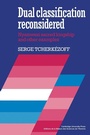
Dual Classification Reconsidered
Nyamwezi Sacred Kingship and Other Examples
Published on 17. September 1987
Book
Hardback
166 pages
978-0-521-30895-3 (ISBN)
Description
The deep structure of symbolism in religious and ritual activities has hitherto mostly been studied from perspectives deriving from classical and contemporary Western thought, which values symmetry, non-contradiction, equality of terms and the rationality of linear discourse and classification systems have therefore come to be defined in binary terms (right/left, male/female, black/white). In this book, Serge Tcherkezoff presents a new perspective on the study of ritual classification. On the basis of a detailed ethnography of the rituals of the Nyamwezi of Tanzania, Tcherkezoff argues for an analysis which recognised contradictions and asymmetry within ritual systems. Following Dumont, he shows that societies are characterised by a hierarchal structure of values, in which each individual element has a meaning only through its position within the whole, thereby replacing the rigid classical structuralist dichotomy with a rich multidimensional approach.
More details
Series
Language
English
Place of publication
Cambridge
United Kingdom
Target group
Professional and scholarly
Dimensions
Height: 228 mm
Width: 152 mm
Thickness: 18 mm
Weight
388 gr
ISBN-13
978-0-521-30895-3 (9780521308953)
Copyright in bibliographic data is held by Nielsen Book Services Limited or its licensors: all rights reserved.
Schweitzer Classification
Other editions
New editions
Book
03/2009
Cambridge University Press
€48.30
Shipment within 15-20 days
Additional editions
Book
03/2009
Cambridge University Press
€48.30
Shipment within 15-20 days
Content
Preface; Introduction; 1. Right/Left oppositions and the 'pre-eminence of the right hand'; Part I. Nyamwezi Classifications: 2. Nyamwezi classifications: right or left?; 3. Right and left: the distinction between levels; 4. Hierarchy and power: kingship captures the kings; Part II. Comparison and conclusion: 5. The same questions asked of other examples; 6. Towards a comparative study of dualist symbolism; Notes; Bibliography; Index.