

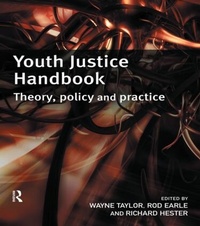
Youth Justice Handbook
Theory, Policy and Practice
1st Edition
Published on 6. October 2009
Book
Paperback/Softback
288 pages
978-1-84392-716-7 (ISBN)
Description
What knowledge and skills do you need to practise effectively as a professional within the youth justice system? What values should inform your work with children and young people subject to criminal justice sanctions? These are the central questions addressed by the editors and contributors in this comprehensive new text.
The Youth Justice Handbook provides an essential resource for practitioners in youth justice as well as those who are studying the subject as part of their training or an academic course. Its aim is to equip practitioners in youth justice and the wider children's workforce with an understanding of key theoretical concepts from a range of disciplines that might inform and enhance their work. It encourages a critical interrogation of the ideas that underpin practice by drawing on social constructionist approaches to issues such as 'child development', 'crime' and 'punishment' and related concepts. It provides a descriptive account of current practice in
areas such as community corrections and incarceration, examining the evidence base for this and suggesting - where appropriate - alternative strategies.
The key objective of the Handbook is to provide students with the confidence to critically reflect on the ideas and debates that currently influence the work undertaken with young people as well as those that may shape practice in the future. By equipping them with the basic skills of analysis and an understanding of key themes and developments, it aims to further promote their progression as reflective practitioners and autonomous learners.
The Youth Justice Handbook takes a multidisciplinary approach, and contains chapters from leading experts in the field which draw on original research and practical experience of working in the area. It is divided into five parts:
* Contexts of childhood and youth
* Research, knowledge and evidence in youth justice
* Policy, possibilities and penal realities in youth justice
* Reflective practice
* Widening contexts
The Youth Justice Handbook provides an essential resource for practitioners in youth justice as well as those who are studying the subject as part of their training or an academic course. Its aim is to equip practitioners in youth justice and the wider children's workforce with an understanding of key theoretical concepts from a range of disciplines that might inform and enhance their work. It encourages a critical interrogation of the ideas that underpin practice by drawing on social constructionist approaches to issues such as 'child development', 'crime' and 'punishment' and related concepts. It provides a descriptive account of current practice in
areas such as community corrections and incarceration, examining the evidence base for this and suggesting - where appropriate - alternative strategies.
The key objective of the Handbook is to provide students with the confidence to critically reflect on the ideas and debates that currently influence the work undertaken with young people as well as those that may shape practice in the future. By equipping them with the basic skills of analysis and an understanding of key themes and developments, it aims to further promote their progression as reflective practitioners and autonomous learners.
The Youth Justice Handbook takes a multidisciplinary approach, and contains chapters from leading experts in the field which draw on original research and practical experience of working in the area. It is divided into five parts:
* Contexts of childhood and youth
* Research, knowledge and evidence in youth justice
* Policy, possibilities and penal realities in youth justice
* Reflective practice
* Widening contexts
More details
Language
English
Place of publication
Cullompton
United Kingdom
Publishing group
Taylor & Francis Ltd
Target group
College/higher education
Product notice
Paperback (trade)
Unsewn / adhesive bound
Dimensions
Height: 244 mm
Width: 170 mm
Thickness: 15 mm
Weight
467 gr
ISBN-13
978-1-84392-716-7 (9781843927167)
Copyright in bibliographic data and cover images is held by Nielsen Book Services Limited or by the publishers or by their respective licensors: all rights reserved.
Schweitzer Classification
Other editions
Additional editions
E-Book
02/2014
1st Edition
Willan Publishing
€67.49
Available for download
E-Book
02/2014
1st Edition
Willan Publishing
€67.49
Available for download
Book
10/2009
1st Edition
Willan Publishing
€327.37
Shipment within 3-4 weeks
Persons
Wayne Taylor works at HM Young Offenders Institute in Northumberland.
Rod Earle is Lecturer in Youth Justice in the Faculty of Heath and Social Care at the Open University.
Richard Hester is the Director of the Department of Health and Social Care at the Open University.
Rod Earle is Lecturer in Youth Justice in the Faculty of Heath and Social Care at the Open University.
Richard Hester is the Director of the Department of Health and Social Care at the Open University.
Content
Introduction Part 1: Contexts of Childhood and Youth Introduction 1. Structural Disadvantage: Youth, Class, Crime and Poverty 2. Transitions to Adulthood 3. From Child to Adult: Theoretical Assumptions in Ideas about Growing Up 4. Sex 'n' Drugs 'n' Rock 'n' Roll: Young People as Consumers 5. Bullying as Abuse Part 2: Research, Knowledge and Evidence in Youth Justice Introduction 6. Research-informed Youth Justice? 7. Whose Account Counts? Politics and Research in Youth Justice 8. Globalisation, Power and Knowledge in Youth Justice 9. Preventing and Reducing Risk 10. What Can we Know, and How Can we Know it? Part 3: Policy, Possibilities and Penal Realities in Youth Justice Introduction 11. Parenting and Youth Justice: Policy and Practice 12. Restorative Justice at the Heart of the Youth Community 13. Children and Young People in Custody 14. Living in a Box: Ethnicity and Identity Inside a Young Men's Prison Part 4: Reflective Practice Introduction 15. Promoting Desistance Amongst Young People 16. Young People's 'Voices' as Evidence 17. Partnership: Putting Relationships to Work 18. Reflective Practice in Youth Justice Part 5: Widening Contexts Introduction 19. The United Nations, Children's Rights and Juvenile Justice 20. Human Rights and Youth Justice in Europe 21. Values in Youth Justice: Practice Approaches to Welfare and Justice for Young People in UK Jurisdictions 22. The Dragonisation of Youth Justice 23. The Development of Restorative Justice in Northern Ireland, Conclusion