

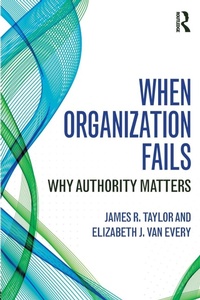
When Organization Fails
Why Authority Matters
1st Edition
Published on 2. June 2014
Book
Paperback/Softback
220 pages
978-0-415-74166-8 (ISBN)
Description
When Organization Fails: Why Authority Matters develops the study of authority as an area of investigation in organizational communication and management. As a research topic, authority has rarely been addressed in depth in the management and organizational communication literature. It is critical, however, to maintaining unity of purpose and action of the organization, and it is frequently cited by organizational members themselves.
Utilizing two case studies, examined in depth and based on the accounts of the individuals involved, authors James R. Taylor and Elizabeth J. van Every explore the pathology of authority when it fails. They develop a theoretical foundation that aims to illuminate authority by positioning it in communication theory.
This volume sets the stage for a new generation of scholars who can make their reputations as experts on authority, and is intended for scholars and graduate students in organizational communication, leadership, and discourse analysis. It also offers practical insights to consultants and management experts worldwide.
Utilizing two case studies, examined in depth and based on the accounts of the individuals involved, authors James R. Taylor and Elizabeth J. van Every explore the pathology of authority when it fails. They develop a theoretical foundation that aims to illuminate authority by positioning it in communication theory.
This volume sets the stage for a new generation of scholars who can make their reputations as experts on authority, and is intended for scholars and graduate students in organizational communication, leadership, and discourse analysis. It also offers practical insights to consultants and management experts worldwide.
More details
Language
English
Place of publication
London
United Kingdom
Publishing group
Taylor & Francis Ltd
Target group
College/higher education
Illustrations
3 s/w Zeichnungen, 13 s/w Tabellen
13 Tables, black and white; 3 Line drawings, black and white
Dimensions
Height: 229 mm
Width: 152 mm
Thickness: 13 mm
Weight
360 gr
ISBN-13
978-0-415-74166-8 (9780415741668)
Copyright in bibliographic data and cover images is held by Nielsen Book Services Limited or by the publishers or by their respective licensors: all rights reserved.
Schweitzer Classification
Other editions
Additional editions

Book
06/2014
1st Edition
Routledge
€233.20
Shipment within 15-20 days
E-Book
06/2014
1st Edition
Routledge
€78.99
Available for download
E-Book
06/2014
1st Edition
Routledge
€78.99
Available for download
Persons
James R. Taylor is an Emeritus Professor of Communication at the Universite de Montreal, and is the founder of the Communication program there. Author of some 100 published papers, he has also authored or coauthored eight books. The Emergent Organization (Routledge), coauthored with Elizabeth J. van Every, received the 2013 ICA Fellows Book Award.
Elizabeth J. van Every, a sociologist by training, has coauthored five books, including The Situated Organization (Routledge). She is also an active member of the research group Language, Organization, and Governance at the Universite de Montreal.
Elizabeth J. van Every, a sociologist by training, has coauthored five books, including The Situated Organization (Routledge). She is also an active member of the research group Language, Organization, and Governance at the Universite de Montreal.
Content
Part 1: Organizational Adaptation to a Changing Social and Technological Environment: The Hazard of Dissonant Practitioner and Managerial Responses Chapter 1. Thirdness as the Basis of Authority Chapter 2. Entanglements of Authority Chapter 3. "Paper Wraps Stones" (Network Management Kills Its Most Popular TV Program) Chapter 4. "Scissors Cut Paper" (The Producers Shred Management's Position) Chapter 5. "Stones Break Scissors" (The President Has the Last Word) Part 2: One Horse, Many Drivers: The Complexity of Inter-Organizational Collaboration. Chapter 6. Integrated National Crime Information System (INCIS) Chapter 7. Writing the "Law" (The Contract: Multiple Agendas) Chapter 8. Position versus Practice: Contests of Authority Chapter 9. The Project: A Different Kind of Authoring Chapter 10. Why Authority Matters