

What About the Workers?
The Conservative Party and the Organised Working Class in British Politics
Published on 20. April 2021
Book
Hardback
280 pages
978-1-5261-0360-4 (ISBN)
Description
The relationship between the Conservative Party and the organised working class is fundamental to the making of modern British politics. Industrialisation and urbanisation saw the emergence of democracy and class politics, symbolised, by the development of trade unions, which assumed growing political significance. The organised working class, though always a minority, was perceived by Conservatives as a challenge; condemned as threatening property, and as harbingers of socialism. Many trade union members dismissed the Conservatives as the bosses' party, ever-ready to restrict the unions' freedom in the interests of profit.
However, at the book's core is a puzzle: why, throughout its history, was the Conservative Party seemingly accommodating towards the organised working class that it ideology, social composition, and the preferences of most Conservatives would seem to permit? And why, in the space of a relatively few years in the 1970s and 1980s, did it abandon this heritage? Taylor argues that throughout its history, the Conservative Party has faced a broad strategic choice with respect to the organised working class: either inclusion or exclusion.
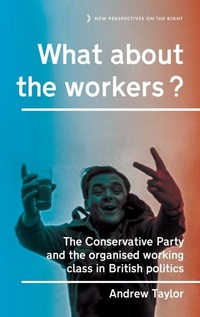
The portrayal of the character on the front cover encapsulates the concept of the 'bloody-minded' British worker - an attitude that encapsulates a determinedly 'conservative' attitude to defending rights and influence
gained during the twentieth century and which led to the reaction against 'union power' in the 1960s and 70s. -- .
However, at the book's core is a puzzle: why, throughout its history, was the Conservative Party seemingly accommodating towards the organised working class that it ideology, social composition, and the preferences of most Conservatives would seem to permit? And why, in the space of a relatively few years in the 1970s and 1980s, did it abandon this heritage? Taylor argues that throughout its history, the Conservative Party has faced a broad strategic choice with respect to the organised working class: either inclusion or exclusion.
The portrayal of the character on the front cover encapsulates the concept of the 'bloody-minded' British worker - an attitude that encapsulates a determinedly 'conservative' attitude to defending rights and influence
gained during the twentieth century and which led to the reaction against 'union power' in the 1960s and 70s. -- .
More details
Series
Language
English
Place of publication
Manchester
United Kingdom
Target group
College/higher education
Professional and scholarly
Illustrations
5 tables
Dimensions
Height: 240 mm
Width: 161 mm
Thickness: 20 mm
Weight
590 gr
ISBN-13
978-1-5261-0360-4 (9781526103604)
Copyright in bibliographic data and cover images is held by Nielsen Book Services Limited or by the publishers or by their respective licensors: all rights reserved.
Schweitzer Classification
Other editions
Additional editions

Andrew Taylor
What About the Workers?
The Conservative Party and the Organised Working Class in British Politics
E-Book
04/2021
1st Edition
Manchester University Press
€189.99
Available for download

Andrew Taylor
What About the Workers?
The Conservative Party and the Organised Working Class in British Politics
E-Book
04/2021
1st Edition
Manchester University Press
from
€189.99
Available for download
Person
Andrew Taylor is Emeritus Professor of Politics at the University of Sheffield -- .
Content
Introduction
1 A strong taste for the despotism of numbers?
2 Peace and good will?
3 We shall get their help
4 War, conservatism and union power
5 Milk and water socialism?
6 The smack of firm government?
7 Confronting the British disease?
8 The enemy within
Conclusions
Bibliography
Index -- .
1 A strong taste for the despotism of numbers?
2 Peace and good will?
3 We shall get their help
4 War, conservatism and union power
5 Milk and water socialism?
6 The smack of firm government?
7 Confronting the British disease?
8 The enemy within
Conclusions
Bibliography
Index -- .