

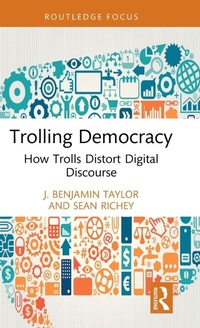
Trolling Democracy
How Trolls Distort Digital Discourse
1st Edition
Published on 8. August 2025
Book
Hardback
128 pages
978-1-041-03975-4 (ISBN)
Description
The Internet is a hub for gathering political information and accounts for significant political activity; however, social interactions online are often disrupted by trolling. As digital democracy continues to evolve, understanding trolling is crucial for developing strategies to foster a healthier online environment conducive to democratic engagement. Understanding the objective of posting deceitful, inflammatory content is crucial.
Trolling Democracy offers both academic and practical insights into one of the most pressing challenges of the digital age. By leveraging theoretical insights, empirical evidence from new surveys, and innovative experiments, J. Benjamin Taylor and Sean Richey offer a comprehensive understanding of trolling's effect on the public sphere and its implications for democratic processes. Furthermore, they address the broader societal concerns raised by the proliferation of trolling, including the spread of misinformation, the erosion of trust in online platforms, and the exacerbation of political polarization.
Enhancing our knowledge of trolling by bridging gaps in previous research and proposing new avenues for future study, Taylor and Richey equip us with the tools to counteract its negative effects more effectively.
Trolling Democracy offers both academic and practical insights into one of the most pressing challenges of the digital age. By leveraging theoretical insights, empirical evidence from new surveys, and innovative experiments, J. Benjamin Taylor and Sean Richey offer a comprehensive understanding of trolling's effect on the public sphere and its implications for democratic processes. Furthermore, they address the broader societal concerns raised by the proliferation of trolling, including the spread of misinformation, the erosion of trust in online platforms, and the exacerbation of political polarization.
Enhancing our knowledge of trolling by bridging gaps in previous research and proposing new avenues for future study, Taylor and Richey equip us with the tools to counteract its negative effects more effectively.
More details
Series
Language
English
Place of publication
London
United Kingdom
Publishing group
Taylor & Francis Ltd
Target group
College/higher education
Postgraduate and Undergraduate Advanced
Illustrations
22 s/w Abbildungen, 22 s/w Zeichnungen, 39 s/w Tabellen
39 Tables, black and white; 22 Line drawings, black and white; 22 Illustrations, black and white
Dimensions
Height: 222 mm
Width: 145 mm
Thickness: 11 mm
Weight
317 gr
ISBN-13
978-1-041-03975-4 (9781041039754)
Copyright in bibliographic data and cover images is held by Nielsen Book Services Limited or by the publishers or by their respective licensors: all rights reserved.
Schweitzer Classification
Other editions
Additional editions
E-Book
08/2025
1st Edition
Routledge
€31.49
Available for download
E-Book
08/2025
1st Edition
Routledge
€31.49
Available for download
Persons
J. Benjamin Taylor is Associate Professor of Political Science at Kennesaw State University. He researches and teaches courses on American political behavior. He has published several books and academic journal articles in Political Communication, State Politics & Policy Quarterly, American Politics Research, Politics & Religion, and Presidential Studies Quarterly.
Sean Richey is Professor of Political Science at Georgia State University. He was a Fulbright Fellow from 2013 to 2014 at the University of Tokyo. He was a Japan Society for the Promotion of Science Post-Doctoral Fellow at the University of Tokyo between 2004 and 2006. He researches American politics, specializing in elections, voting behavior, public opinion, and quantitative methodology. His research has appeared in two peer-reviewed books and academic journal articles, including in Political Research Quarterly, the British Journal of Political Science, Political Communication, Political Behavior, International Studies Quarterly, and others.
Sean Richey is Professor of Political Science at Georgia State University. He was a Fulbright Fellow from 2013 to 2014 at the University of Tokyo. He was a Japan Society for the Promotion of Science Post-Doctoral Fellow at the University of Tokyo between 2004 and 2006. He researches American politics, specializing in elections, voting behavior, public opinion, and quantitative methodology. His research has appeared in two peer-reviewed books and academic journal articles, including in Political Research Quarterly, the British Journal of Political Science, Political Communication, Political Behavior, International Studies Quarterly, and others.
Content
1. The Impact of Trolling on Democracy 2. Deliberative Democratic Theory and Trolling 3. Who are the Victims of Online Harassment and Trolling? 4. Need for Chaos Scale: Psychological Determinants of Internet Trolling 5. Nonpsychological Predictors of Trolling 6. Identifying Trolling and Trolls Online 7. The Effect of Trolling on Down-the-Line Behaviors 8. Conclusion: Trolling, Deliberative Democracy, and the Path Forward. Appendix