

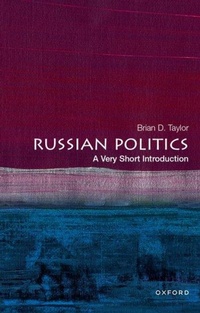
Russian Politics
A Very Short Introduction
Published on 23. January 2025
Book
Paperback/Softback
168 pages
978-0-19-751602-7 (ISBN)
Description
Russia is rarely out of the news. This has been particularly true since it launched the largest war in Europe since World War II when it invaded Ukraine in 2022. Yet Russian politics can be difficult to understand. It is powerfully shaped by large, impersonal forces such as geography, and Russia's place in the international political and economic system. At the same time, Russia's formal political institutions, such as the Constitution and electoral procedures, are relatively weak and manipulable compared to those of stable, established democracies. Under these circumstances, powerful leaders such as Mikhail Gorbachev, Boris Yeltsin, and Vladimir Putin represent a source of potential dynamism and change.
This Very Short Introduction provides a guide to understanding Russian Politics that goes beyond the headlines, offering a vivid account of the key forces driving Russian politics. It places Russia in a global context while explaining its internal political development. Several major themes run through the book, including the primacy of the state over society, the role of the so-called "West," which has represented a source of inspiration, of threat, and of competition for generations of Russians, and the collapse of the Soviet Union in 1991. The Soviet collapse brought about dramatic change across multiple spheres, from the nature of the political and economic system to the country's borders and who counted as a citizen. To this day, Russia is still working its way through the consequences of these transformations.
This Very Short Introduction provides a guide to understanding Russian Politics that goes beyond the headlines, offering a vivid account of the key forces driving Russian politics. It places Russia in a global context while explaining its internal political development. Several major themes run through the book, including the primacy of the state over society, the role of the so-called "West," which has represented a source of inspiration, of threat, and of competition for generations of Russians, and the collapse of the Soviet Union in 1991. The Soviet collapse brought about dramatic change across multiple spheres, from the nature of the political and economic system to the country's borders and who counted as a citizen. To this day, Russia is still working its way through the consequences of these transformations.
Reviews / Votes
Taylor achieves a rare feat: a balanced, scholarly, and extremely wideranging introduction to what the lay reader needs to know about Russian politics in approximately one to two hours of reading. * Jeremy Morris, The Russian Review *More details
Series
Language
English
Place of publication
New York
United States
Illustrations
10 images
Dimensions
Height: 170 mm
Width: 107 mm
Thickness: 10 mm
Weight
136 gr
ISBN-13
978-0-19-751602-7 (9780197516027)
Copyright in bibliographic data and cover images is held by Nielsen Book Services Limited or by the publishers or by their respective licensors: all rights reserved.
Schweitzer Classification
Other editions
Additional editions
E-Book
09/2024
OUP eBook
€9.49
Available for download
E-Book
09/2024
OUP eBook
€9.49
Available for download
Person
Brian D. Taylor is Professor of Political Science and Director of the Moynihan Institute of Global Affairs in the Maxwell School of Citizenship and Public Affairs at Syracuse University. He is the author of several books on Russian politics, including The Code of Putinism and State Building in Putin's Russia: Policing and Coercion after Communism.
Content
List of illustrationsIntroduction1. Governing the world's largest country2. Power, status, and greatness3. Playing economic catch-up4. The failed experiment of democratic constitutionalism5. Eternal state, changing society6. Tsars and courtiersReferencesFurther ReadingIndex