

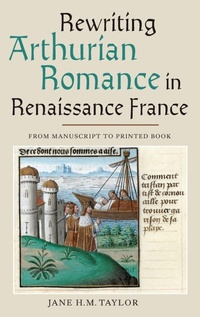
Rewriting Arthurian Romance in Renaissance France
From Manuscript to Printed Book
Published on 16. January 2014
Book
Hardback
294 pages
978-1-84384-365-8 (ISBN)
Description
First comprehensive examination of the ways in which printers, publishers and booksellers adapted and rewrote Arthurian romance in early modern France, for new audiences and in new forms.
Arthurian romance in Renaissance France has long been treated by modern critics as marginal - although manuscripts and printed volumes, adaptations and rewritings, show just how much writers, and especially publishers, saw its potential attractions for readers. This book is the first full-length study of what happens to Arthur at the beginning of the age of print. It explores the fascinations of Arthurian romance in the sixteenth and early seventeenth centuries, from the magnificent presentation volumes offered by Antoine Verard or Galliot du Pre in the early years of the century to the perfunctory abbreviated Lancelot published by Benoit Rigaud in Lyon in 1591; from PierreSala's dutiful "translation" of Yvain to Jean Maugin's exuberant rewriting of the prose Tristan; from attempts at "new" romance like the little-known Giglan to the runaway best-seller Amadis de Gaule.The book's primary focus is the techniques and stratagems employed by publishers and their workshops to renew Arthurian romance for a new readership: the ways in which the publishers, the translators and the adapters of the Renaissance tailor romance to fit new cultural contexts. Their story - which is the story of the rise and fall of one of the great genres of the Middle Ages - allows privileged insights into socio-cultural and ideological attitudes in the France of the Renaissance, and into issues of literary taste, particular patterns of choice and preference.
Jane H.M. Taylor is Emeritus Professor of French at Durham University.
Arthurian romance in Renaissance France has long been treated by modern critics as marginal - although manuscripts and printed volumes, adaptations and rewritings, show just how much writers, and especially publishers, saw its potential attractions for readers. This book is the first full-length study of what happens to Arthur at the beginning of the age of print. It explores the fascinations of Arthurian romance in the sixteenth and early seventeenth centuries, from the magnificent presentation volumes offered by Antoine Verard or Galliot du Pre in the early years of the century to the perfunctory abbreviated Lancelot published by Benoit Rigaud in Lyon in 1591; from PierreSala's dutiful "translation" of Yvain to Jean Maugin's exuberant rewriting of the prose Tristan; from attempts at "new" romance like the little-known Giglan to the runaway best-seller Amadis de Gaule.The book's primary focus is the techniques and stratagems employed by publishers and their workshops to renew Arthurian romance for a new readership: the ways in which the publishers, the translators and the adapters of the Renaissance tailor romance to fit new cultural contexts. Their story - which is the story of the rise and fall of one of the great genres of the Middle Ages - allows privileged insights into socio-cultural and ideological attitudes in the France of the Renaissance, and into issues of literary taste, particular patterns of choice and preference.
Jane H.M. Taylor is Emeritus Professor of French at Durham University.
Reviews / Votes
Theoretically informed, well documented, and comprehensive, Rewriting Arthurian Romance in Renaissance France provides a much-needed map with which to navigate a prolific textual production that was seen as anecdotal, in part because it did not fit traditional histories of literary culture in the Renaissance. * H-FRANCE * This volume is a valuable tool for those interested in the power of the print market to shape literary history. Its bibliographical analyses show an acute sensitivity to the role of the book as material object in the various afterlives of past textual practices. . . . [It serves] as a springboard for further study of these uncommon works by medievalists and early modernists alike. * MODERN LANGUAGE STUDIES * With this book, Jane Taylor offers us a remarkable, sophisticated study of how Arthurian materials were treated in the age of print. . . . [A] pioneering book. The approach should be of interest to medievalists of all stripes (not just Arthurians) as well as Renaissance scholars. * THE MEDIEVAL REVIEW *More details
Series
Language
English
Place of publication
Cambridge
United Kingdom
Publishing group
Boydell & Brewer Ltd
Target group
Professional and scholarly
Product notice
Cloth over boards
Illustrations
13 b/w illus.
Dimensions
Height: 240 mm
Width: 161 mm
Thickness: 21 mm
Weight
611 gr
ISBN-13
978-1-84384-365-8 (9781843843658)
Copyright in bibliographic data and cover images is held by Nielsen Book Services Limited or by the publishers or by their respective licensors: all rights reserved.
Schweitzer Classification
Other editions
Additional editions
E-Book
01/2014
1st Edition
De Gruyter
€48.99
Available for download
Person
JANE TAYLOR is Emeritus Professor of Medieval French at the University of Durham.
Content
Introduction
Pierre Sala, Poacher
'Books Printed Here': The Business of the Print Shop
'A Condition of Survival': Lancelot and Tristan
'Skimble-Skamble Stuff': Meliadus, Merlin, Greaal
'Imperious Seductions': Giglan and Perceval
'Satyric Scenes in Landscape Style': Amadis de Gaule
'Fruitlesse Historie': Maugin's Tristan, Rigaud's Lancelot
Afterword
Appendices
Bibliography
Pierre Sala, Poacher
'Books Printed Here': The Business of the Print Shop
'A Condition of Survival': Lancelot and Tristan
'Skimble-Skamble Stuff': Meliadus, Merlin, Greaal
'Imperious Seductions': Giglan and Perceval
'Satyric Scenes in Landscape Style': Amadis de Gaule
'Fruitlesse Historie': Maugin's Tristan, Rigaud's Lancelot
Afterword
Appendices
Bibliography