

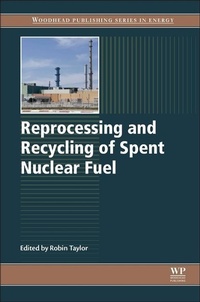
Reprocessing and Recycling of Spent Nuclear Fuel
Published on 15. April 2015
Book
Hardback
684 pages
978-1-78242-212-9 (ISBN)
Description
Reprocessing and Recycling of Spent Nuclear Fuel presents an authoritative overview of spent fuel reprocessing, considering future prospects for advanced closed fuel cycles. Part One introduces the recycling and reprocessing of spent nuclear fuel, reviewing past and current technologies, the possible implications of Generation IV nuclear reactors, and associated safely and security issues. Parts Two and Three focus on aqueous-based reprocessing methods and pyrochemical methods, while final chapters consider the cross-cutting aspects of engineering and process chemistry and the potential for implementation of advanced closed fuel cycles in different parts of the world.
More details
Series
Language
English
Place of publication
Cambridge
United Kingdom
Publishing group
Elsevier Science & Technology
Target group
College/higher education
R&D professionals and postgraduate working on the separation and recycling of spent nuclear fuel
Product notice
sewn/stitched
Cloth over boards
Dimensions
Height: 231 mm
Width: 155 mm
Thickness: 38 mm
Weight
1406 gr
ISBN-13
978-1-78242-212-9 (9781782422129)
Copyright in bibliographic data and cover images is held by Nielsen Book Services Limited or by the publishers or by their respective licensors: all rights reserved.
Schweitzer Classification
Other editions
Additional editions
Robin Taylor
Reprocessing and Recycling of Spent Nuclear Fuel
E-Book
01/2015
Elsevier
€240.00
Available for download
Person
Content
Preface
Part 1 Introductory issues and future challenges
1. Introduction to the reprocessing and recycling of spent nuclear fuels
2. Role of recycling in advanced nuclear fuel cycles
3. Key challenges in advanced reprocessing of spent nuclear fuels
4 Safety and security issues in the reprocessing and recycling of spent nuclear fuels for advanced fuel cycles
Part 2 Advances in aqueous separation processes
5. Current head-end technologies and future developments in the reprocessing of spent nuclear fuels
6. Process engineering design for the reprocessing and recycling of spent nuclear fuels
7. The use of organic extractants in solvent extraction processes in the partitioning of spent nuclear fuels
8. Radiation chemistry in the reprocessing and recycling of spent nuclear fuels
9. Reprocessing of spent fast reactor nuclear fuels
10. Minor actinide separation in the reprocessing of spent nuclear fuels: recent advances in Europe
11. Minor actinide separation in the reprocessing of spent nuclear fuels: recent advances in the USA
12. Advanced thermal denitration conversion processes for aqueous based reprocessing and recycling of spent nuclear fuels
13. The co-precipitation and conversion of mixed actinide oxalates for aqueous based reprocessing of spent nuclear fuels
14. Gelation and other innovative conversion processes for aqueous based reprocessing and recycling of spent nuclear fuels
Part 3 Pyrochemical processes
15. International developments in electrorefining for pyrochemical processing of spent nuclear fuels
16. Oxide electro-reduction and other techniques for pyrochemical processing of spent nuclear fuels: developments in Korea
17. Pyrochemical processes for recovery of actinides from spent nuclear fuels: European developments
18. Pyrochemical fuel cycle technologies for processing of spent nuclear fuels: developments in Japan
Part 4 Implementation of advanced closed fuel cycles
19. Development of closed nuclear fuel cycles in the United States
20. Development of closed nuclear fuel cycles in China
21. Development of closed nuclear fuel cycles in Korea
22. Development of closed nuclear fuel cycles in Japan
23. Proliferation resistance, used fuel and multinational approaches to the provision of fuel cycle services
24. Developments in reprocessing of spent nuclear fuels for the thorium fuel cycle
Part 1 Introductory issues and future challenges
1. Introduction to the reprocessing and recycling of spent nuclear fuels
2. Role of recycling in advanced nuclear fuel cycles
3. Key challenges in advanced reprocessing of spent nuclear fuels
4 Safety and security issues in the reprocessing and recycling of spent nuclear fuels for advanced fuel cycles
Part 2 Advances in aqueous separation processes
5. Current head-end technologies and future developments in the reprocessing of spent nuclear fuels
6. Process engineering design for the reprocessing and recycling of spent nuclear fuels
7. The use of organic extractants in solvent extraction processes in the partitioning of spent nuclear fuels
8. Radiation chemistry in the reprocessing and recycling of spent nuclear fuels
9. Reprocessing of spent fast reactor nuclear fuels
10. Minor actinide separation in the reprocessing of spent nuclear fuels: recent advances in Europe
11. Minor actinide separation in the reprocessing of spent nuclear fuels: recent advances in the USA
12. Advanced thermal denitration conversion processes for aqueous based reprocessing and recycling of spent nuclear fuels
13. The co-precipitation and conversion of mixed actinide oxalates for aqueous based reprocessing of spent nuclear fuels
14. Gelation and other innovative conversion processes for aqueous based reprocessing and recycling of spent nuclear fuels
Part 3 Pyrochemical processes
15. International developments in electrorefining for pyrochemical processing of spent nuclear fuels
16. Oxide electro-reduction and other techniques for pyrochemical processing of spent nuclear fuels: developments in Korea
17. Pyrochemical processes for recovery of actinides from spent nuclear fuels: European developments
18. Pyrochemical fuel cycle technologies for processing of spent nuclear fuels: developments in Japan
Part 4 Implementation of advanced closed fuel cycles
19. Development of closed nuclear fuel cycles in the United States
20. Development of closed nuclear fuel cycles in China
21. Development of closed nuclear fuel cycles in Korea
22. Development of closed nuclear fuel cycles in Japan
23. Proliferation resistance, used fuel and multinational approaches to the provision of fuel cycle services
24. Developments in reprocessing of spent nuclear fuels for the thorium fuel cycle