

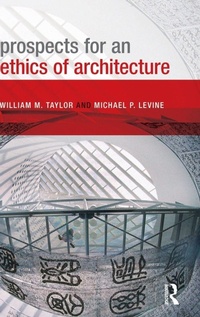
Prospects for an Ethics of Architecture
1st Edition
Published on 4. February 2011
Book
Hardback
228 pages
978-0-415-58971-0 (ISBN)
Description
Bringing together the reflections of an architectural theorist and a philosopher, this book encourages philosophers and architects, scholars and designers alike, to reconsider what they do as well as what they can do in the face of challenging times. It does so by exploring the notion that architecture and design can (and possibly should), in their own right, make for a distinctive form of ethical investigation.
The book is less concerned with absolutist understandings of the two components of ethics, a theory of 'the good' and a theory of 'the right', than with remaining open to multiple relations between ideas about the built environment, design practices and the plurality of kinds of human subjects (inhabitants, individuals and communities) accommodated by buildings and urban spaces.
The built environment contributes to the inculcation of all sorts of values (good and bad). Thus, this book aims to change the way people commonly think about ethics, not only in relation to the built environment, but to themselves, their ways of thinking and modes of behaviour.
The book is less concerned with absolutist understandings of the two components of ethics, a theory of 'the good' and a theory of 'the right', than with remaining open to multiple relations between ideas about the built environment, design practices and the plurality of kinds of human subjects (inhabitants, individuals and communities) accommodated by buildings and urban spaces.
The built environment contributes to the inculcation of all sorts of values (good and bad). Thus, this book aims to change the way people commonly think about ethics, not only in relation to the built environment, but to themselves, their ways of thinking and modes of behaviour.
More details
Language
English
Place of publication
London
United Kingdom
Publishing group
Taylor & Francis Ltd
Target group
College/higher education
Professional and scholarly
Illustrations
27 s/w Photographien bzw. Rasterbilder
27 Halftones, black and white
Dimensions
Height: 240 mm
Width: 161 mm
Thickness: 17 mm
Weight
517 gr
ISBN-13
978-0-415-58971-0 (9780415589710)
Copyright in bibliographic data and cover images is held by Nielsen Book Services Limited or by the publishers or by their respective licensors: all rights reserved.
Schweitzer Classification
Other editions
Additional editions
William M. Taylor | Michael P. Levine
Prospects for an Ethics of Architecture
E-Book
12/2012
1st Edition
Routledge
€77.99
Available for download
William M. Taylor | Michael P. Levine
Prospects for an Ethics of Architecture
E-Book
12/2012
1st Edition
Routledge
€77.99
Available for download
William M. Taylor | Michael P. Levine
Prospects for an Ethics of Architecture
Book
02/2011
1st Edition
Routledge
€84.20
Shipment within 15-20 days
Persons
William M. Taylor is Professor of Architecture at the University of Western Australia where he teaches architectural design and history and theory of the built environment. His recent work includes The Vital Landscape, Nature and the Built Environment in Nineteenth-Century Britain (Ashgate, 2004), the edited collection The Geography of Law, Landscape and Regulation (Hart, Oxford, 2006) and the co-edited book An Everyday Transience: The Urban Imaginary of Goldfields Photographer John Joseph Dwyer (UWA Press, 2010). He is currently researching the subject of architecture and transience and preparing a collection of essays on architecture, ships and the sea.
Michael P. Levine is Professor of Philosophy at the University of Western Australia. He has taught at the University of Pennsylvania, Swarthmore College, Baruch College (City University of New York), the University of Virginia, and in Moscow as a Fulbright Fellow. Recent publications include Politics Most Unusual: Violence, Sovereignty and Democracy in the 'War on Terror' (co-authored); Integrity and the Fragile Self (2003, co-authored); Racism in Mind (2003, co-edited); The Analytic Freud (ed.); and articles on moral psychology, philosophy of religion, history of philosophy, metaphysics, and film. He is currently writing on philosophy and film.
Michael P. Levine is Professor of Philosophy at the University of Western Australia. He has taught at the University of Pennsylvania, Swarthmore College, Baruch College (City University of New York), the University of Virginia, and in Moscow as a Fulbright Fellow. Recent publications include Politics Most Unusual: Violence, Sovereignty and Democracy in the 'War on Terror' (co-authored); Integrity and the Fragile Self (2003, co-authored); Racism in Mind (2003, co-edited); The Analytic Freud (ed.); and articles on moral psychology, philosophy of religion, history of philosophy, metaphysics, and film. He is currently writing on philosophy and film.
Content
Preface. Acknowledgements. Introduction 1. Ethics, Architecture and Philosophy 2. Architecture, Ethics and Aesthetics 3. Architecture and Culture 4. Experiencing Architecture 5. Writing on 'The Wall': Memory, Monuments and Memorials 6. Building Community: New Urbanism, Planning and Democracy. Conclusion. Bibliography