

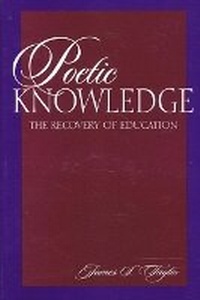
Poetic Knowledge
The Recovery of Education
Published on 18. December 1997
Book
Hardback
220 pages
978-0-7914-3585-4 (ISBN)
Description
This book rediscovers a traditional mode of knowledge that remains viable today. Contrasted to the academic and cultural fads often based on the scientific methodology of the Cartesian legacy, or any number of trendy experiments in education, Poetic Knowledge returns to the freshness and importance of first knowledge, a knowledge of the senses and the passions.
"Poetic knowledge" is not the knowledge of poetry, nor is it even knowledge in the sense that we often think of today, that is, the mastery of scientific, technological, or business information. Rather, it is an intuitive, obscure, mysterious way of knowing reality, not always able to account for itself, but absolutely essential if one is ever to advance properly to the higher degrees of certainty. From Socrates to the Middle Ages, and even into the twentieth century, the case for poetic knowledge is revealed with the care of philosophical archeology. Taylor demonstrates the effectiveness of the poetic mode of education through his own observations as a teacher, and two experimental "poetic" schools in the twentieth century.
"Poetic knowledge" is not the knowledge of poetry, nor is it even knowledge in the sense that we often think of today, that is, the mastery of scientific, technological, or business information. Rather, it is an intuitive, obscure, mysterious way of knowing reality, not always able to account for itself, but absolutely essential if one is ever to advance properly to the higher degrees of certainty. From Socrates to the Middle Ages, and even into the twentieth century, the case for poetic knowledge is revealed with the care of philosophical archeology. Taylor demonstrates the effectiveness of the poetic mode of education through his own observations as a teacher, and two experimental "poetic" schools in the twentieth century.
Reviews / Votes
"There are relatively few persons who can analyze as clearly and as lucidly the writings of Aristotle, Plato, and Acquinas as does this author. Like Taylor's educational philosophy, he seeks to move his readers' affections and will as well as their intellects, and he does this successfully." -- Richard Harp, University of Nevada"With pithy brevity he has managed to provide both a history of the treatment of poetic knowledge and to develop his own very persuasive account." -- Ralph McInerny, University of Notre Dame
More details
Language
English
Place of publication
Albany, NY
United States
Target group
College/higher education
Professional and scholarly
US School Grade: College Graduate Student and over
Illustrations
Total Illustrations: 0
Dimensions
Height: 216 mm
Width: 140 mm
Thickness: 25 mm
Weight
227 gr
ISBN-13
978-0-7914-3585-4 (9780791435854)
Copyright in bibliographic data and cover images is held by Nielsen Book Services Limited or by the publishers or by their respective licensors: all rights reserved.
Schweitzer Classification
Other editions
Additional editions
E-Book
12/1997
State University of New York Press
€35.99
Available for download
Person
James S. Taylor has been a teacher of English and American literature, Humanities, Western Civilization, and Philosophy of Education, for over twenty years, in private schools and public colleges.
Content
Acknowledgments
Introduction
1 The Validity of Poetic Knowledge
2 The Philosophical Foundations of Poetic Knowledge
3 Connatural, Intentional, and Intuitive Knowledge
4 Descartes and the Cartesian Legacy
5 Voices for Poetic Knowledge after Descartes
6 Poetic Knowledge and the Integrated Humanities Program
7 The Future of the Poetic Mode of Knowledge in Education
Notes
Selected Bibliography
Index
Introduction
1 The Validity of Poetic Knowledge
2 The Philosophical Foundations of Poetic Knowledge
3 Connatural, Intentional, and Intuitive Knowledge
4 Descartes and the Cartesian Legacy
5 Voices for Poetic Knowledge after Descartes
6 Poetic Knowledge and the Integrated Humanities Program
7 The Future of the Poetic Mode of Knowledge in Education
Notes
Selected Bibliography
Index