

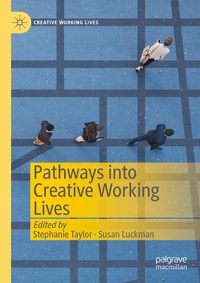
Pathways into Creative Working Lives
Description
This book presents research on pathways into creative work. The promise of 'doing what you love' continues to attract new entrants to the cultural and creative industries. Is that promise betrayed by the realities of pathways into creative work, or does a creative identification offer new personal and professional possibilities in the precarious contexts of contemporary work and employment? Two decades into the 21 st century, aspiring creative workers undertake training and higher education courses in increasing numbers. Some attempt to convert personal enthusiasms and amateur activities into income-earning careers. To manage the uncertainties of self-employment, workers may utilise skills developed in other occupations, even developing timely new forms of collective organisation. The collection explores the experience of creative career entrants in numerous national contexts, including Australia, Belgium, China, Ireland, Italy, Finland, the Netherlands, Russia, the US andthe UK. Chapters investigate the transitions of new workers and the obstacles they encounter on creative pathways.
Chapters 1, 12 and 15 are available open access under a Creative Commons Attribution 4.0 International License via link.springer.com.
Reviews / Votes
"A key strength of the collection is that all chapters have empirical fieldwork at their centre, with most using interviews or ethnographically informed methods. Pathways into Creative Working Lives is a welcome addition to the literature on creative working lives and will be of interest to sociologists, as well as those interested in cultural policy contexts. The chapters are organised coherently, maintain a high level of empirical detail and analytical insight, and throw up some interesting comparisons. The key strength of the collection lies in the focus it places on lives as they are lived - on the constant recalibration of creative hopes and dreams." (Laura Harris, Cultural Trends)
"Who gets to be a creative worker? How and why do some people fail and succeed in their efforts to get there? This is a crucial issue for anyone concerned with social justice in the arts and cultural industries, but it's been surprisingly neglected. Luckman and Taylor's excellent collection fills that gap with aplomb, and is an indispensable addition to the 'turn to cultural work' in humanities and social science." (David Hesmondhalgh, Professor of Media, Music and Culture, University of Leeds, UK)
"The Creative Economy is a global phenomenon that is often researched nationally. While working conditions differ, problems of inequality and exclusion are common. An international collection is vital to understanding that and will inform any academic or activist concerned with cultural labour." (Kate Oakley, Professor of Cultural Policy, University of Glasgow, UK)"This is a vitally important contribution to the field." (David Lee, Associate Professor of Media and Communication, University of Leeds, UK)
More details
Other editions
Additional editions
Persons
Stephanie Taylor is Professor of Social Psychology at The Open University, UK. She is co-author of Contemporary Identities of Creativity and Creative Work (2012) and co-editor of The New Normal of Working Lives (2018) .
Susan Luckman is Professor of Cultural and Creative Industries at the University of South Australia. She is author of Craft and the Creative Economy (2015) and co-editor of The New Normal of Working Lives (2018).
Content
1. Creative aspiration and the betrayal of promise? The experience of new creative workers.- 2. Unexpected enterprises: Remixing creative entrepreneurship.- 3. New entrants' narrations of their aspirations and experiences of media production work.- 4. Creative graduates' pathways in the hybrid cultural economy of contemporary Russia.- 5. Young women's aspirations and transitions into, through and away from contemporary creative work.- 6. Working the field: career pathways amongst artists and writers in Shanghai.- 7. In the orbit of the art biennial: reflecting on the networks of donors, mediators, artists and curators.- 8. 'Meaning and soul': co-working, creative career and independent co-work spaces.- 9. Expat agencies: Expatriation and exploitation in the creative industries in the UK and the Netherlands.- 10. "Diversity" initiatives and addressing inequalities in craft.- 11. Becoming and Being a Creative and Entrepreneurial Mom inFinland.- 12. It started with the arts and now it concerns all sectors: The case of Smart, a cooperative of 'salaried autonomous workers'.- 13. Reputation and Personal Branding in the Platform Economy.- 14. Cities' hope labour in insecure times: On aspiring creative industries, travelling expectations and aesthetic pedagogies.- 15. New pathways into creative work?.