

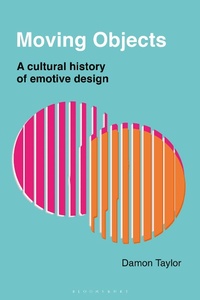
Moving Objects
A Cultural History of Emotive Design
Published on 9. February 2023
Book
Paperback/Softback
248 pages
978-1-350-36000-6 (ISBN)
Description
Moving Objects deals with emotive design: designed objects that demand to be engaged with rather than simply used. If postmodernism depended upon ironic distance, and Critical Design is all about questions, then emotive design runs hotter than this, confronting how designers are using feelings in what they make.
Damon Taylor's original study considers these emotionally laden, highly authored works, often produced in limited editions and sold like art - objects such as a chair made from cuddly toys, a leather sofa that resembles a cow, and a jewellery box fashioned from human hair.
Tracing the phenomenon back to the 'Dutch inflection' that began with Droog designers like Jurgen Bey and Hella Jongerius, Taylor conducts an analysis of the development of Design Art and looks for its origins in the uncanny explorations of surrealism. Offering a critique of Speculative Design, and an examination of the work of designers such as Mathias Bengtsson, whose work involves 'growing' furniture inside computers, Taylor asks what happens when the tangible melts into the datascape and design becomes a question of mobilities. In this way, Moving Objects examines contemporary issues of how we live with artefacts and what design can do.
Damon Taylor's original study considers these emotionally laden, highly authored works, often produced in limited editions and sold like art - objects such as a chair made from cuddly toys, a leather sofa that resembles a cow, and a jewellery box fashioned from human hair.
Tracing the phenomenon back to the 'Dutch inflection' that began with Droog designers like Jurgen Bey and Hella Jongerius, Taylor conducts an analysis of the development of Design Art and looks for its origins in the uncanny explorations of surrealism. Offering a critique of Speculative Design, and an examination of the work of designers such as Mathias Bengtsson, whose work involves 'growing' furniture inside computers, Taylor asks what happens when the tangible melts into the datascape and design becomes a question of mobilities. In this way, Moving Objects examines contemporary issues of how we live with artefacts and what design can do.
Reviews / Votes
Moving Objects offers an innovative framework for measuring value in design. Taylor touts examples that recall our humanity and heighten our awareness of everyday objects we take for granted ... If our emotions project onto our surroundings and into our work as Taylor suggests, Moving Objects provides a robust roadmap for using those emotions to shape - and view - our world more intentional. * Design and Culture * Moving Objects is a unique book. The study uses unexpected insights and connects previously separate disciplines and different types of design. Damon Taylor shows himself to be a brilliant researcher who enriches the design world with a great knowledge of design history, an original analysis of how design works and also thinks along with us about the future possibilities in design. -- Timo de Rijk, Director of the Design Museum Den Bosch, NetherlandsMore details
Language
English
Place of publication
London
United Kingdom
Publishing group
Bloomsbury Publishing PLC
Target group
College/higher education
Illustrations
50 bw illus
Dimensions
Height: 155 mm
Width: 235 mm
Thickness: 19 mm
Weight
534 gr
ISBN-13
978-1-350-36000-6 (9781350360006)
Copyright in bibliographic data and cover images is held by Nielsen Book Services Limited or by the publishers or by their respective licensors: all rights reserved.
Schweitzer Classification
Other editions
Additional editions
E-Book
09/2020
1st Edition
Bloomsbury Visual Arts
€28.49
Available for download
E-Book
09/2020
1st Edition
Bloomsbury Visual Arts
€28.49
Available for download
Person
Damon Taylor is is Principal Lecturer in Design Theory and Practice at the University of Brighton, UK. His research centres upon how our physical experience of the world coincides with our cultural, social and political relationship to designed objects.
Content
List of Figures
Acknowledgements
Introduction
1. Droog: the Dry and the Moist
2. Framing Design Art
3. Viscerealities
4. Valuing Emotive Design
5. Rhetorical Devices and Lyrical Things
6. To the Ends of the Earth
Notes
Select Bibliography
Acknowledgements
Introduction
1. Droog: the Dry and the Moist
2. Framing Design Art
3. Viscerealities
4. Valuing Emotive Design
5. Rhetorical Devices and Lyrical Things
6. To the Ends of the Earth
Notes
Select Bibliography