

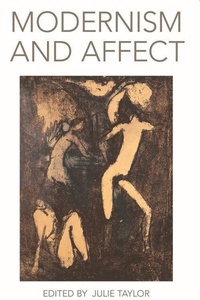
Modernism and Affect
Published on 17. May 2015
Book
Hardback
240 pages
978-0-7486-9325-2 (ISBN)
Description
This collection reconsiders Modernism in the light of the humanities' "affective turn"
This book addresses an under-researched area of modernist studies, reconsidering modernist attitudes towards feeling in the light of the humanities' turn to affect. The eleven original chapters and chapter-length introduction consider the affective dimensions of a range of forms and media - including literature, architecture, philosophy, dance, visual art, and design - tracing modernism from its origins in the nineteenth century to its afterlives in the postwar period. Modernism and Affect engages with contemporary theories of affect but also turns to a surprisingly wide range of theoretical models - including psychoanalysis, phenomenology, critical theory and poststructuralism - as it emphasises the complexities of modernist affect and emotion.
Key Features* Presents 11 original essays by international scholars exploring the relationships between modernism and affect* Offers a multi- and interdisciplinary approach to modernist studies* Challenges the assumption that modernism is marked by a lack of interest in the emotions* Outlines influential theories of affect for scholars and students of modernist studies
Julie Taylor is lecturer in American Studies/Literature at the University of Northumbria at Newcastle, UK. She is the author of Djuna Barnes and Affective Modernism (2012) and has recent and forthcoming publications on American modernism in the journals Modern Fiction Studies, Modernism/modernity, and Twentieth Century Literature.
This book addresses an under-researched area of modernist studies, reconsidering modernist attitudes towards feeling in the light of the humanities' turn to affect. The eleven original chapters and chapter-length introduction consider the affective dimensions of a range of forms and media - including literature, architecture, philosophy, dance, visual art, and design - tracing modernism from its origins in the nineteenth century to its afterlives in the postwar period. Modernism and Affect engages with contemporary theories of affect but also turns to a surprisingly wide range of theoretical models - including psychoanalysis, phenomenology, critical theory and poststructuralism - as it emphasises the complexities of modernist affect and emotion.
Key Features* Presents 11 original essays by international scholars exploring the relationships between modernism and affect* Offers a multi- and interdisciplinary approach to modernist studies* Challenges the assumption that modernism is marked by a lack of interest in the emotions* Outlines influential theories of affect for scholars and students of modernist studies
Julie Taylor is lecturer in American Studies/Literature at the University of Northumbria at Newcastle, UK. She is the author of Djuna Barnes and Affective Modernism (2012) and has recent and forthcoming publications on American modernism in the journals Modern Fiction Studies, Modernism/modernity, and Twentieth Century Literature.
Reviews / Votes
This volume offers a lively, provocative, state-of-the-art contribution to modernism and affect theory. While the focus on canonical authors such as Joyce and Woolf will appeal to students, the volume opens up new perspectives on modernist writing by engaging with visual arts, as well as by attending to the dynamics of affect. -- Randy L. and Melvin R. Berlin Professor of the Development of the Novel in English * Maud Ellamnn, University of Chicago * Modernism and Affect successfully stages an impressive array of thoughtprovoking encounters between modernism and affect. The collection will be of particular interest to those scholars and students of modernism who have been curious about the 'affective turn' but have yet to delve deeply into it, or for those looking for models of 'how to' read literature through an affective lens Ultimately, Modernism and Affect makes a compelling contribution, offering fresh provocation and insight into modernist studies by placing affect at the heart of modernism. -- Wendy J. Truran * Textual Practice *More details
Language
English
Place of publication
Edinburgh
United Kingdom
Target group
Professional and scholarly
Product notice
sewn/stitched
Cloth over boards
Illustrations
11 black and white illustrations
Dimensions
Height: 236 mm
Width: 155 mm
Thickness: 20 mm
Weight
544 gr
ISBN-13
978-0-7486-9325-2 (9780748693252)
Copyright in bibliographic data and cover images is held by Nielsen Book Services Limited or by the publishers or by their respective licensors: all rights reserved.
Schweitzer Classification
Other editions
Additional editions
E-Book
05/2015
Edinburgh University Press
€0.00
Available for download
E-Book
05/2015
Edinburgh University Press
€92.49
Available for download
Person
Julie Taylor is lecturer in American Studies/Literature at the University of Northumbria at Newcastle, UK. She is the author of Djuna Barnes and Affective Modernism (Edinburgh UP, 2012) and has recent and forthcoming publications on American modernism in the journals Modern Fiction Studies, Modernism/modernity, and Twentieth Century Literature.
Content
Acknowledgments; Notes on Contributors; List of Illustrations; Introduction: Modernism and Affect; 1. Mind, Body and Embarrassment in Henry James's The Awkward Age, John Attridge; 2. The Trauma of Form: Death Drive as Affect in A la recherche du temps perdu, Robbie McLaughlan; 3. Logic of the Heart: Affective Ethical Valuing in T.E. Hulme and Max Scheler, Christos Hadjiyiannis; 4. The Line that Binds: Climbing Narratives, Ropework and Epistolary Practice, Abbie Garrington; 5. The Amplification of Affect: Tension, Intensity and Form in Modern Dance, Paul Atkinson and Michelle Duffy; 6. Love and the Art Object, Joanne Winning; 7. Animating Cane: Race, Affect, History and Jean Toomer, Julie Taylor; 8. Fear and Precarious Life after Political Representation in Baudelaire, Richard Cole; 9. Bloom-Space of Theory: The Pleasure and the Bliss of Gerty MacDowell, Maria-Daniella Dick; 10. From Odysseus to Rotpeter: Adorno and Kafka, Mimicry and Happiness, Doug Haynes; 11. Making Happy, Happy-making: The Eameses and Communication by Design, Justus Nieland; Index