

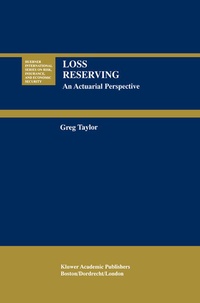
Loss Reserving
An Actuarial Perspective
Published on 29. February 2000
Book
Hardback
XII, 389 pages
978-0-7923-8502-8 (ISBN)
Description
All property and casualty insurers are required to carry out loss reserving as a statutory accounting function. Thus, loss reserving is an essential sphere of activity, and one with its own specialized body of knowledge. While few books have been devoted to the topic, the amount of published research literature on loss reserving has almost doubled in size during the last fifteen years.
Greg Taylor's book aims to provide a comprehensive, state-of-the-art treatment of loss reserving that reflects contemporary research advances to date. Divided into two parts, the book covers both the conventional techniques widely used in practice, and more specialized loss reserving techniques employing stochastic models. Part I, Deterministic Models, covers very practical issues through the abundant use of numerical examples that fully develop the techniques under consideration. Part II, Stochastic Models, begins with a chapter that sets up the additional theoretical material needed to illustrate stochastic modeling. The remaining chapters in Part II are self-contained, and thus can be approached independently of each other. A special feature of the book is the use throughout of a single real life data set to illustrate the numerical examples and new techniques presented. The data set illustrates most of the difficult situations presented in actuarial practice. This book will meet the needs for a reference work as well as for a textbook on loss reserving.
Greg Taylor's book aims to provide a comprehensive, state-of-the-art treatment of loss reserving that reflects contemporary research advances to date. Divided into two parts, the book covers both the conventional techniques widely used in practice, and more specialized loss reserving techniques employing stochastic models. Part I, Deterministic Models, covers very practical issues through the abundant use of numerical examples that fully develop the techniques under consideration. Part II, Stochastic Models, begins with a chapter that sets up the additional theoretical material needed to illustrate stochastic modeling. The remaining chapters in Part II are self-contained, and thus can be approached independently of each other. A special feature of the book is the use throughout of a single real life data set to illustrate the numerical examples and new techniques presented. The data set illustrates most of the difficult situations presented in actuarial practice. This book will meet the needs for a reference work as well as for a textbook on loss reserving.
More details
Series
Edition
2000 ed.
Language
English
Place of publication
New York
United States
Target group
Professional and scholarly
Research
Illustrations
XII, 389 p.
Dimensions
Height: 241 mm
Width: 160 mm
Thickness: 27 mm
Weight
773 gr
ISBN-13
978-0-7923-8502-8 (9780792385028)
DOI
10.1007/978-1-4615-4583-5
Schweitzer Classification
Other editions
Additional editions
Book
11/2012
Springer
€213.99
Shipment within 7-9 days
Content
I Deterministic Models.- 1 Basic Concepts.- 2 Claim Counts.- 3 Claim Amounts - Simple Models.- 4 Claim Amounts - Other Deterministic Models.- 5 Combination of Deterministic Estimates of Liability.- II Stochastic Models.- 6 Stochastic Techniques.- 7 Stochastic Chain Ladder.- 8 Stochastic Models with a GLM Basis.- 9 Credibility Models.- 10 Kalman Filter.- 11 Bootstrap.- 12 Final Estimates of Liability.- Appendix A - Notation.- Appendix B - Data for Numerical Example.