

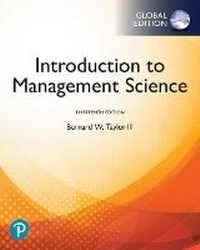
Introduction to Management Science, Global Edition
13th Edition
Published on 5. March 2019
Book
Paperback/Softback
864 pages
978-1-292-26304-5 (ISBN)
Description
Introduction to Management Science gives students a strong foundation in how to make decisions and solve complex problems using both quantitative methods and software tools. In addition to extensive examples, problem sets, and cases, the 13th Edition incorporates Excel 2016 and other software resources, developing students' ability to leverage the technology they will use throughout their careers. By practicing these modelling techniques, students gain a useful framework for problem-solving that they can then apply in the workplace.
Samples
Download the detailed table of contents
Samples
Download the detailed table of contents
More details
Edition
13th edition
Language
English
Place of publication
Harlow
United Kingdom
Target group
Professional and scholarly
Dimensions
Height: 251 mm
Width: 203 mm
Thickness: 28 mm
Weight
1340 gr
ISBN-13
978-1-292-26304-5 (9781292263045)
Copyright in bibliographic data and cover images is held by Nielsen Book Services Limited or by the publishers or by their respective licensors: all rights reserved.
Schweitzer Classification
Other editions
Additional editions
E-Book
12/2018
13th Edition
Pearson
from
€58.19
Available for download
Previous edition

Bernard Taylor
Introduction to Management Science, Global Edition
Book
10/2015
12th Edition
Pearson Education Limited
€106.65
Shipment within 10-20 days
Person
About our author Bernard W. Taylor, III received the PhD and MBA from the University of Georgia and a BIE from the Georgia Institute of Technology. He has served as President of the Decision Sciences Institute and as a member of its Executive Committee and Board of Directors. He also served as the Program Chair for the 1988 National Decision Sciences Institute (DSI) Meeting in Las Vegas, Associate Program Chairman, Council Member, Vice-President, Treasurer, and as the Editor of Decision Line, the newsletter of DSI. He was named a Fellow of DSI in 1984. He is a past President, Vice-President, and Program Chairman of the Southeast Decision Sciences Institute.
In 1991 he was the recipient of the Distinguished Service Award from DSI, and in 1984 he received the Distinguished Service Award for Southeast DSI. He is author of the book Introduction to Management Science (Pearson, 12th edition), and co-author of Operations Management (Wiley, 9th edition), and, Management Science (W.C. Brown, 4th edition). Dr. Taylor has published numerous articles in such journals as Operations Research, Management Science, Decision Sciences, IIE Transactions, Journal of the Operational Research Society, Computers and Operations Research, Omega, and the International Journal of Production Research, among others. In 1984 he received the Stanley T. Hardy Award for the greatest contribution to the field of production and operations management for his paper in Decision Sciences (with Huang and Rees) on the Japanese kanban production system. He has also served on the editorial boards of the Journal of Operations Management, Production and Operations Management, Journal of Management, the Review of Business and Economic Research, and Computers and Operations Research.
Taylor's research and teaching interests are in the areas of management science applications and operations management. He has received the University Certificate of Teaching Excellence on 4 occasions and the College of Business Teaching Excellence Award once. In 1989 he was awarded the College of Business PhD Teaching Excellence Award. He served as Head of the Department of Business Information Technology from 1983 to 2017.
In 1991 he was the recipient of the Distinguished Service Award from DSI, and in 1984 he received the Distinguished Service Award for Southeast DSI. He is author of the book Introduction to Management Science (Pearson, 12th edition), and co-author of Operations Management (Wiley, 9th edition), and, Management Science (W.C. Brown, 4th edition). Dr. Taylor has published numerous articles in such journals as Operations Research, Management Science, Decision Sciences, IIE Transactions, Journal of the Operational Research Society, Computers and Operations Research, Omega, and the International Journal of Production Research, among others. In 1984 he received the Stanley T. Hardy Award for the greatest contribution to the field of production and operations management for his paper in Decision Sciences (with Huang and Rees) on the Japanese kanban production system. He has also served on the editorial boards of the Journal of Operations Management, Production and Operations Management, Journal of Management, the Review of Business and Economic Research, and Computers and Operations Research.
Taylor's research and teaching interests are in the areas of management science applications and operations management. He has received the University Certificate of Teaching Excellence on 4 occasions and the College of Business Teaching Excellence Award once. In 1989 he was awarded the College of Business PhD Teaching Excellence Award. He served as Head of the Department of Business Information Technology from 1983 to 2017.
Content
1. Management Science
2. Linear Programming: Model Formulation and Graphical Solution
3. Linear Programming: Computer Solution and Sensitivity Analysis
4. Linear Programming: Modeling Examples
5. Integer Programming
6. Transportation, Transshipment, and Assignment Problems
7. Network Flow Models
8. Project Management
9. Multicriteria Decision Making
10. Nonlinear Programming
11. Probability and Statistics
12. Decision Analysis
13. Queuing Analysis
14. Simulation
15. Forecasting
16. Inventory Management
2. Linear Programming: Model Formulation and Graphical Solution
3. Linear Programming: Computer Solution and Sensitivity Analysis
4. Linear Programming: Modeling Examples
5. Integer Programming
6. Transportation, Transshipment, and Assignment Problems
7. Network Flow Models
8. Project Management
9. Multicriteria Decision Making
10. Nonlinear Programming
11. Probability and Statistics
12. Decision Analysis
13. Queuing Analysis
14. Simulation
15. Forecasting
16. Inventory Management