

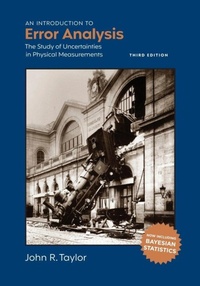
An Introduction to Error Analysis, third edition
The study of uncertainties in physical measurements
3rd Edition
Will be published approx. on 30. August 2022
Book
Hardback
380 pages
978-1-940380-14-8 (ISBN)
Description
John R. Taylor's best-selling text will be released in a new third edition that features Bayesian statistics and updated new chapter-ending problems throughout. Previously translated into nine languages, this brilliant little text introduces the study of uncertainties to lower division science students using familiar examples.
This remarkable text by John R. Taylor has been a non-stop best-selling international hit since it was first published forty years ago. However, the two-plus decades since the second edition was released have seen two dramatic developments; the huge rise in popularity of Bayesian statistics, and the continued increase in the power and availability of computers and calculators. In response to the former, Taylor has added a full chapter dedicated to Bayesian thinking, introducing conditional probabilities and Bayes' theorem. The several examples presented in the new third edition are intentionally very simple, designed to give readers a clear understanding of what Bayesian statistics is all about as their first step on a journey to become practicing Bayesians. In response to the second development, Taylor has added a number of chapter-ending problems that will encourage readers to learn how to solve problems using computers. While many of these can be solved using programs such as Matlab or Mathematica, almost all of them are stated to apply to commonly available spreadsheet programs like Microsoft Excel. These programs provide a convenient way to record and process data and to calculate quantities like standard deviations, correlation coefficients, and normal distributions; they also have the wonderful ability - if students construct their own spreadsheets and avoid the temptation to use built-in functions - to teach the meaning of these concepts.
This remarkable text by John R. Taylor has been a non-stop best-selling international hit since it was first published forty years ago. However, the two-plus decades since the second edition was released have seen two dramatic developments; the huge rise in popularity of Bayesian statistics, and the continued increase in the power and availability of computers and calculators. In response to the former, Taylor has added a full chapter dedicated to Bayesian thinking, introducing conditional probabilities and Bayes' theorem. The several examples presented in the new third edition are intentionally very simple, designed to give readers a clear understanding of what Bayesian statistics is all about as their first step on a journey to become practicing Bayesians. In response to the second development, Taylor has added a number of chapter-ending problems that will encourage readers to learn how to solve problems using computers. While many of these can be solved using programs such as Matlab or Mathematica, almost all of them are stated to apply to commonly available spreadsheet programs like Microsoft Excel. These programs provide a convenient way to record and process data and to calculate quantities like standard deviations, correlation coefficients, and normal distributions; they also have the wonderful ability - if students construct their own spreadsheets and avoid the temptation to use built-in functions - to teach the meaning of these concepts.
More details
Edition
3rd Revised edition
Language
English
Place of publication
United States
Target group
College/higher education
Professional and scholarly
Edition type
Revised edition
Product notice
Laminated cover
Dimensions
Height: 261 mm
Width: 185 mm
Thickness: 22 mm
Weight
801 gr
ISBN-13
978-1-940380-14-8 (9781940380148)
Copyright in bibliographic data and cover images is held by Nielsen Book Services Limited or by the publishers or by their respective licensors: all rights reserved.
Schweitzer Classification
Person
Content
Preface to the Third Edition
Part I.
Chapter 1. Preliminary Description of Error Analysis
Chapter 2. How to Report and Use Uncertainties
Chapter 3. Propagation of Uncertainties
Chapter 4. Statistical Analysis of Random Uncertainties
Chapter 5. The Normal Distribution
Part II.
Chapter 6. Rejection of Data
Chapter 7. Weighted Averages
Chapter 8. Least-Square Fitting
Chapter 9. Covariance and Correlation
Chapter 10. The Binomial Distribution
Chapter 11. The Poisson Distribution
Chapter 12. The Chi-Squared Test for a Distribution
Chapter 13. Bayesian Statistics
Appendix A. Normal Error Integral, I
Appendix B. Normal Error Integral, II
Appendix C. Probabilities for Correlation Coefficients
Appendix D. Probabilities for Chi Squared
Appendix E. Two Proofs Concerning Sample Standard Deviations
Part I.
Chapter 1. Preliminary Description of Error Analysis
Chapter 2. How to Report and Use Uncertainties
Chapter 3. Propagation of Uncertainties
Chapter 4. Statistical Analysis of Random Uncertainties
Chapter 5. The Normal Distribution
Part II.
Chapter 6. Rejection of Data
Chapter 7. Weighted Averages
Chapter 8. Least-Square Fitting
Chapter 9. Covariance and Correlation
Chapter 10. The Binomial Distribution
Chapter 11. The Poisson Distribution
Chapter 12. The Chi-Squared Test for a Distribution
Chapter 13. Bayesian Statistics
Appendix A. Normal Error Integral, I
Appendix B. Normal Error Integral, II
Appendix C. Probabilities for Correlation Coefficients
Appendix D. Probabilities for Chi Squared
Appendix E. Two Proofs Concerning Sample Standard Deviations