

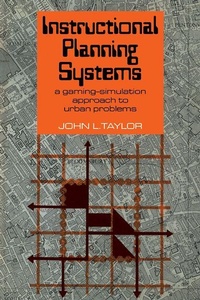
Instructional Planning Systems
A Gaming-Simulation Approach to Urban Problems
Published on 4. June 2009
Book
Paperback/Softback
204 pages
978-0-521-11273-4 (ISBN)
Description
This book is concerned with the educational aspects of gaming simulation procedures and their application to urban studies and to the teaching of town planning. It analyses the availability and relevance of these instructional simulation techniques as a simple way of presenting, relating and manipulating many divergent observations concerning the environment and human settlement. Dr Taylor divides his book into three main sections: the first identifies the background and evolution of instructional simulation, the second examines urban development gaming's emerging importance and justification and the third reviews some of the issues that must be contemplated if the potential of gaming simulation techniques are to be fully realised. This was the first book to provide a comprehensive and authoritative review of the state of knowledge on instructional simulations relevant to urban problems. As such it will be of great interest and practical value to all those involved in urban studies and environmental planning.
More details
Language
English
Place of publication
Cambridge
United Kingdom
Target group
Professional and scholarly
Product notice
Paperback (trade)
Illustrations
Worked examples or Exercises
Dimensions
Height: 229 mm
Width: 152 mm
Thickness: 12 mm
Weight
339 gr
ISBN-13
978-0-521-11273-4 (9780521112734)
Copyright in bibliographic data and cover images is held by Nielsen Book Services Limited or by the publishers or by their respective licensors: all rights reserved.
Schweitzer Classification
Other editions
Additional editions

Book
01/1971
Cambridge University Press
€3.71
Article exhausted; check for reprint
Previous edition
Book
01/1971
Cambridge University Press
€3.71
Article exhausted; check for reprint
Content
1. Point of departure; 2. The basis for discussion; 3. The genesis of an approach, 4. Selected planning developments; 5. Impact, pitfalls and pay-offs; 6. A gaming-simulation rationale; 7. Simulation in practice; 8. The way ahead.