

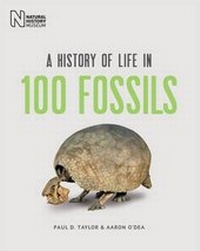
A History of Life in 100 Fossils
Published on 4. September 2014
Book
Hardback
224 pages
978-0-565-09347-1 (ISBN)
Description
This is the epic story of life on Earth, uniquely retold through some of the most significant fossils ever found. The book travels through 3.5 billion years of Earth's history and across all seven continents, showcasing the unusual and wonderful creatures that have played a pivotal role in our evolutionary past. Ancient Australian microbes reveal the very first signs of life on Earth, tiny Triassic snails demonstrate the effects of past mass extinctions, and the remains of our own ancestors tell us where we came from. The history of all living things can be found in the ground. Epic tales of survival and migration, evolution and destruction are hidden in the buried remains of animals and plants that lived long ago. A History of Life in 100 Fossils brings together remarkable fossil discoveries to illustrate how life on Earth evolved. Palaeontologists Paul D. Taylor and Aaron O'Dea explain the importance of each fossil and tell the engaging stories of the sharp-eyed and sharp-witted people who discovered them.Discover Cambrian worms from China that provide a window on early animal life in the sea, ancient insects encapsulated by amber, the first fossil bird Archaeopteryx and the last ancestor of humankind.
The fossils have been selected from the renowned collections of the two premier natural history museums in the world, London's Natural History Museum and the Smithsonian Institution, Washington. Each fossil is beautifully illustrated with photographs to bring this unique story to life.
The fossils have been selected from the renowned collections of the two premier natural history museums in the world, London's Natural History Museum and the Smithsonian Institution, Washington. Each fossil is beautifully illustrated with photographs to bring this unique story to life.
Reviews / Votes
"Lavishly illustrated with satisfyingly large photos of fossils, this is a learned yet accessible introduction to the history of long-dead living things." The Good Book Guide; "From single-celled foraminifera to gigantic steppe mammoths, this volume presents a sweeping panorama of ancient life and is recommended for non-specialists interested in palaeontology or evolutionary biology." Library Journal; "How did we get from the beginning to where we are now? That is the story of this book...one hundred stepping stones from the Earth's deep-time past to its shallow present, each artfully illustrated by an iconic fossil...These are the classics" Nature Geoscience; "Of course, the book could be read from cover to cover to discover how these remarkable fossil discoveries illustrate how life on earth has evolved. However, it could also be enjoyed by dipping in randomly, as each of the 100 sections are self-contained stories - whether about dinosaur teeth discovered in Sussex or Australopithecus skulls from South Africa. And each fossil is beautifully illustrated, with full colour photographs...if you want to see how fossils have driven our understanding of life on earth, this is for you." Deposits magazineMore details
Language
English
Place of publication
London
United Kingdom
Illustrations
Colour photographs and illustrations throughout
Dimensions
Height: 253 mm
Width: 216 mm
Thickness: 20 mm
Weight
400 gr
ISBN-13
978-0-565-09347-1 (9780565093471)
Copyright in bibliographic data and cover images is held by Nielsen Book Services Limited or by the publishers or by their respective licensors: all rights reserved.
Schweitzer Classification
Persons
Paul D. Taylor has worked in the Earth Sciences Department at the Natural History Museum, London for 35 years, heading the Invertebrate and Plants division between 1990 and 2003. His research focuses on fossil and living bryozoans, with subsidiary interests in evolution, palaeoecology and fossil folklore. He is the author of Fossil Invertebrates. Aaron O'Dea is a palaeobiologist at the Smithsonian Tropical Research Institute in Panama. He uses the fossil record to understand the drivers of evolution and to reconstruct what Caribbean reefs were like before humans. Aaron has a broad passion for exploring, understanding and communicating the history of life in the tropics.