

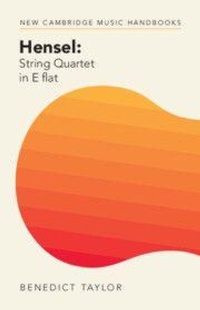
Hensel: String Quartet in E flat
String Quartet in E flat
Published on 30. November 2023
Book
Hardback
134 pages
978-1-316-51384-2 (ISBN)
Description
The String Quartet in E flat major (1834) by Fanny Hensel, nee Mendelssohn, is one of the most important works by a female composer written in the nineteenth century. Composed at a turning point in her life (as Hensel was not only grappling with her own creative voice but also coming to terms with her identity as a married woman, and the role her family expected of her), the quartet is significant in showing a woman composing in a genre that was then almost exclusively the domain of male artists. Benedict Taylor's illuminating book situates itself within developing scholarly discourse on the music of women composers, going beyond apologetics - or condemnation of those who hindered their development - to examine the strength and qualities of the music and how it responded to the most progressive works of the period.
More details
Series
Language
English
Place of publication
Cambridge
United Kingdom
Product notice
sewn/stitched
Cloth over boards
Illustrations
Worked examples or Exercises
Dimensions
Height: 216 mm
Width: 140 mm
Thickness: 10 mm
Weight
304 gr
ISBN-13
978-1-316-51384-2 (9781316513842)
Copyright in bibliographic data and cover images is held by Nielsen Book Services Limited or by the publishers or by their respective licensors: all rights reserved.
Schweitzer Classification
Other editions
Additional editions
Benedict Taylor
Hensel: String Quartet in E flat
E-Book
12/2023
Cambridge University Press
€21.99
Available for download
Benedict Taylor
Hensel: String Quartet in E flat
E-Book
11/2023
Cambridge University Press
€21.99
Available for download
Book
11/2023
Cambridge University Press
€19.00
Shipment within 15-20 days
Person
Benedict Taylor is Reader at the Reid School of Music, University of Edinburgh. Publications include Mendelssohn, Time and Memory: The Romantic Conception of Cyclic Form (2011), The Melody of Time: Music and Temporality in the Romantic Era (2016), and Music, Subjectivity, and Schumann (2022).
Content
1. Introduction; 2. Background; 3. Genesis and private reception; 4. First movement: Adagio ma non troppo; 5. Second movement: Allegretto; 6. Third movement: Romanza; 7. Finale: Allegro molto vivace; 8. Responding to the Quartet.