

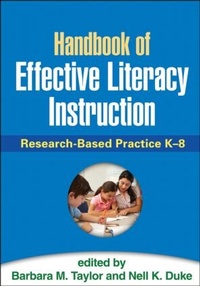
Handbook of Effective Literacy Instruction
Research-Based Practice K-8
1st Edition
Published on 10. May 2013
Book
Hardback
626 pages
978-1-4625-0941-6 (ISBN)
Description
This highly readable handbook synthesizes the best research on K-8 literacy instruction and distills key implications for classroom practice. Noted contributors provide clear recommendations for creating effective, motivating classroom environments; teaching core components of literacy; integrating literacy with content-area instruction; and building a schoolwide literacy program that helps all students succeed. Helpful figures, tables, resource lists, reflection questions, and concrete examples from real classrooms make the book an ideal tool for teacher training and professional development. Numerous reproducible worksheets and checklists can be downloaded and printed in a convenient 8 1/2" x 11" size.
Reviews / Votes
"This is what a handbook should be! The range of topics regarding effective literacy instruction is comprehensive. The information provided is accessible and state of the art. The authors address fundamental components of literacy lessons as well as specific teaching practices for meeting the needs of heterogeneous classrooms of students. I look forward to teaching with this volume in the literacy methods course in our elementary teacher education program."--Annemarie Sullivan Palincsar, PhD, Jean and Charles Walgreen Chair of Reading and Literacy, University of Michigan"This brilliantly organized handbook is a treasure trove of important information, provided in an eminently usable format. Today's teachers want to know what the research says about important questions of practice, but are often stymied by research articles lacking in practical application. This volume is written expressly for educators in search of fresh, research-supported tactics to engage students in meaningful literacy work. Readers will find extremely valuable suggestions for their classrooms and for facilitating colleagues' learning. I fully expect to see this book on the desks of teachers, literacy leaders, and principals around the country--it will absolutely remain in a prominent place on my own!"--Ellin O. Keene, MA, education consultant and author, Denver, Colorado
"A terrific addition to the literature. The consistent structure across the chapters makes the content particularly accessible, with implications for instruction front and center. Cross-referencing among the chapters is also handled well. The range of topics covered includes basic literacy processes as well as 21st-century literacies and the contexts in which literacy is taught and used. The Handbook demonstrates just how rich the field of literacy research has been, and how much we know about teaching and learning that can support excellent practices across grade levels and school subjects."--Taffy E. Raphael, PhD, Department of Curriculum and Instruction, University of Illinois at Chicago
"Taylor and Duke have assembled a first-rate team of researchers and teacher educators who address the critical issues facing practitioners today, in a way that is both research based and highly accessible. This volume is an excellent text for courses in literacy education and a key resource for professional development activities."--Dorothy S. Strickland, PhD, Samuel DeWitt Proctor Professor of Education Emerita, Rutgers, The State University of New Jersey
"I'm using this text in my graduate-level Foundations of Literacy course. I reviewed a variety of texts on literacy instruction aligned with CCSS and beyond, and this one was the best! It offers the perfect balance between theory and practice, providing the knowledge needed to make the kinds of instructional decisions that will lead to positive student outcomes. My students use the text as a core required reading text, we discuss it in class, and they use it as a guide to write their reflections about what they are observing in the field. The book is easy to read for new teachers and has a depth of knowledge that veteran teachers are hungry for."--Eugenia Mora-Flores, EdD, Rossier School of Education, University of Southern California -
More details
Language
English
Place of publication
New York
United States
Publishing group
Guilford Publications
Target group
College/higher education
Dimensions
Height: 254 mm
Width: 178 mm
Weight
1294 gr
ISBN-13
978-1-4625-0941-6 (9781462509416)
Copyright in bibliographic data and cover images is held by Nielsen Book Services Limited or by the publishers or by their respective licensors: all rights reserved.
Schweitzer Classification
Other editions
Additional editions
Barbara M. Taylor | Nell K. Duke
Handbook of Effective Literacy Instruction
Research-Based Practice K-8
Book
09/2014
1st Edition
Guilford Press
€67.00
Shipment within 15-20 days
Persons
Edited by Barbara M. Taylor, EdD, Department of Curriculum and Instruction (Emeritas), University of Minnesota; and Nell K. Duke, EdD, Program in Language, Literacy, and Culture, Department of Educational Studies, University of Michigan
Content
Taylor, Duke, Introduction. Part I: Fundamental Components of Effective Literacy Lessons. Roehrig, Brinkerhoff, Rawls, Pressley, Motivating Classroom Practices to Support Effective Literacy Instruction. Sailors, Kumar, Blady, Willson, Literacy Tools Created and Used within Print-Rich Classroom Environments. Taylor, Grouping Practices, Independent Learning Activities, and Effective Instruction. Balanced, Differentiated Teaching: Explicit Instruction, Scaffolded Support, and Active Student Peterson, Responding. Valencia, Hebard, Classroom Literacy Assessment: Strategies for Informing Instruction and Monitoring Student Progress. McIntyre, Turner, Culturally Responsive Literacy Instruction. Taffe, Bauer, Digital Literacy. Part II: Effective Teaching and Assessment to Develop Essential Literacy Abilities in Students. Johnson, Kuhn, Automaticity versus Fluency: Developing Essential Literacy Abilities with Print. Stahl, Today's Comprehension Strategy Instruction: "Not Your Father's Oldsmobile,". Garas-York, Shanahan, Almasi, Comprehension: High-Level Talk and Writing about Texts. Kucan, Vocabulary Instruction. Troia, Effective Writing Instruction in the 21st Century. Duke, Watanabe, Reading and Writing Specific Genres. Part III: Effective Integration of Literacy with Instruction in Content Areas. Cervetti, Integration of Literacy and Science. Halvorsen, Alleman, Brugar, Integration of Literacy and Social Studies. Fogelberg, Satz, Skalinder, Integration of Literacy and Mathematics. Fisher, McDonald, Frey, Integration of Literacy and the Arts: Creating Classrooms That Perform. Part IV: Essential Collaborations for Effective Schoolwide Literacy Instruction. Taylor, Developing and Implementing a Framework for Ongoing Schoolwide Reading Improvement. Weber, Improving the School Literacy Program: Developing Coherence in Curriculum, Instruction, and Assessments. Walpole, Najera, Improving the School Reading Program: A New Call for Collaboration. Peterson, Professional Learning: Professional Learning Communities, Whole-School Meetings, and Cross-School Sharing. Sailors, Russell, Augustine, Alexander, Professional Learning with and from a Literacy Coach: A Poem in Two Voices. Roberts, Partnering with Parents.