

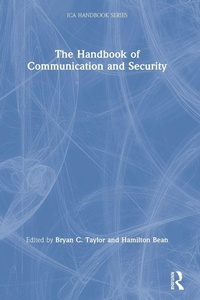
The Handbook of Communication and Security
1st Edition
Published on 2. July 2019
Book
Hardback
432 pages
978-0-8153-9678-9 (ISBN)
Description
The Handbook of Communication and Security provides a comprehensive collection and synthesis of communication scholarship that engages security at multiple levels, including theoretical vs. practical, international vs. domestic, and public vs. private. The handbook includes chapters that leverage communication-based concepts and theories to illuminate and influence contemporary security conditions. Collectively, these chapters foreground and analyze the role of communication in shaping the economic, technological, and cultural contexts of security in the 21st century. This book is ideal for advanced undergraduate and postgraduate students and scholars in the numerous subfields of communication and security studies.
More details
Series
Language
English
Place of publication
New York
United States
Publishing group
Taylor & Francis Inc
Target group
College/higher education
Illustrations
7 s/w Abbildungen, 1 s/w Zeichnung, 5 s/w Tabellen
5 Tables, black and white; 1 Line drawings, black and white; 7 Illustrations, black and white
Dimensions
Height: 260 mm
Width: 183 mm
Thickness: 29 mm
Weight
1032 gr
ISBN-13
978-0-8153-9678-9 (9780815396789)
Copyright in bibliographic data and cover images is held by Nielsen Book Services Limited or by the publishers or by their respective licensors: all rights reserved.
Schweitzer Classification
Other editions
Additional editions
Bryan C. Taylor | Hamilton Bean
The Handbook of Communication and Security
Book
06/2019
1st Edition
Routledge
€131.60
Shipment within 15-20 days
Bryan C. Taylor | Hamilton Bean
The Handbook of Communication and Security
E-Book
06/2019
1st Edition
Routledge
€128.99
Available for download
Bryan C. Taylor | Hamilton Bean
The Handbook of Communication and Security
E-Book
06/2019
1st Edition
Routledge
€128.99
Available for download
Persons
Bryan C. Taylor is Professor of Communication at the University of Colorado Boulder, and Director of its Peace, Conflict, and Security Program. His research interests include the communicative status of nuclear weapons, and the role of mimesis in articulations of media and security. His related research has been published in journals including Annals of the International Communication Association, Communication Theory, Critical Studies of Media Communication, and elsewhere. He is co-editor of the volume Nuclear Legacies: Communication, Controversy, and the U.S. Nuclear Weapons Complex.
Hamilton Bean is Associate Professor of Communication at the University of Colorado Denver, where he conducts research at the intersection of communication, organization, and security. Since 2005, he has been affiliated with the National Consortium for the Study of Terrorism and Responses to Terrorism (START), a U.S. Department of Homeland Security Center of Excellence. He is the author of No More Secrets: Open Source Information and the Reshaping of U.S. Intelligence.
Hamilton Bean is Associate Professor of Communication at the University of Colorado Denver, where he conducts research at the intersection of communication, organization, and security. Since 2005, he has been affiliated with the National Consortium for the Study of Terrorism and Responses to Terrorism (START), a U.S. Department of Homeland Security Center of Excellence. He is the author of No More Secrets: Open Source Information and the Reshaping of U.S. Intelligence.
Content
Introduction: Conceptualizing Communication ? ? Security Part I: Communication Contexts and Genres 1. Communication History and Security 2. Crisis/Emergency Communication and Security 3. Ecological Communication and Security 4. Discourse and Security 5. Group Communication and Security 6. Health Communication and Security 7. Intercultural Communication and Security 8. Organizational Communication and Security 9. Political Communication and Security 10. Rhetoric and Security 11. Strategic Communication and Security 12. Visual Communication and Security Part II: Special Topics 13. Biosecurity and Communication 14. Communicatively Countering Violent Extremism Online 15. Cybersecurity and Communication 16. Communicative Dimensions of Neoliberalism, Globalization, and Militarism 17. Memory, Security, and Communication 18. Nuclear Deterrence and Communication 19. Rituals of Communication and Security 20. Strategic Narrative and Security 21. Surveillance and Communication 22. Communicating Terrorism and Counterterrorism Part III: The Futures of Communication ? ? Security 23. Commentary: Communication and Security Creep