

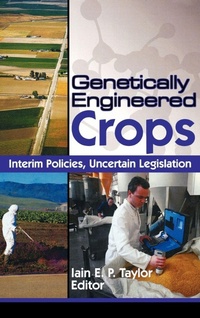
Genetically Engineered Crops
Interim Policies, Uncertain Legislation
1st Edition
Published on 8. March 2007
Book
Hardback
426 pages
978-1-56022-988-9 (ISBN)
Description
Take a closer look at the questions surrounding the long-term impact of GE crops
Genetically Engineered Crops examines current controversies surrounding the potential health, environmental, and social impacts of plants produced using molecular biology techniques. Educators, professionals, and practitioners representing a wide range of disciplines, including plant biotechnology, environmental health risk assessment, law, food safety assessment, and bio safety, address the uncertainties of the science, biological risks, national and international governance issues in North and South America, Europe, and Africa, and the need for full public understanding of genetically engineered crops.
Proper regulation of food requires a broad understanding of the science and of varying public perceptions of the technology that will lead to effective governance. Genetically Engineered Crops examines ecological, health, and environmental concerns about crop genetic engineering, the need for precaution, biosafety, and liability, and the challenges faced in meeting the public's demands for proper understanding of the risks involved. With no worldwide framework for regulation in place and public concern about food safety growing, this vital book takes a closer look at the long-term impact of GE crops and their place in the future of agriculture.
Genetically Engineered Crops examines:
the laboratory hazards of gene splicing
environmental releases of GEOs
the loss of agrobiodiversity
the ecological effects of HRCs
ecological and environmental risk assessment of GE crops
human health implications of GE foods
allergenicity and toxicity
the precautionary principle
international trade and regulatory harm
smart regulations in Canada
shortcomings in risk assessment
liability and compensation
and much more
Genetically Engineered Crops is a vital reference resource for anyone working in the plant and crop sciences, the social sciences, national and international bioregulation, environmental law, and agribusiness.
Genetically Engineered Crops examines current controversies surrounding the potential health, environmental, and social impacts of plants produced using molecular biology techniques. Educators, professionals, and practitioners representing a wide range of disciplines, including plant biotechnology, environmental health risk assessment, law, food safety assessment, and bio safety, address the uncertainties of the science, biological risks, national and international governance issues in North and South America, Europe, and Africa, and the need for full public understanding of genetically engineered crops.
Proper regulation of food requires a broad understanding of the science and of varying public perceptions of the technology that will lead to effective governance. Genetically Engineered Crops examines ecological, health, and environmental concerns about crop genetic engineering, the need for precaution, biosafety, and liability, and the challenges faced in meeting the public's demands for proper understanding of the risks involved. With no worldwide framework for regulation in place and public concern about food safety growing, this vital book takes a closer look at the long-term impact of GE crops and their place in the future of agriculture.
Genetically Engineered Crops examines:
the laboratory hazards of gene splicing
environmental releases of GEOs
the loss of agrobiodiversity
the ecological effects of HRCs
ecological and environmental risk assessment of GE crops
human health implications of GE foods
allergenicity and toxicity
the precautionary principle
international trade and regulatory harm
smart regulations in Canada
shortcomings in risk assessment
liability and compensation
and much more
Genetically Engineered Crops is a vital reference resource for anyone working in the plant and crop sciences, the social sciences, national and international bioregulation, environmental law, and agribusiness.
More details
Language
English
Place of publication
Bosa Roca
United States
Publishing group
Taylor & Francis Inc
Target group
Professional and scholarly
Dimensions
Height: 235 mm
Width: 157 mm
Thickness: 30 mm
Weight
848 gr
ISBN-13
978-1-56022-988-9 (9781560229889)
Copyright in bibliographic data and cover images is held by Nielsen Book Services Limited or by the publishers or by their respective licensors: all rights reserved.
Schweitzer Classification
Other editions
Additional editions
E-Book
03/2007
CRC Press
€111.99
Available for download
E-Book
03/2007
1st Edition
CRC Press
€111.99
Available for download
Book
03/2007
1st Edition
CRC Press
€124.78
Shipment within 3-4 weeks
Person
Iain E. P. Taylor, PhD, holds BSc and doctorate degrees from the University of Liverpool. He joined the faculty of the University of British Columbia Botany Department in 1968. His research interests in plant cell walls have recently been paralleled by research on ethics in science, scholarly publishing, and professionalism. He retired and was appointed Professor Emeritus in December 2003. He was editor?in-chief of the Canadian Journal o f Botany from 1989 to 1999, and has served as assistant editor in chief of the NRC of Canada Research Journals since 1991. He is associated with the W. Maurice Young Centre for Applied Ethics at UBC and is the research director at the university's Botanical Garden.
Content
Introduction. Genetic Engineering of Crops: Science Meets Civil Society's Response Abbreviations PART I. SCIENCE AND THE FUTURE Chapter 1. The Birth of Synthetic Biology and the Genetic Mode of Production Chapter 2. Controversy Around Terminology and Novelty: Engineered, Modified Biotechnology and Transgenics Chapter 3. Transgenic Crops, Agrobiodiversity, and Agroecosystem Function Chapter 4. Ecological Risk Assessment of GE Crops: Getting the Science Fundamentals Right Chapter 5. Coping with Uncertainty: The Human Health Implications of GE Foods Chapter 6. Future Research Tackling the Technology Divide: A Research Agenda for Crop Biotechnology Chapter 7. Next Challenges for Crop GE: Maturing of Governance and Moves Beyond Food Issues PART II: ISSUES IN CURRENT GOVERNANCE Chapter 8. A Precautionary Framework for Biotechnology Chapter 9. The Precautionary Principle and Biotechnology: Guiding a Public Interest Research Agenda Chapter 10. Trade, Science, and Canada's Regulatory Framework for Determining the Environmental Safety of GE Crops Chapter 11. Principles Driving U.S. Governance of Agbiotech Chapter 12. Biotechnology Policy in the European Union Chapter 13. Regulatory Regimes for GE Crops in Africa Chapter 14. GEO Research and Agribusiness in Brazil: Impact of the Regulatory Framework Chapter 15. Toward a Liability and Compensation Regime under the Biosafety Protocol PART III: CHALLENGES TO CIVIL SOCIETY Chapter 16. Public Spheres Pushing for Change: Public Participation in the Governance of GE Crops Chapter 17. Risky Delusions: Misunderstanding Science and Misperforming Publics in the GE Crops Issue