

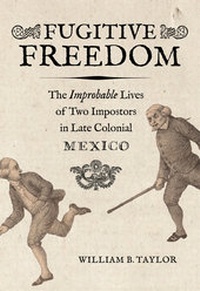
Fugitive Freedom
The Improbable Lives of Two Impostors in Late Colonial Mexico
1st Edition
Published on 23. February 2021
Book
Hardback
224 pages
978-0-520-36856-9 (ISBN)
Description
The curious tale of two priest impersonators in late colonial Mexico
Cut loose from their ancestral communities by wars, natural disasters, and the great systemic changes of an expanding Europe, vagabond strangers and others out of place found their way through the turbulent history of early modern Spain and Spanish America. As shadowy characters inspiring deep suspicion, fascination, and sometimes charity, they prompted a stream of decrees and administrative measures that treated them as nameless threats to good order and public morals. The vagabonds and impostors of colonial Mexico are as elusive in the written record as they were on the ground, and the administrative record offers little more than commonplaces about them. Fugitive Freedom locates two of these suspect strangers, Joseph Aguayo and Juan Atondo, both priest impersonators and petty villains in central Mexico during the last years of Spanish rule.
Displacement brought picaros to the forefront of Spanish literature and popular culture-a protean assortment of low life characters, seen as treacherous but not usually violent, shadowed by poverty, on the move and on the make in selfish, sometimes clever ways as they navigated a hostile, sinful world. What to make of the lives and longings of Aguayo and Atondo, which resemble those of one or another literary picaro? Did they imagine themselves in literary terms, as heroes of a certain kind of story? Could impostors like these have become fixtures in everyday life with neither a receptive audience nor permissive institutions? With Fugitive Freedom, William B. Taylor provides a rare opportunity to examine the social histories and inner lives of two individuals at the margins of an unfinished colonial order that was coming apart even as it was coming together.
Cut loose from their ancestral communities by wars, natural disasters, and the great systemic changes of an expanding Europe, vagabond strangers and others out of place found their way through the turbulent history of early modern Spain and Spanish America. As shadowy characters inspiring deep suspicion, fascination, and sometimes charity, they prompted a stream of decrees and administrative measures that treated them as nameless threats to good order and public morals. The vagabonds and impostors of colonial Mexico are as elusive in the written record as they were on the ground, and the administrative record offers little more than commonplaces about them. Fugitive Freedom locates two of these suspect strangers, Joseph Aguayo and Juan Atondo, both priest impersonators and petty villains in central Mexico during the last years of Spanish rule.
Displacement brought picaros to the forefront of Spanish literature and popular culture-a protean assortment of low life characters, seen as treacherous but not usually violent, shadowed by poverty, on the move and on the make in selfish, sometimes clever ways as they navigated a hostile, sinful world. What to make of the lives and longings of Aguayo and Atondo, which resemble those of one or another literary picaro? Did they imagine themselves in literary terms, as heroes of a certain kind of story? Could impostors like these have become fixtures in everyday life with neither a receptive audience nor permissive institutions? With Fugitive Freedom, William B. Taylor provides a rare opportunity to examine the social histories and inner lives of two individuals at the margins of an unfinished colonial order that was coming apart even as it was coming together.
Reviews / Votes
"An extremely rewarding book. . . . Above all, the book is characterized by Taylor's insightful historical analysis, which brings the past to life but always treats its own terms and in all of its complexity." * Journal of Colonialism and Colonial History * "In sum, Fugitive Freedom weaves together extraordinary Inquisition cases to illuminate the cracks and imperfections built into the edifice of the Spanish Empire. No doubt, historians, students, and enthusiasts of colonial Mexico will take delight in Taylor's sharp analysis and supple prose." * H-Net: Humanities & Social Sciences Online * "This readable account of . . . curious lives opens windows onto many aspects of everyday life in colonial Mexico." * Literary Review * "Compact and beautifully written." * Hispanic American Historical Review * "William Taylor is one of Mexican history's great masters of social history. . . .No one historian is going to solve this riddle about fiction and lived reality, and Taylor's lively study offers welcome grist for the historiographic mill on the subject." * Journal of Arizona History * "The book's detail and verve, along with Taylor's penchant for provocative questions make Fugitive Freedom ideal for the undergraduate classroom, including not only courses on Latin American history, but on the historian's craft as well." * The Middle Ground Journal * "William B. Taylor has written a wonderfully entertaining and accessible story about two Mexican picaros who lived extraordinary lives at the margins of colonial society. . . . this is an important book that gives us new insight into life in colonial Mexico." * EIAL: Estudios Interdisciplinarios de America Latina *More details
Edition
First Edition
Language
English
Place of publication
Berkerley
United States
Target group
Professional and scholarly
Product notice
Cloth over boards
Illustrations
3 b-w maps
Dimensions
Height: 210 mm
Width: 140 mm
Thickness: 25 mm
Weight
408 gr
ISBN-13
978-0-520-36856-9 (9780520368569)
Copyright in bibliographic data and cover images is held by Nielsen Book Services Limited or by the publishers or by their respective licensors: all rights reserved.
Schweitzer Classification
Other editions
Additional editions
E-Book
02/2021
1st Edition
Naval Institute Press
€22.49
Available for download
Person
William B. Taylor is Muriel McKevitt Sonne Professor of History, Emeritus, at the University of California, Berkeley. His books on Latin American history include Theater of a Thousand Wonders: A History of Miraculous Images and Shrines in New Spain, as well as Drinking, Homicide, and Rebellion in Colonial Mexican Villages and Magistrates of the Sacred: Priests and Parishioners in Eighteenth-Century Mexico.
Content
List of Maps
Preface
Introduction
Strangers in the Land: Prosperity, Poverty, Expansion, and Displacement in Spain and New Spain
A World of Appearances and Suspicion
Two Impostors
The Mexican Inquisition after 1750
1 Joseph Lucas Aguayo y Herrera, Escape Artist
A Life on His Own and on the Move: "I left determined to make my way in life . . . for good or ill"
Aguayo Presents Himself: Reading His Actions and Words: ". . . leaving nothing behind but my shadow"
Inquisitors Take the Measure of Joseph Aguayo: "An escaped criminal and backslider"
Conclusion: "What I tell you is either truth or lies"
2 Juan Atondo's Vagrant Heart
Aspirations and Transgressions
Atondo Presents Himself to the Inquisition
The Inquisitors and Others Appraise Juan Atondo
Conclusion: His Propension Religiosa
3 Protean Picaros
Early Literary Picaros: "A vagabond is a newcomer in a heap of trouble"
Mexican Literary Picaros?
Conclusion
4 Aguayo and Atondo, Picaros After All?
Aguayo: "The picaro both incorporates and transcends the wanderer, the jester, and the have-not."
Atondo: "You are the stranger who gets stranger by the hour"
Conclusion
Conclusion
Beyond Picaros
Fugitive Freedom
Notes
Bibliography
Index
Preface
Introduction
Strangers in the Land: Prosperity, Poverty, Expansion, and Displacement in Spain and New Spain
A World of Appearances and Suspicion
Two Impostors
The Mexican Inquisition after 1750
1 Joseph Lucas Aguayo y Herrera, Escape Artist
A Life on His Own and on the Move: "I left determined to make my way in life . . . for good or ill"
Aguayo Presents Himself: Reading His Actions and Words: ". . . leaving nothing behind but my shadow"
Inquisitors Take the Measure of Joseph Aguayo: "An escaped criminal and backslider"
Conclusion: "What I tell you is either truth or lies"
2 Juan Atondo's Vagrant Heart
Aspirations and Transgressions
Atondo Presents Himself to the Inquisition
The Inquisitors and Others Appraise Juan Atondo
Conclusion: His Propension Religiosa
3 Protean Picaros
Early Literary Picaros: "A vagabond is a newcomer in a heap of trouble"
Mexican Literary Picaros?
Conclusion
4 Aguayo and Atondo, Picaros After All?
Aguayo: "The picaro both incorporates and transcends the wanderer, the jester, and the have-not."
Atondo: "You are the stranger who gets stranger by the hour"
Conclusion
Conclusion
Beyond Picaros
Fugitive Freedom
Notes
Bibliography
Index