

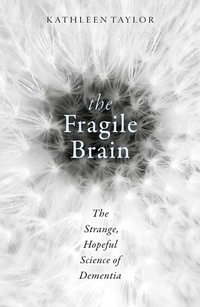
The Fragile Brain
The strange, hopeful science of dementia
Published on 24. November 2016
Book
Hardback
336 pages
978-0-19-872608-1 (ISBN)
Description
Neurodegenerative diseases, such as a stroke, Alzheimer's and dementia, are now tragically commonplace within the western world. Our brains are a strange and complex organ, and there is much to be discovered about what causes them to fail in such devastating ways.
In this book Kathleen Taylor presents the ever-developing research into the cause and cure of these life-changing conditions, focusing on insights arising from the relatively new field of neuroimmunology - the increasing recognition of the important role of the immune system in the brain. Interweaving the latest scientific ideas on neurodegenerative diseases with accounts of the devastation which illnesses affecting the brain can cause to sufferers and to anyone who cares about them, The Fragile Brain is not only an important account of current research in this field, but a very personal study. As instances of dementia rise in our ageing populations, many harbour anxieties concerning the future.This book is about knowing the enemy.
In this book Kathleen Taylor presents the ever-developing research into the cause and cure of these life-changing conditions, focusing on insights arising from the relatively new field of neuroimmunology - the increasing recognition of the important role of the immune system in the brain. Interweaving the latest scientific ideas on neurodegenerative diseases with accounts of the devastation which illnesses affecting the brain can cause to sufferers and to anyone who cares about them, The Fragile Brain is not only an important account of current research in this field, but a very personal study. As instances of dementia rise in our ageing populations, many harbour anxieties concerning the future.This book is about knowing the enemy.
Reviews / Votes
Taylor has crafted a personal, astonishingly coherent review of our current state of knowledge about the causes of Alzheimer's disease and dementia, as well as possible solutions, from lifestyle adjustments to drug developments. * Michael Heneka, Nature * The Fragile Brain addresses how people interact with those who have dementia, and how both information and respect are needed. This is of utmost importance: information can quell many fears. * Michael Heneka, Nature * Taylor has the talent to make complex biology easy, but not trivial. * Michael Heneka, Nature * The Fragile Brain, as a trove of accessible, up-to-date science, has something to offer caregivers and families of people with dementia; medical professionals in dementia diagnosis and treatment; and specialists in memory clinics. * Michael Heneka, Nature * detailed and accessible book * Leon Burakowski, South Shropshire Journal *More details
Language
English
Place of publication
Oxford
United Kingdom
Target group
College/higher education
Professional and scholarly
Illustrations
9 black and white figures
Dimensions
Height: 241 mm
Width: 156 mm
Thickness: 35 mm
Weight
576 gr
ISBN-13
978-0-19-872608-1 (9780198726081)
Copyright in bibliographic data and cover images is held by Nielsen Book Services Limited or by the publishers or by their respective licensors: all rights reserved.
Schweitzer Classification
Other editions
Additional editions
E-Book
11/2016
1st Edition
OUP eBook
€19.49
Available for download
E-Book
10/2016
1st Edition
OUP eBook
€19.49
Available for download
Person
Dr Kathleen Taylor studied physiology and philosophy at the University of Oxford. After a research MSc at Stirling University, working on brain chemistry, she returned to Oxford to do a DPhil in visual neuroscience and postdoctoral work on cognitive neuroscience. In 2002 she won two writing competitions run by the Times Higher Education Supplement, one for science writing and one for an essay in the humanities/social sciences. She has written on a range of topics from consciousness to cruelty, including several books published by OUP in the last decade: Brainwashing (2004), Cruelty (2009) and The Brain Supremacy (2012).
Content
SECTION 1: THE PROBLEM; SECTION 2: RISK FACTORS; SECTION 3: MECHANISMS