

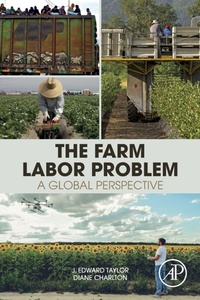
The Farm Labor Problem
A Global Perspective
Published on 5. December 2018
Book
Paperback/Softback
241 pages
978-0-12-816409-9 (ISBN)
Description
The Farm Labor Problem: A Global Perspective explores the unique character of agricultural labor markets and the implications for food production, farm worker welfare and advocacy, and immigration policy. Agricultural labor markets differ from other labor markets in fundamental ways related to seasonality and uncertainty, and they evolve differently than other labor markets as economies develop. We weave economic analysis with the history of agricultural labor markets using data and real-world events. The farm labor history of California and the United States is particularly rich, so it plays a central role in the book, but the book has a global perspective ensuring its relevance to Europe and high-income Asian countries.
The chapters in this book provide readers with the basics for understanding how farm labor markets work (labor in agricultural household models, farm labor supply and demand, spatial market equilibria); farm labor and immigration policy; farm labor organizing; farm employment and rural poverty; unionization and the United Farm Workers movement; the Fair Food Program as a new approach to collective bargaining; the declining immigrant farm labor supply; and what economic development in relatively low-income countries portends for the future of agriculture in the United States and other high-income countries. The book concludes with a chapter called "Robots in the Fields," which extrapolates current trends to a perhaps not-so-distant future.
The Farm Labor Problem serves as both a guide to policy makers, farmworker advocates and international development organizations and as a textbook for students of agricultural economics and economics.
The chapters in this book provide readers with the basics for understanding how farm labor markets work (labor in agricultural household models, farm labor supply and demand, spatial market equilibria); farm labor and immigration policy; farm labor organizing; farm employment and rural poverty; unionization and the United Farm Workers movement; the Fair Food Program as a new approach to collective bargaining; the declining immigrant farm labor supply; and what economic development in relatively low-income countries portends for the future of agriculture in the United States and other high-income countries. The book concludes with a chapter called "Robots in the Fields," which extrapolates current trends to a perhaps not-so-distant future.
The Farm Labor Problem serves as both a guide to policy makers, farmworker advocates and international development organizations and as a textbook for students of agricultural economics and economics.
More details
Language
English
Place of publication
San Diego
United States
Publishing group
Elsevier Science Publishing Co Inc
Target group
Professional and scholarly
Policy-makers, farmworker advocates, and international development organizations, and as a textbook for students of economics and agricultural economics
Product notice
Paperback (trade)
Dimensions
Height: 229 mm
Width: 152 mm
Thickness: 13 mm
Weight
330 gr
ISBN-13
978-0-12-816409-9 (9780128164099)
Copyright in bibliographic data and cover images is held by Nielsen Book Services Limited or by the publishers or by their respective licensors: all rights reserved.
Schweitzer Classification
Other editions
Additional editions
E-Book
11/2018
Academic Press
€109.00
Available for download
Persons
J. Edward Taylor is a professor of Agricultural and Resource Economics at the University of California, Davis. He is a Fellow of both the Agricultural and Applied Economics Association (AAEA) and the American Association for the Advancement of Science (AAAS). Ed co-authored the award-winning book Beyond Experiments in Development Economics: Local Economy-wide Impact Evaluation (Oxford University Press, 2014), Essentials of Development Economics (University of California Press, 2015), Essentials of Applied Econometrics (University of California Press, 2016) and Worlds in Motion: Understanding International Migration at the End of the Millennium (Oxford University Press, 2005). He is listed in Who's Who in Economics as one of the world's most cited economists. Ed has advised numerous foreign governments and international development agencies on matters related to economic development, and he has been an editor of the American Journal of Agricultural Economics. Diane Charlton is an assistant professor in the Department of Agricultural Economics and Economics at Montana State University. She completed her Ph.D. at University of California, Davis in 2016. Her dissertation focused on the causes and consequences of the agricultural transition, analyzing household panel data from rural Mexico. She has co-authored two award-winning papers on the declining farm labor supply from rural Mexico. She continues to research labor economics, agricultural markets, the economics of labor migration, and the economics of education.
Content
1. The Farm Labor Problem2. Agricultural Labor Demand3. Agricultural Labor Supply: Who Does Farm Work and Who Doesn't?4. Equilibrium and Immigration in the Farm Labor Market5. Labor in an Agricultural Household Model6. Farm Labor and Immigration Policy7. Farm Labor Organizing from Cesar Chavez and the United Farm Workers to Fair Foods8. The End of Farm Labor Abundance9. Robots in the Fields