

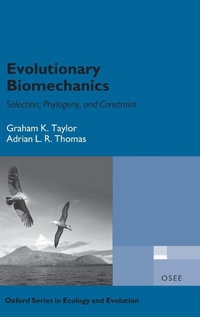
Evolutionary Biomechanics
Published on 2. January 2014
Book
Hardback
172 pages
978-0-19-856637-3 (ISBN)
Description
Evolutionary biomechanics is the study of evolution through the analysis of biomechanical systems. Its unique advantage is the precision with which physical constraints and performance can be predicted from first principles. Instead of reviewing the entire breadth of the biomechanical literature, a few key examples are explored in depth as vehicles for discussing fundamental concepts, analytical techniques, and evolutionary theory. Each chapter develops a conceptual theme, developing the underlying theory and techniques required for analyses in evolutionary biomechanics. Examples from terrestrial biomechanics, metabolic scaling, and bird flight are used to analyse how physics constrains the design space that natural selection is free to explore, and how adaptive evolution finds solutions to the trade-offs between multiple complex conflicting performance objectives.
Evolutionary Biomechanics is suitable for graduate level students and professional researchers in the fields of biomechanics, physiology, evolutionary biology and palaeontology. It will also be of relevance and use to researchers in the physical sciences and engineering.
Evolutionary Biomechanics is suitable for graduate level students and professional researchers in the fields of biomechanics, physiology, evolutionary biology and palaeontology. It will also be of relevance and use to researchers in the physical sciences and engineering.
Reviews / Votes
This is a scholarly volume that approaches a challenging subject in a straightforward and rigorous manner, which is illuminating without being overpowering...ideal for students who want both depth and a fascinating context. * Ian Carter, The Biologist * This volume provides for all. ... This is a great volume for undergraduates or postdoctoral researchers. * Christian Laurent, Quarterly Review of Biology *More details
Series
Language
English
Place of publication
Oxford
United Kingdom
Target group
Professional and scholarly
Illustrations
60 line illustrations
Dimensions
Height: 240 mm
Width: 161 mm
Thickness: 14 mm
Weight
429 gr
ISBN-13
978-0-19-856637-3 (9780198566373)
Copyright in bibliographic data and cover images is held by Nielsen Book Services Limited or by the publishers or by their respective licensors: all rights reserved.
Schweitzer Classification
Other editions
Additional editions
E-Book
01/2014
1st Edition
OUP eBook
€40.99
Available for download
Persons
Graham Taylor is Associate Professor of Mathematical Biology at the University of Oxford, Department of Zoology, with a particular focus on the dynamics and control of flight, and a strong interest in evolutionary theory and animal behaviour.
Adrian Thomas is Professor of Biomechanics at the University of Oxford, Department of Zoology, and works on Biomechanics and Evolution, with a particular focus on animal flight and aerodynamics. He does aerodynamics consultancy work with drone and paraglider manufacturers and flies the wings he helps design.
Adrian Thomas is Professor of Biomechanics at the University of Oxford, Department of Zoology, and works on Biomechanics and Evolution, with a particular focus on animal flight and aerodynamics. He does aerodynamics consultancy work with drone and paraglider manufacturers and flies the wings he helps design.
Content
1. Themes ; 2. Selection ; 3. Constraint ; 4. Scaling ; 5. Phylogeny ; 6. Form and function in ight ; 7. Adaptation in avian wing design ; 8. Trade-offs: selection, phylogeny and constraint