

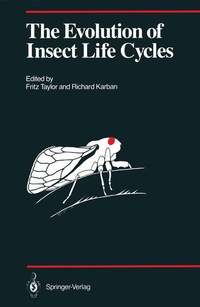
The Evolution of Insect Life Cycles
Published on 1. July 2012
Book
Paperback/Softback
X, 287 pages
978-1-4613-8668-1 (ISBN)
Description
This book was developed out of a symposium at the XVII International Congress of Entomology held in Hamburg, Germany, on August 21, 1984. This symposium was organized by Drs. William Bradshaw and Hugh Dingle, who subsequently asked us to edit the proceedings. The chapters represent, for the most part, papers that were read in Hamburg but have been expanded and updated. The goal of this volume is to provide a comprehensive view of current research on insect life cycles, including field and laboratory studies, broad comparisons among species or local populations, and intensive studies of single populations, as well as theoretical research. Of necessity, given the magnitude of research now being carried out on insects, some important research programs are not included, and therein lie the makings of future volumes. This volume is divided into three parts. The first part, Geographical Patterns in Insect Life Cycles, explores various applications of a comparative method that has been valuable in investigating the potential for variability in life history parameters and the relation of these parameters to important variables in the environment.
More details
Series
Edition
Softcover reprint of the original 1st ed. 1986
Language
English
Place of publication
New York
United States
Target group
Professional and scholarly
Research
Illustrations
X, 287 p.
Dimensions
Height: 244 mm
Width: 170 mm
Thickness: 17 mm
Weight
522 gr
ISBN-13
978-1-4613-8668-1 (9781461386681)
DOI
10.1007/978-1-4613-8666-7
Schweitzer Classification
Other editions
Additional editions
Fritz Taylor | Richard Karban
The Evolution of Insect Life Cycles
Book
11/1986
Springer
€85.55
Article exhausted; check different version
Content
I Geographical Patterns in Insect Life Cycles.- 1 Life Cycle Strategies of an Intertidal Midge Between Subtropic and Arctic Latitudes.- 2 Significance of Ovipositor Length in Life Cycle Adaptations of Crickets.- 3 Geographical Variation and Ecological Control of Diapause in Flies.- 4 Geography of Density-Dependent Selection in Pitcher-Plant Mosquitoes.- 5 Geographical Patterns in the Photoperiodic Induction of Hibernal Diapause.- II Diversity of Life Cycle Patterns.- 6 Diapause Strategies in the Australian Plague Locust (Chortoicetes terminifera Walker).- 7 Life Cycle Strategies and Plant Succession.- 8 Polymorphism in the Larval Hibernation Strategy of the Burnet Moth, Zygaena trifolii.- 9 r-K Selection at Various Taxonomic Levels in the Pierine Butterflies of North and South America.- 10 Adaptive Significance of Genetic Variability of Photoperiodism in Mecoptera and Lepidoptera.- 11 Mosquito Maternity: Egg Brooding in the Life Cycle of Trichoprosopon digitatum.- III Mechanisms of Insect Life Cycle Evolution.- 12 The Evolution of Insect Life Cycle Syndromes.- 13 Evolution of Wing Polymorphism and Its Impact on Life Cycle Adaptation in Insects.- 14 Prolonged Development in Cicadas.- 15 Toward a Theory for the Evolution of the Timing of Hibernal Diapause.- IV Concluding Remarks.- 16 Pervasive Themes in Insect Life Cycle Strategies.