

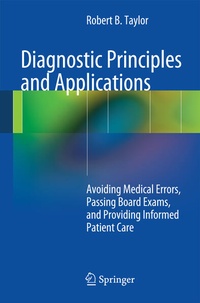
Diagnostic Principles and Applications
Avoiding Medical Errors, Passing Board Exams, and Providing Informed Patient Care
Published on 1. March 2013
Book
Paperback/Softback
XX, 416 pages
978-1-4614-1110-9 (ISBN)
Description
This book fills the need for a resource presenting important diagnostic facts that clinicians should have learned during their classroom lectures and subsequent clinical training, but often didn't. The content will be literature-based information that can help the clinician avoid diagnostic errors. Most other diagnosis books on the market are either "physical diagnosis" texts targeting student readers or "differential diagnosis" books intended for use by practicing physicians, though both types of books aim to be comprehensive. What sets this book apart from other diagnosis books is that it is a curated collection of facts, tailored specifically to address common gaps in clinical knowledge and describe less-traveled pathways to important diagnostic destinations. This book focuses on high-impact techniques. Essential Diagnostic Facts Every Clinician Should Know contains: -Classical diagnostic pearls clinicians should have learned in physical diagnosis courses. For example, a patient with acute pericarditis may find that leaning forward relieves the pain. -Red flag symptoms of serious disease. For example, an infant that tastes salty when kissed might be the first clue to a diagnosis of cystic fibrosis. -Pathognomonic signs allowing an occasional early diagnosis: For example, Koplik spots in a febrile child are found only with measles. -Plastic pearls exposed: For example, contrary to clinical lore, back pain at night has not been found to be a useful indicator for serious spinal pathology. -Counterintuitive clinical manifestations: For example, the patient with gout may have a normal or even low serum uric acid level during an acute attack. -Clinical manifestations that may point to uncommon diagnoses: For example, nocturnal bone pain, sometimes dramatically relieved by aspirin, characterizes osteoid osteoma.
Reviews / Votes
From the reviews:
"This is a book of what are commonly referred to as clinical pearls. . Although the audience includes every clinician engaged in the practice of medicine, the book may be more appropriate for experienced practitioners . . This is an entertaining book . ." (Vincent F. Carr, Doody's Book Reviews, March, 2014)
More details
Edition
2013 ed.
Language
English
Place of publication
New York
United States
Target group
Professional and scholarly
Professional/practitioner
Illustrations
40 s/w Abbildungen, 67 farbige Abbildungen
XX, 416 p. 107 illus., 67 illus. in color.
Dimensions
Height: 235 mm
Width: 155 mm
Thickness: 24 mm
Weight
657 gr
ISBN-13
978-1-4614-1110-9 (9781461411109)
DOI
10.1007/978-1-4614-1111-6
Schweitzer Classification
Other editions
Additional editions
Robert B. Taylor
Diagnostic Principles and Applications
Avoiding Medical Errors, Passing Board Exams, and Providing Informed Patient Care
E-Book
03/2013
1st Edition
Springer
€53.49
Available for download
Person
Robert B. Taylor is a luminary in the field of family medicine and the author or editor of more than 25 books.
Content
Undifferentiated problems.- Infants and children.- The nervous system.- The eye.- The ear, nose and throat.- The cardiovascular system.- The respiratory system.- The digestive system.- The kidney and male genitourinary system.- The female reproductive system.- The musculoskeletal system.- The skin and subcutaneous tissues.- The endocrine and metabolic systems.- Blood and hematologic system.- Infections and infestations.- Mental health problems.- Laboratory and imaging diagnostics.- Appendix: Glossary of statistical terms used in this book.