

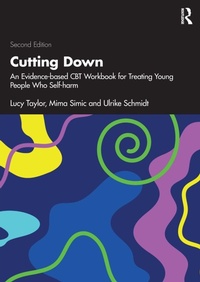
Cutting Down
An Evidence-based CBT Workbook for Treating Young People Who Self-harm
2nd Edition
Published on 21. July 2022
Book
Paperback/Softback
282 pages
978-0-367-75578-2 (ISBN)
Description
Cutting Down provides a practical and accessible treatment programme based on Cognitive Behaviour Therapy (CBT) principles for young people who self-harm.
This fully revised and updated second edition includes new techniques from 'third' wave CBT, Acceptance Commitment Therapy (ACT) and Dialectical Behaviour Therapy (DBT). This enriches the material and brings the concepts up to date. Another key addition to this new edition is the inclusion of strategies for young people who engage in suicidal behaviour. The manual is evidence based and focuses on a flexible and formulation driven model to direct treatment in around 15 sessions for young people and six sessions for parents and caregivers. It provides a clear structure for each session and an easy-to-follow outline on how the therapist should deliver each session. The content of each session is supported by handouts and worksheets which can be used within sessions or as homework between sessions.
Enhanced with online resources, the workbook will be useful for all professionals working with young people who self-harm across a wide range of settings from schools, primary care and voluntary sector, to community mental health services and inpatient units.
This fully revised and updated second edition includes new techniques from 'third' wave CBT, Acceptance Commitment Therapy (ACT) and Dialectical Behaviour Therapy (DBT). This enriches the material and brings the concepts up to date. Another key addition to this new edition is the inclusion of strategies for young people who engage in suicidal behaviour. The manual is evidence based and focuses on a flexible and formulation driven model to direct treatment in around 15 sessions for young people and six sessions for parents and caregivers. It provides a clear structure for each session and an easy-to-follow outline on how the therapist should deliver each session. The content of each session is supported by handouts and worksheets which can be used within sessions or as homework between sessions.
Enhanced with online resources, the workbook will be useful for all professionals working with young people who self-harm across a wide range of settings from schools, primary care and voluntary sector, to community mental health services and inpatient units.
Reviews / Votes
'Suicide is the second leading cause of death in young people. Self-harm is one of the strongest known predictors of suicide. Building on the success achieved by the first edition, this book represents a major advance in psychological treatments of self-harm in young people.' Dennis Ougrin, Professor, MBBS, MRCPsych, PGDip(Oxon), PGCAPHE, PhD; Consultant Child and Adolescent Psychiatrist; Visiting Professor of Child and Adolescent Psychiatry and Global Mental Health, Institute of Psychiatry, Psychology and Neuroscience, King's College London'This second edition of Cutting Down again offers structure and practicality to achieve the best outcomes for young people who self-harm and their families. In this accessible manual, the authors bring "order" to the management of self-harm which will give both therapist and patients confidence and direction. The overall stance is of positivity, normalisation, hope and collaboration, enhanced by the addition of a parent/carer module, a new hopelessness module and up to date techniques from third wave CBT, offers an accessible and evidenced based protocol to reduce and stop self-harm.' Isobel Heyman, Professor, Honorary Consultant Child and Adolescent Psychiatrist, Psychological Medicine, Great Ormond Street Hospital for Children NHS Foundation Trust
'Cutting Down 2nd Edition is an excellent resource for mental health professionals working with young people who self-harm. This edition contains additional treatment approaches for young people presenting with hopelessness and associated suicidal ideation, a module for parents/carers and the inclusion of further strategies from third wave CBT.' Dr Katrina Hunt, Consultant Clinical Psychologist, Head of National & Specialist CAMHS DBT Service, South London and Maudsley NHS Foundation Trust
More details
Edition
2nd edition
Language
English
Place of publication
London
United Kingdom
Publishing group
Taylor & Francis Ltd
Target group
College/higher education
Professional and scholarly
General, Postgraduate, Professional, and Professional Practice & Development
Illustrations
87 s/w Abbildungen, 49 s/w Photographien bzw. Rasterbilder, 38 s/w Zeichnungen
38 Line drawings, black and white; 49 Halftones, black and white; 87 Illustrations, black and white
Dimensions
Height: 297 mm
Width: 210 mm
Thickness: 17 mm
Weight
769 gr
ISBN-13
978-0-367-75578-2 (9780367755782)
Copyright in bibliographic data and cover images is held by Nielsen Book Services Limited or by the publishers or by their respective licensors: all rights reserved.
Schweitzer Classification
Other editions
Additional editions
Lucy Taylor | Mima Simic | Ulrike Schmidt
Cutting Down
An Evidence-based CBT Workbook for Treating Young People Who Self-harm
E-Book
07/2022
2nd Edition
Routledge
€52.99
Available for download
Lucy Taylor | Mima Simic | Ulrike Schmidt
Cutting Down
An Evidence-based CBT Workbook for Treating Young People Who Self-harm
E-Book
07/2022
2nd Edition
Routledge
€52.99
Available for download
Lucy Taylor | Mima Simic | Ulrike Schmidt
Cutting Down
An Evidence-based CBT Workbook for Treating Young People Who Self-harm
Book
07/2022
2nd Edition
Routledge
€179.41
Shipment within 15-20 days
Previous edition
Lucy Taylor | Mima Simic | Ulrike Schmidt
Cutting Down: A CBT workbook for treating young people who self-harm
A CBT workbook for treating young people who self-harm
Book
02/2015
1st Edition
Routledge
€65.87
Article exhausted; check for reprint
Persons
Dr Lucy Taylor is a Consultant Clinical Psychologist working in independent practice in Surrey. She has worked over 20 years in the NHS, including jointly heading up the National & Specialist Child and Adolescent Dialectical Behaviour Therapy (DBT) Service, Maudsley Hospital.
Dr Mima Simic is Consultant Child Adolescent Psychiatrist leading the Maudsley Centre for Child and Adolescent Eating Disorder. She was Consultant for the Community Adolescent Mental Health Team and National & Specialist Child and Adolescent Dialectical Behaviour Therapy (DBT) Service, Maudsley Hospital for nearly a decade. She has researched treatments for self-harm in which she teaches and trains mental health professionals.
Ulrike Schmidt is Professor of Eating Disorders at King's College London and a Consultant Psychiatrist at the Maudsley Hospital. One key focus of her research is on developing brief scalable psychological treatments of value to the NHS, for people with eating disorders and other common mental health problems, including self-harm.
Dr Mima Simic is Consultant Child Adolescent Psychiatrist leading the Maudsley Centre for Child and Adolescent Eating Disorder. She was Consultant for the Community Adolescent Mental Health Team and National & Specialist Child and Adolescent Dialectical Behaviour Therapy (DBT) Service, Maudsley Hospital for nearly a decade. She has researched treatments for self-harm in which she teaches and trains mental health professionals.
Ulrike Schmidt is Professor of Eating Disorders at King's College London and a Consultant Psychiatrist at the Maudsley Hospital. One key focus of her research is on developing brief scalable psychological treatments of value to the NHS, for people with eating disorders and other common mental health problems, including self-harm.
Content
Acknowledgements; Introduction; Part 1: What's going on? Assessment, psychoeducation, risk assessment and safety planning; Session 1: Understanding self-harm; Session 2: Values, strengths and goals; Session 3: Are you ready to make a change?; Part 2: Feelings, thoughts and behaviour; Session 4: You and your feelings; Session 5: Links between feelings, thoughts and behaviours; Session 6: Dealing with thoughts; Session 7: Core beliefs and rules of living; Session 8: Formulation of your journey; Part 3: Coping strategies; Session 9: The coping tree; Session 10: Understanding and managing fear and distress; Session 11: Being mindful; Session 12: Managing emotions; Session 13: Managing relationships; Session 14: Hopelessness; Part 4: On you go!; Session 15: Ending therapy; Part 5: Parent sessions; Session 1: Psychoeducation; Session 2: Validation; Session 3: How to help; Session 4: Moving forward together; Session 5: Support with new skills; Session 6: Next steps; Index