

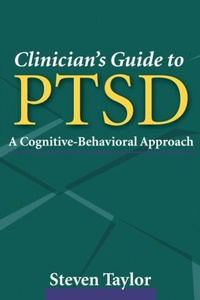
Clinician's Guide to PTSD, First Edition
A Cognitive-Behavioral Approach
1st Edition
Published on 21. September 2006
Book
Hardback
322 pages
978-1-59385-326-6 (ISBN)
Description
Grounded in the latest clinical and neurobiological research, this book provides both an understanding of posttraumatic stress disorder (PTSD) and a guide to empirically supported treatment. The author offers well-documented, practical recommendations for planning and implementing cognitive-behavioral therapy with people who have experienced different types of trauma--sexual assault, combat, serious accidents, and more--and shows how to use a case formulation approach to tailor interventions to the needs of each patient. Coverage includes different conceptual models of PTSD, approaches to integrating psychopharmacology into treatment, and strategies for addressing frequently encountered comorbid conditions. Illustrated with helpful case examples, the book features over a dozen reproducible handouts and forms.
Reviews / Votes
"Sophisticated, up to date, and comprehensive. Rich with clinical examples, this book is a valuable resource for mental health clinicians who work or intend to work with clients suffering from PTSD related to any source of traumatization, from natural disasters and serious accidents to rape and intimate partner abuse. The author draws on extensive clinical and research experience to help the clinician understand the bases of client problems, plan treatment, and implement cognitive and exposure interventions. In the classroom, this book would be suitable as a primary text for graduate-level courses on posttraumatic stress or as a supplemental text for courses on psychopathology."--Edward S. Kubany, PhD, Honolulu, Hawaii"This book is a gem! It is comprehensive, covering both the science and art of cognitive-behavioral treatment for PTSD, yet it is also concise and user-friendly. It offers a compendium of new and established treatment methods in a case formulation approach that demonstrates how empirically supported treatment protocols can be adapted for individual patients. This volume includes everything a clinician, student, or researcher interested in PTSD needs to know. Taylor's thorough review of the literature even addresses neurobiology for the CBT therapist. A valuable resource for every clinician's bookshelf."--Barbara Olasov Rothbaum, PhD, Emory University School of Medicine
"Posttraumatic stress disorder (PTSD), perhaps more than any other mental disorder, has catapulted to prominence in recent years. PTSD is a major public health problem for which treatment is often inaccessible to sufferers. In this book, Taylor outlines a cognitive-behavioral approach that is evidence based, yet flexible enough to be tailored to the needs of the individual client. The book is a valuable resource for clinical psychology graduate students, postdoctoral fellows, and psychiatry residents, as well as any mental health professional desirous of increasing his or her knowledge base in this area of treatment."--Murray B. Stein, MD, MPH, University of California, San Diego "This book is a gem! It is comprehensive, covering both the science and art of cognitive-behavioral treatment for PTSD, yet it is also concise and user-friendly. It offers a compendium of new and established treatment methods in a case formulation approach that demonstrates how empirically supported treatment protocols can be adapted for individual patients. This volume includes everything a clinician, student, or researcher interested in PTSD needs to know. Taylor's thorough review of the literature even addresses neurobiology for the CBT therapist. A valuable resource for every clinician's bookshelf." - Barbara Olasov Rothbaum, PhD, Department of Psychiatry and Trauma and Anxiety Recovery Program, Emory University School of Medicine, USA
"Sophisticated, up to date, and comprehensive. Rich with clinical examples, this book is a valuable resource for mental health clinicians who work or intend to work with clients suffering from PTSD related to almost any source of traumatization, from natural disasters and serious accidents to rape and intimate partner abuse. The author draws on extensive clinical and research experience to help the clinician understand the bases of client problems, plan treatment, and implement cognitive and exposure interventions. In the classroom, this book would be suitable as a primary text for graduate-level courses on posttraumatic stress or as a supplemental text for courses on psychopathology." - Edward S. Kubany, in private practice, Honolulu, Hawaii, USA
More details
Language
English
Place of publication
New York
United States
Target group
Professional and scholarly
Dimensions
Height: 229 mm
Width: 152 mm
Weight
578 gr
ISBN-13
978-1-59385-326-6 (9781593853266)
Copyright in bibliographic data and cover images is held by Nielsen Book Services Limited or by the publishers or by their respective licensors: all rights reserved.
Schweitzer Classification
Other editions
New editions
Book
08/2017
2nd Edition
Guilford Press
€71.50
Shipment within 15-20 days
Additional editions
Book
07/2009
1st Edition
Guilford Publications
€53.41
Article exhausted; check for reprint
Person
Steven Taylor, PhD, is a clinical psychologist and Professor in the Department of Psychiatry at the University of British Columbia. For 10 years he was Associate Editor of Behaviour Research and Therapy and now is Associate Editor of the Journal of Cognitive Psychotherapy, as well as being on the editorial boards of several journals. He has published over 180 journal articles and book chapters and 11 books on anxiety disorders and related topics. He served as a consultant on the text revision of the Diagnostic and Statistical Manual of Mental Disorders (DSM-IV-TR). Dr. Taylor has received career awards from the Canadian Psychological Association, the Association for Advancement of Behavior Therapy, the Anxiety Disorders Association of America, and the British Columbia Psychological Association. He is also a fellow of several scholarly organizations, including the Academy of Cognitive Therapy, the Canadian Psychological Association, and the American Psychological Society. Dr. Taylor is actively involved in clinical teaching and supervision. His clinical and research interests include cognitive-behavioral treatments and mechanisms of anxiety disorders and related conditions.
Content
I. Conceptual and Empirical Foundations
1. Clinical Features of Posttraumatic Stress Disorder
2. Cognitive and Behavioral Features of PTSD: What the Research Tells Us
3. Cognitive-Behavioral Models
4. Neurobiology for the Cognitive-Behavioral Therapist
5. Treatments: A Review of the Research
II. Treatment Methods and Protocols
6. Assessment
7. Cognitive-Behavioral Therapy: An Overview
8. Developing a Case Formulation and Treatment Plan
9. Psychoeducation, Treatment Engagement, and Emotion Regulation Strategies
10. Cognitive Interventions I: General Considerations and Approaches
11. Cognitive Interventions II: Methods for Specific Types of Beliefs
12. Exposure Exercises I: Imaginal and Interoceptive Exposure
13. Exposure Exercises II: Situational Exposure
14. Adjunctive Methods and Relapse Prevention
1. Clinical Features of Posttraumatic Stress Disorder
2. Cognitive and Behavioral Features of PTSD: What the Research Tells Us
3. Cognitive-Behavioral Models
4. Neurobiology for the Cognitive-Behavioral Therapist
5. Treatments: A Review of the Research
II. Treatment Methods and Protocols
6. Assessment
7. Cognitive-Behavioral Therapy: An Overview
8. Developing a Case Formulation and Treatment Plan
9. Psychoeducation, Treatment Engagement, and Emotion Regulation Strategies
10. Cognitive Interventions I: General Considerations and Approaches
11. Cognitive Interventions II: Methods for Specific Types of Beliefs
12. Exposure Exercises I: Imaginal and Interoceptive Exposure
13. Exposure Exercises II: Situational Exposure
14. Adjunctive Methods and Relapse Prevention