

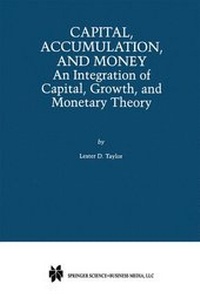
Capital, Accumulation, and Money
An Integration of Capital, Growth, and Monetary Theory
Published on 31. March 2000
Book
Hardback
XVIII, 265 pages
978-0-7923-7781-8 (ISBN)
Description
Capital, Accumulation, and Money: An Integration of Capital, Growth, and Monetary Theory is a book about capital. A root concept of capital is developed which allows for most existing concepts of capital to be unified and related to one another in consistent fashion. Such a root concept of capital offers a framework for integrating monetary and capital theory, and for analyzing the functioning of an economy, whether that economy is in a steady state of subsistence or in a process of sustainable growth. Specifically, it is shown that a conservation principle emerges that both implies and imposes a variety of constraints on the macro behavior of an economy, constraints which make for straightforward understanding and analysis of such concepts as the real stock of money, real-balance effects, and the general price level. New and illuminating insights are also provided into aggregate supply and demand, natural and money rates of interest, the relationship between real and monetary economies, and economic growth and development.
More details
Language
English
Place of publication
NY
United States
Target group
College/higher education
Professional and scholarly
Research
Illustrations
1
Dimensions
Height: 23.5 cm
Width: 15.5 cm
Thickness: 17 mm
Weight
1280 gr
ISBN-13
978-0-7923-7781-8 (9780792377818)
DOI
10.1007/978-1-4757-4709-6
Schweitzer Classification
Other editions
New editions
Lester D. Taylor
Capital, Accumulation, and Money
An Integration of Capital, Growth, and Monetary Theory
Book
01/2010
2nd Edition
Springer
€160.49
Shipment within 7-9 days
Content
List of Figures. Preface. Prologue: Tales of Myros: Emergence of a Primitive Economy from an Economic State of Nature. 1. Premises and an Overview. 2. Myros and Other Concepts and Definitions. 3. The Macroeconomic Framework. 4. Interest and Money. 5. Production and Investment. 6. The General Price Level and Inflation. 7. Capital Values, Wealth, and Related Topics. 8. Macroeconomic Equilibrium and Employment. 9. Capital Theory in Perspective. 10. Opportunity and Sunk Costs. 11. Trade, Transfers, and Monetary Overhangs. 12. Questions Related to Consumption and Saving. 13. Questions Related to Economic Growth. 14. Themes and Counter Themes: Fluid Capital in Retrospect. Appendices. Bibliography. Index.