

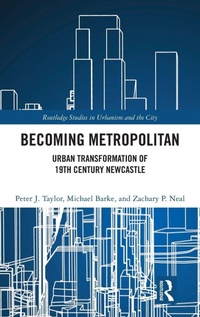
Becoming Metropolitan
Urban Transformation of 19th Century Newcastle
1st Edition
Published on 22. May 2026
Book
Hardback
116 pages
978-1-041-22637-6 (ISBN)
Description
Using a unique data-rich study of Newcastle's becoming a metropolitan city region in the nineteenth century, this book explores a new understanding of how successful cities attain a metropolitan status through disruptions of incessant economic advances being ameliorated by myriad social organizations to create a new vibrant urban environment.
The book defines the specific process of 'becoming metropolitan' by bringing together economic and social urban studies to explain an interactive development that when successful creates a metropolitan city region. In addition, a real example of this is meticulously described through a detailed case study that traces the process across decades to a metropolitan outcome. In doing so, it combines theoretical and empirical understandings within a single text and provides accessible information to a unique and large dataset.
Becoming Metropolitan will appeal to graduates and researchers of geography, sociology, planning, and history specializing in cities and urban studies. It will also be valuable to a larger public audience with interest in cities, as 'metropolitan' is a commonplace idea easily understood, especially in the case- study city.
The book defines the specific process of 'becoming metropolitan' by bringing together economic and social urban studies to explain an interactive development that when successful creates a metropolitan city region. In addition, a real example of this is meticulously described through a detailed case study that traces the process across decades to a metropolitan outcome. In doing so, it combines theoretical and empirical understandings within a single text and provides accessible information to a unique and large dataset.
Becoming Metropolitan will appeal to graduates and researchers of geography, sociology, planning, and history specializing in cities and urban studies. It will also be valuable to a larger public audience with interest in cities, as 'metropolitan' is a commonplace idea easily understood, especially in the case- study city.
More details
Series
Language
English
Place of publication
London
United Kingdom
Publishing group
Taylor & Francis Ltd
Target group
College/higher education
Professional and scholarly
Academic and Undergraduate Advanced
Product notice
Laminated cover
Illustrations
47 s/w Tabellen, 4 s/w Zeichnungen, 4 s/w Abbildungen
47 Tables, black and white; 4 Line drawings, black and white; 4 Illustrations, black and white
Dimensions
Height: 234 mm
Width: 156 mm
Thickness: 10 mm
Weight
358 gr
ISBN-13
978-1-041-22637-6 (9781041226376)
Copyright in bibliographic data and cover images is held by Nielsen Book Services Limited or by the publishers or by their respective licensors: all rights reserved.
Schweitzer Classification
Other editions
Additional editions
Peter J. Taylor | Michael Barke | Zachary P. Neal
Becoming Metropolitan
Urban Transformation of 19th Century Newcastle
E-Book
05/2026
Routledge
€60.49
Available for download
Peter J. Taylor | Michael Barke | Zachary P. Neal
Becoming Metropolitan
Urban Transformation of 19th Century Newcastle
E-Book
05/2026
Routledge
€60.49
Available for download
Persons
Peter J. Taylor is a Fellow of the British Academy and of the UK Academy of Social Sciences, and Founder of the Globalization and World Cities Research Network (GaWC). He is Emeritus Professor of Geography at both Loughborough and Northumbria Universities. He has held visiting positions in the USA, Canada, Belgium, and the Netherlands, and has been an advisor to the Chinese Academy of Social Sciences. He is the author of several hundred publications of which 170 are peer-reviewed articles. Relevant books include Extraordinary Cities (2013), World City Network (2016), Cities Demanding the Earth (2020), and Advanced Introduction to Cities (2021). He has been awarded Honorary Doctorates by Ghent University and Oulu University and was designated for 2003 Distinguished Scholarship Honors by the Association of American Geographers.
Michael Barke is the Honorary Librarian, Executive Committee and Council Member of the Society of Antiquaries of Newcastle upon Tyne (established 1813) based at the Great North Museum: Hancock in Newcastle upon Tyne. Formerly he was Reader in Human Geography at Northumbria University. He has published over 120 articles and book chapters in peer-reviewed academic journals and texts. He is co-author of Newcastle upon Tyne: Mapping the City (2021) and has published numerous articles in Northern History, Urban History, International Journal of Regional and Local History, Archaeologia Aeliana, and The Local Historian. He was Treasurer and member of the Executive Council of the International Seminar on Urban Form for over 20 years.
Zachary P. Neal is Professor of Psychology at Michigan State University. He is a member of the Board of Directors of the International Network for Social Network Analysis and chairs their Working Group on Data Sharing. He is the author of over 100 peer- reviewed articles, and his books include The Connected City (2013), Handbook of Applied Systems Science (co-ed 2016), and Handbook of Cities and Networks (co-ed 2021). He is Co-Editor-in-Chief of the journal Global Networks and has held editorial positions for the journals Evidence and Policy, City and Community, and Journal of Urban Affairs. His research focusses on the development of methods for studying social networks, and on their application for understanding cities.
Michael Barke is the Honorary Librarian, Executive Committee and Council Member of the Society of Antiquaries of Newcastle upon Tyne (established 1813) based at the Great North Museum: Hancock in Newcastle upon Tyne. Formerly he was Reader in Human Geography at Northumbria University. He has published over 120 articles and book chapters in peer-reviewed academic journals and texts. He is co-author of Newcastle upon Tyne: Mapping the City (2021) and has published numerous articles in Northern History, Urban History, International Journal of Regional and Local History, Archaeologia Aeliana, and The Local Historian. He was Treasurer and member of the Executive Council of the International Seminar on Urban Form for over 20 years.
Zachary P. Neal is Professor of Psychology at Michigan State University. He is a member of the Board of Directors of the International Network for Social Network Analysis and chairs their Working Group on Data Sharing. He is the author of over 100 peer- reviewed articles, and his books include The Connected City (2013), Handbook of Applied Systems Science (co-ed 2016), and Handbook of Cities and Networks (co-ed 2021). He is Co-Editor-in-Chief of the journal Global Networks and has held editorial positions for the journals Evidence and Policy, City and Community, and Journal of Urban Affairs. His research focusses on the development of methods for studying social networks, and on their application for understanding cities.
Content
1. Introduction: The Choice Of Nineteenth Century Newcastle 2. Cities As Organised Complexity 3. A Century Of 'Explosive City Growth' 4. Introducing 'Rounding Out' 5. A Multitude Of Functional Associations 6. Initial Period Of Rapid Growth (1800-45) 7. Transition Period (1846-69) 8. Metropolitan Conurbation Outcome (1870-99) 9. A Century Of Rounding Out 10. Metropolitan In Context