

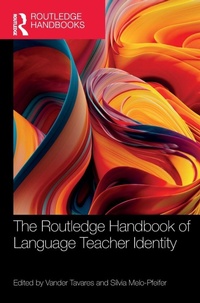
The Routledge Handbook of Language Teacher Identity
1st Edition
Will be published approx. on 23. March 2026
Book
Hardback
550 pages
978-1-032-80095-0 (ISBN)
Description
The Routledge Handbook of Language Teacher Identity is the first comprehensive, systematic survey of the field. It offers a broad, cutting-edge, and authoritative overview of language teacher identity, highlighting its growing complexity and global relevance.
This handbook is organized into six interconnected, sequential parts: theoretical perspectives, analytical and methodological approaches, ideologies, innovations, professional development, and specific language teaching contexts. Contributors engage with perspectives and possibilities on an international scale, addressing issues of racism, sexism, ethnocentrism, linguicism, accentism, native-speakerism, neo-nationalism, neoliberalism, and (dis)ability, exploring how these intersect with language teachers' professionalization, sense of belonging, authenticity, and legitimacy. Written in accessible language, thirty-four carefully curated chapters identify the major trends and developments in the field, including translanguaging, digital language teaching, study-abroad, and leadership. The volume also amplifies voices from systematically underrepresented groups, such as teachers of multiple languages and Indigenous language teachers.
This reliable source is of specialised interest for language teachers, teacher educators, students and researchers in the fields of language education and applied linguistics. It supports both academic research and policy development.
This handbook is organized into six interconnected, sequential parts: theoretical perspectives, analytical and methodological approaches, ideologies, innovations, professional development, and specific language teaching contexts. Contributors engage with perspectives and possibilities on an international scale, addressing issues of racism, sexism, ethnocentrism, linguicism, accentism, native-speakerism, neo-nationalism, neoliberalism, and (dis)ability, exploring how these intersect with language teachers' professionalization, sense of belonging, authenticity, and legitimacy. Written in accessible language, thirty-four carefully curated chapters identify the major trends and developments in the field, including translanguaging, digital language teaching, study-abroad, and leadership. The volume also amplifies voices from systematically underrepresented groups, such as teachers of multiple languages and Indigenous language teachers.
This reliable source is of specialised interest for language teachers, teacher educators, students and researchers in the fields of language education and applied linguistics. It supports both academic research and policy development.
Reviews / Votes
"Tavares and Melo-Pfeifer present us here with a kaleidoscope of frameworks, contexts, processes and ideologies that they masterfully weave into a coherent and ground-breaking theory of language teacher identity development, as it focuses on a dynamic process of becoming and being."Ofelia Garcia, The Graduate Center, City University of New York
"This handbook assembles cutting-edge research on language teacher identity from a global perspective. The combination of innovative theoretical and methodological approaches and the rich and diverse empirical evidence makes the volume an essential reference for anyone researching on language teacher identity and teacher development broadly."
Li Wei, Director and Dean, UCL Institute of Education
"This handbook offers an exciting roadmap of the burgeoning field of language teacher identity. Its conceptualization is comprehensive and original, its content both engaging and accessible. It brims with fascinating new insights and it moves the domain forward. A tour de force and formidable resource certain to become deeply influential!"
Lourdes Ortega, Georgetown University
More details
Series
Language
English
Place of publication
London
United Kingdom
Publishing group
Taylor & Francis Ltd
Target group
College/higher education
Professional and scholarly
Academic and Postgraduate
Illustrations
18 s/w Photographien bzw. Rasterbilder, 3 s/w Zeichnungen, 9 s/w Tabellen, 21 s/w Abbildungen
9 Tables, black and white; 3 Line drawings, black and white; 18 Halftones, black and white; 21 Illustrations, black and white
Dimensions
Height: 250 mm
Width: 175 mm
Thickness: 37 mm
Weight
1207 gr
ISBN-13
978-1-032-80095-0 (9781032800950)
Copyright in bibliographic data and cover images is held by Nielsen Book Services Limited or by the publishers or by their respective licensors: all rights reserved.
Schweitzer Classification
Other editions
Additional editions
Vander Tavares | Silvia Melo-Pfeifer
The Routledge Handbook of Language Teacher Identity
E-Book
03/2026
Routledge
€324.99
Available for download
Vander Tavares | Silvia Melo-Pfeifer
The Routledge Handbook of Language Teacher Identity
E-Book
03/2026
Routledge
€324.99
Available for download
Persons
Vander Tavares is an Associate Professor of Education at the University of Inland Norway. His research interests include critical second language education, teacher education, and the internationalization of higher and language education. He is the editor of Social Justice through Pedagogies of Multiliteracies (2024, Routledge).
Silvia Melo-Pfeifer is Full Professor at the University of Hamburg. She carries out research on pluralistic approaches to language learning and teaching -with particular emphasis on intercomprehension across languages of the same linguistic family-, heritage language education, and foreign language teacher education.
Silvia Melo-Pfeifer is Full Professor at the University of Hamburg. She carries out research on pluralistic approaches to language learning and teaching -with particular emphasis on intercomprehension across languages of the same linguistic family-, heritage language education, and foreign language teacher education.
Content
Language teacher identity: Becoming and being a language teacher Part 1: 1. Poststructuralism and language teacher identity 2. Positive psychology and language teacher identity 3. Identity-in-relation: Language teacher identity under decolonial lenses 4. Language teachers facing the challenges of pluralistic approaches: Towards a new understanding of their identity 5. Feminist research on language teacher identity Part 2: 6. Conducting ethnography in language teacher identity research: Applications, issues, and future directions 7. Autoethnography as a research methodology to study language teacher identity 8. Narrative inquiry and language teacher identity 9. Arts-based approaches for research on language teacher identity: A focus on visual methods 10. Materialities in researching language teacher multilingual identity: Methodological affordances of the Dominant Language Constellation 11. Researching language teacher identity: Discourse and content analytical approaches Part 3: 12. Becoming a language teacher: Navigating linguistic discrimination and its intersections for non-native English-speaking (NNES) teachers 13. Challenging monolingualism, native-speakerism, and standard language ideology in language teacher training 14. Toward a dual-level intersectionality theory for critical multilingual teacher education: Excavating identity through cross-circle Englishes 15. Critical race theory for language teacher identity research and practice in English language teaching 16. Language teacher identities in times of crisis: Rethinking ideologies of place and space in a transnational world 17. Neoliberal ideology and linguistic entrepreneurship: Extending the language teacher identity research agenda 18. Intersectionality in language teacher identity: Conceptions, conundrums and ways forward 19. Alienation, authenticity, and teacher identity Part 4: 20. Language teacher identity and translanguaging 21. Anti-oppressive pedagogies and language teacher identities: Issues, strategies, and what is yet to (be)come 22. Language teacher identity development and multiliteracies education 23. Teacher identity development through digitally mediated experiences Part 5: 24. Language teacher identity and professional development: Reflecting on debates, connections, and research avenues 25. Language teacher identity and agency in contexts of introduction programs bureaucracy 26. Interplay between language teacher identity and leadership development: A conceptual framework for research 27. Language teacher identity development through professionalisation on study abroad 28. Who's teaching? A critical reflection on language teacher identities in the context of newcomer and immigrant student education 29. Identity conflicts: Agency and investment in language teacher students' identity development Part 6: 30. Initial teacher education and professional identity: Learning to become a foreign language primary teacher 31. English as an L2 teacher identity development from an intersectional perspective 32. South Saami teacher identity in the making: New educational trajectories 33. Language teacher identities of teachers of multiple languages 34. Identity as a concept for professional knowledge of teachers in content and language integrated learning: Potential and limitations.