

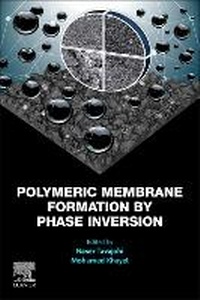
Polymeric Membrane Formation by Phase Inversion
Published on 26. March 2024
Book
Paperback/Softback
460 pages
978-0-323-95628-4 (ISBN)
Description
Polymeric Membrane Formation by Phase Inversion analyzes the four main phase inversion techniques. Effective parameters in each technique are covered, along with the methodologies needed to prepare advanced membranes for specific separations in both liquid and gas phases. Roll-to-roll casting, spinning hollow fiber, and electrospinning nanofibers are presented, along with an analysis of the impact of solvent toxicity, membrane production, and the source of raw materials on the environment. The book describes a roadmap for designing different morphological characteristics for preparing specific membranes for special applications, along with the merits and disadvantages of each method. This book provides an easy, comprehensive reference for academic and industry professionals working in membrane engineering.
More details
Language
English
Place of publication
Philadelphia
United States
Target group
Professional and scholarly
Dimensions
Height: 235 mm
Width: 191 mm
Weight
950 gr
ISBN-13
978-0-323-95628-4 (9780323956284)
Copyright in bibliographic data and cover images is held by Nielsen Book Services Limited or by the publishers or by their respective licensors: all rights reserved.
Schweitzer Classification
Other editions
Additional editions
Naser Tavajohi | Mohamed Khayet
Polymeric Membrane Formation by Phase Inversion
E-Book
03/2024
Elsevier
€200.00
Available for download
Persons
Dr. Naser Tavajohi is an Associate Professor in the Chemistry Department at Umea University. Naser earned his master's degree in chemical engineering with a specific focus on separation processes. During his master's program, he studied the fabrication, modeling, and optimization of flat sheet membranes using non-solvent-induced phase separation. In 2015, Naser received his Ph.D. from Hanyang University and the University of Calabria. His Ph.D. thesis focused on the preparation of hollow fiber membranes through thermally induced phase separation. He stood out as one of the pioneering researchers emphasizing the significance of sustainability in membrane production, as evidenced by several papers published during his Ph.D. years. After two postdoctoral experiences, Naser became an Assistant Professor in the Chemistry Department at Umea University in 2019. In 2021, he was selected as a young talented researcher at the Faculty of Science and Technology at Umea University by the Royal Swedish Academy Skytteanska Samfundet. In 2022, he became a docent, and in 2023, he was promoted to Associate Professor. Throughout his academic journey, he introduced an array of alternative solvents for the preparation of polymeric membranes via phase inversion. Dr. Tavajohi and his team are dedicated to developing the next generation of polymeric membranes for use in liquid separation, gas separation, and the energy sector. For more insights into his research endeavors, visit his laboratory website: www.nordicmembrane.com.
Dr. Mohamed Khayet is director of the University Complutense of Madrid (UCM) Research Group "Membranes and Renewable Energies (MER)? and Professor (Applied Physics Area) at the Faculty of Physical Sciences (UCM) (Department of Structure of Matter, Thermal Physics and Electronics). He got his Ph.D. (1997) in Physical Sciences and he realized various research stays in various international institutions (Industrial Membrane Research Institute in Ottawa, Canada; Institute of Nuclear Chemistry and Technology in Warsaw, Poland; Centre for Clean Water Technologies at the University of Nottingham in UK; Singapore Membrane Technology Centre and Nanyang Technological University in Singapore, Yale University in New Haven, USA; University of California Berkeley in USA, etc.). Among other grants, he got the Fulbright Grant (2019). He is an expert in the field of membrane science, nanotechnology and renewable energies. He has coordinated various national and international projects (over 20) funded by different institutions (European Union, Middle East Desalination Research Centre, Spanish Ministries; Companies such as Abengoa, etc.) on membranes and modules engineering for different separation processes. He published over 200 papers in international journals, filed 6 International Patents, published 5 books and various book chapters in the field of membrane science and related technology. Among other recognitions, he received the Prince Sultan Bin Abdulaziz International Prize for Water (PSIPW) in 2012. He edited various special issues in international journals such as Desalination, Polymers and Membranes. He acted as Editor of the international Journal "Desalination? (2018-2022) and served as associated editor of different journals. Currently, he is member of the Editorial Board of various journals related with water treatment, renewable energy, nanotechnology, membrane science and separation processes.
- Google Scholar: https://scholar.google.com/citations?user=H_lnjFkAAAAJ&hl=en
- Scopus: https://www.scopus.com/authid/detail.uri?authorId=56517090400
- ORCID ID: https://orcid.org/0000-0002-5117-2975
Dr. Mohamed Khayet is director of the University Complutense of Madrid (UCM) Research Group "Membranes and Renewable Energies (MER)? and Professor (Applied Physics Area) at the Faculty of Physical Sciences (UCM) (Department of Structure of Matter, Thermal Physics and Electronics). He got his Ph.D. (1997) in Physical Sciences and he realized various research stays in various international institutions (Industrial Membrane Research Institute in Ottawa, Canada; Institute of Nuclear Chemistry and Technology in Warsaw, Poland; Centre for Clean Water Technologies at the University of Nottingham in UK; Singapore Membrane Technology Centre and Nanyang Technological University in Singapore, Yale University in New Haven, USA; University of California Berkeley in USA, etc.). Among other grants, he got the Fulbright Grant (2019). He is an expert in the field of membrane science, nanotechnology and renewable energies. He has coordinated various national and international projects (over 20) funded by different institutions (European Union, Middle East Desalination Research Centre, Spanish Ministries; Companies such as Abengoa, etc.) on membranes and modules engineering for different separation processes. He published over 200 papers in international journals, filed 6 International Patents, published 5 books and various book chapters in the field of membrane science and related technology. Among other recognitions, he received the Prince Sultan Bin Abdulaziz International Prize for Water (PSIPW) in 2012. He edited various special issues in international journals such as Desalination, Polymers and Membranes. He acted as Editor of the international Journal "Desalination? (2018-2022) and served as associated editor of different journals. Currently, he is member of the Editorial Board of various journals related with water treatment, renewable energy, nanotechnology, membrane science and separation processes.
- Google Scholar: https://scholar.google.com/citations?user=H_lnjFkAAAAJ&hl=en
- Scopus: https://www.scopus.com/authid/detail.uri?authorId=56517090400
- ORCID ID: https://orcid.org/0000-0002-5117-2975
Content
1. Non-solvent induced phase separation
2. Thermally induced phase separation
3. Vapor induced phase separation
4. Evaporation induced phase separation
5. Hollow fiber membranes
6. Nanofiber membranes
7. Mixed matrix and nanocomposite membranes
8. Modified membranes
9. Solvent in membrane formation
10. Polymeric materials for membrane formation
11. Modeling membrane formation
12. New applications of polymeric phase inversion membranes
13. Sustainability in membrane production
14. Future directions
2. Thermally induced phase separation
3. Vapor induced phase separation
4. Evaporation induced phase separation
5. Hollow fiber membranes
6. Nanofiber membranes
7. Mixed matrix and nanocomposite membranes
8. Modified membranes
9. Solvent in membrane formation
10. Polymeric materials for membrane formation
11. Modeling membrane formation
12. New applications of polymeric phase inversion membranes
13. Sustainability in membrane production
14. Future directions