

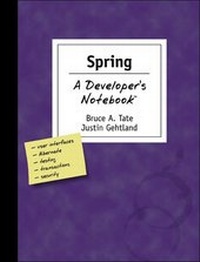
Spring: A Developer's Notebook
1st Edition
Published on 17. May 2005
Book
Paperback/Softback
202 pages
978-0-596-00910-6 (ISBN)
Description
Since development first began on Spring in 2003, there's been a constant buzz about it in Java development publications and corporate IT departments. The reason is clear: Spring is a lightweight Java framework in a world of complex heavyweight architectures that take forever to implement. Spring is like a breath of fresh air to overworked developers. In Spring, you can make an object secure, remote, or transactional, with a couple of lines of configuration instead of embedded code. The resulting application is simple and clean. In Spring, you can work less and go home early, because you can strip away a whole lot of the redundant code that you tend to see in most J2EE applications. You won't be nearly as burdened with meaningless detail. In Spring, you can change your mind without the consequences bleeding through your entire application. You'll adapt much more quickly than you ever could before. Spring: A Developer's Notebook offers a quick dive into the new Spring framework, designed to let you get hands-on as quickly as you like. If you don't want to bother with a lot of theory, this book is definitely for you. You'll work through one example after another.
Along the way, you'll discover the energy and promise of the Spring framework. This practical guide features ten code-intensive labs that'll rapidly get you up to speed. You'll learn how to do the following, and more: * install the Spring Framework * set up the development environment * use Spring with other open source Java tools such as Tomcat, Struts, and Hibernate * master AOP and transactions * utilize ORM solutions As with all titles in the Developer's Notebook series, this no-nonsense book skips all the boring prose and cuts right to the chase. It's an approach that forces you to get your hands dirty by working through one instructional example after another-examples that speak to you instead of at you.
Along the way, you'll discover the energy and promise of the Spring framework. This practical guide features ten code-intensive labs that'll rapidly get you up to speed. You'll learn how to do the following, and more: * install the Spring Framework * set up the development environment * use Spring with other open source Java tools such as Tomcat, Struts, and Hibernate * master AOP and transactions * utilize ORM solutions As with all titles in the Developer's Notebook series, this no-nonsense book skips all the boring prose and cuts right to the chase. It's an approach that forces you to get your hands dirty by working through one instructional example after another-examples that speak to you instead of at you.
More details
Other editions
Additional editions
Bruce Tate
Spring: A Developer's Notebook
E-Book
04/2005
1st Edition
O'Reilly
€24.99
Available for download
Bruce Tate
Spring: A Developer's Notebook
E-Book
04/2005
1st Edition
O'Reilly
€19.49
Available for download
Content
Foreword; Preface; Chapter 1. Getting Started; Building Two Classes with a Dependency; Using Dependency Injection; Automating the Example; Injecting Dependencies with Spring; Writing a Test; Chapter 2. Building a User Interface; Setting Up Tomcat; Building a View with Web MVC; Enhancing the Web Application; Running a Test; Chapter 3. Integrating Other Clients; Building a Struts User Interface; Using JSF with Spring; Integrating JSF with Spring; Chapter 4. Using JDBC; Setting Up the Database and Schema; Using Spring JDBC Templates; Refactoring Out Common Code; Using Access Objects; Running a Test with EasyMock; Chapter 5. OR Persistence; Integrating iBATIS; Using Spring with JDO; Using Hibernate with Spring; Running a Test Case; Chapter 6. Services and AOP; Building a Service; Configuring a Service; Using an Autoproxy; Advising Exceptions; Testing a Service with Mocks; Testing a Service with Side Effects; Chapter 7. Transactions and Security; Programmatic Transactions; Configuring Simple Transactions; Transactions on Multiple Databases; Securing Application Servlets; Securing Application Methods; Building a Test-Friendly Interceptor; Chapter 8. Messaging and Remoting; Sending Email Messages Remoting; Working with JMS; Testing JMS Applications; Chapter 9. Building Rich Clients; Getting Started; Building the Application Shell; Building the Bike Navigator View; Building the Bike Editor Forms; Index