

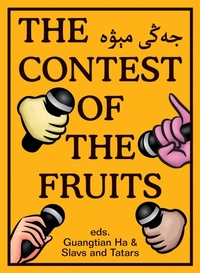
The Contest of the Fruits
Published on 5. October 2021
Book
Paperback/Softback
200 pages
978-0-262-54251-7 (ISBN)
Description
A satirical poem about the rivalry of various fruits becomes a point of departure for investigations of tolerance and identity in a pluralistic world.
The Contest of the Fruits takes a nineteenth-century Uyghur satirical poem as a departure point for investigations of language, politics, religion, humor, resilience, and resistance in a pluralistic world. Composed at the crossroads of multiple civilizations and empires and born of the Uyghurs' liminal position at the edges of Islam and the frontiers of China, "The Contest of the Fruits" captures a world in which borders are gateways rather than dividing lines. The poem, highly performative, embellished with verbal flourishes, and featuring the ribald rivalry of such fruits as mulberry, pomegranate, quince, and pear, may be the first Turkic rap battle.
The book, which accompanies a project by the art collective Slavs and Tatars, brings together artists, academics, poets, and performers to create a visually compelling volume that deploys different registers (high and low) to examine subjects often considered mutually exclusive (for example, religion and hip-hop). It offers essays by leading scholars and journalists that cover topics ranging from language politics to the prominence of Uyghur rappers in China. Shorter "pop-out" texts take a more tentacular approach to Uyghur culture, sampling poetry by diaspora Uyghur poets and discussing such subjects as calligraphy, Uyghur pop music, mäshräp, and the Sufi practice of Samāc.
Copublished with Haverford College
The Contest of the Fruits takes a nineteenth-century Uyghur satirical poem as a departure point for investigations of language, politics, religion, humor, resilience, and resistance in a pluralistic world. Composed at the crossroads of multiple civilizations and empires and born of the Uyghurs' liminal position at the edges of Islam and the frontiers of China, "The Contest of the Fruits" captures a world in which borders are gateways rather than dividing lines. The poem, highly performative, embellished with verbal flourishes, and featuring the ribald rivalry of such fruits as mulberry, pomegranate, quince, and pear, may be the first Turkic rap battle.
The book, which accompanies a project by the art collective Slavs and Tatars, brings together artists, academics, poets, and performers to create a visually compelling volume that deploys different registers (high and low) to examine subjects often considered mutually exclusive (for example, religion and hip-hop). It offers essays by leading scholars and journalists that cover topics ranging from language politics to the prominence of Uyghur rappers in China. Shorter "pop-out" texts take a more tentacular approach to Uyghur culture, sampling poetry by diaspora Uyghur poets and discussing such subjects as calligraphy, Uyghur pop music, mäshräp, and the Sufi practice of Samāc.
Copublished with Haverford College
More details
Language
English
Place of publication
Cambridge (Massachusetts)
United States
Publishing group
MIT Press Ltd
Product notice
Paperback (trade)
Unsewn / adhesive bound
Illustrations
190 figures
Dimensions
Height: 259 mm
Width: 193 mm
Thickness: 12 mm
Weight
495 gr
ISBN-13
978-0-262-54251-7 (9780262542517)
Copyright in bibliographic data and cover images is held by Nielsen Book Services Limited or by the publishers or by their respective licensors: all rights reserved.
Schweitzer Classification
Persons
Slavs and Tatars is an internationally renowned art collective devoted to an area east of the former Berlin Wall and west of the Great Wall of China, known as Eurasia. They have had solo exhibitions at the Museum of Modern Art in New York, Salt in Istanbul, Kunsthalle Zurich, and other venues. Publications include Crack Up--Crack Down, Mirrors for Princes, and Friendship of Nations. Guangtian Ha is Assistant Professor of Religion at Haverford College and the author of Fragile Transcendence: Sound and Saint in Sino-Sufism, to be published in September 2021. He is currently working on a new project that examines the entwinement of sex and slavery in the making of Islam in maritime Asia.