

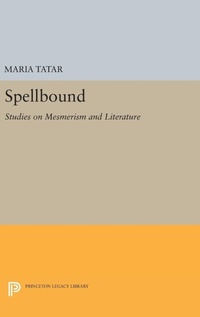
Spellbound
Studies on Mesmerism and Literature
Will be published approx. on 19. April 2016
Book
Hardback
320 pages
978-0-691-63440-1 (ISBN)
Description
Franz Anton Mesmer's concept of animal magnetism exercised a profound influence on key European and American thinkers. Mesmer, who saw in his discovery the secret of health, had hoped to recover the harmony between man and nature by harnessing the power of magnetic fluids. In calling attention to the existence of a second self that surfaces in the hypnotic trance, Mesmer made his real contribution and took the first, decisive steps on the road leading to the unconscious. While most critical studies of mesmerism originate in the history of science or medicine, Maria Tatar's book takes a fresh approach by tracing the impact of mesmerism on literature. The author launches her account with a portrait of Mesmer and places his views in the context of eighteenth-century thought. She then explores the significance of Mesmer's ideas and studies their influence on nineteenth-century German, French, and American writers. In conclusion, she examines the ways in which modern authors absorbed and reshaped the mesmerist legacy bequeathed to them by earlier generations.
Whether discussing the electrical energy vibrating through Kleist's dramas, the electrical heat radiating from Hoffmann's figures, the streams of magnetic fluid coursing through Balzac's novels, or the magnetic chain of humanity linking Hawthorne's characters, Professor Tatar recaptures the meaning of ideas, motifs, and metaphors often overlooked by literary critics. Her study illuminates, in a remarkable way, the subtle connections between science, psychology, and literature. Originally published in 1978. The Princeton Legacy Library uses the latest print-on-demand technology to again make available previously out-of-print books from the distinguished backlist of Princeton University Press. These editions preserve the original texts of these important books while presenting them in durable paperback and hardcover editions. The goal of the Princeton Legacy Library is to vastly increase access to the rich scholarly heritage found in the thousands of books published by Princeton University Press since its founding in 1905.
Whether discussing the electrical energy vibrating through Kleist's dramas, the electrical heat radiating from Hoffmann's figures, the streams of magnetic fluid coursing through Balzac's novels, or the magnetic chain of humanity linking Hawthorne's characters, Professor Tatar recaptures the meaning of ideas, motifs, and metaphors often overlooked by literary critics. Her study illuminates, in a remarkable way, the subtle connections between science, psychology, and literature. Originally published in 1978. The Princeton Legacy Library uses the latest print-on-demand technology to again make available previously out-of-print books from the distinguished backlist of Princeton University Press. These editions preserve the original texts of these important books while presenting them in durable paperback and hardcover editions. The goal of the Princeton Legacy Library is to vastly increase access to the rich scholarly heritage found in the thousands of books published by Princeton University Press since its founding in 1905.
More details
Series
Language
English
Place of publication
New Jersey
United States
Target group
College/higher education
Professional and scholarly
Product notice
Trade binding
Dimensions
Height: 240 mm
Width: 161 mm
Thickness: 22 mm
Weight
646 gr
ISBN-13
978-0-691-63440-1 (9780691634401)
Copyright in bibliographic data and cover images is held by Nielsen Book Services Limited or by the publishers or by their respective licensors: all rights reserved.
Schweitzer Classification
Other editions
Additional editions
E-Book
05/2015
1st Edition
Princeton University Press
€55.99
Available for download
Person
Maria Tatar
Content
*Frontmatter, pg. i*Contents, pg. vii*List of Illustrations, pg. viii*Preface, pg. ix*1. From Mesmer to Freud: Animal Magnetism, Hypnosis, and Suggestion, pg. 1*2. Salvation by Electricity: Science, Poetry, and "Naturphilosophie", pg. 45*3. Thunder, Lightning, and Electricity: Moments of Recognition in Heinrich von Kleist's Dramas, pg. 82*4. Blindness and Insight: Visionary Experience in the Tales of E.T.A. Hoffmann, pg. 121*5. The Metaphysics of the Will: Voyeurs and Visionaries in Balzac's "Comedie humaine", pg. 152*6. Masters and Slaves: The Creative Process in Hawthorne's Fiction, pg. 189*7. From Science Fiction to Psychoanalysis: Henry James's "Bostonians," D. H. Lawrence's "Women in Love," and Thomas Mann's "Mario and the Magician", pg. 230*Appendix. Mesmer's Propositions, pg. 273*Index, pg. 277