

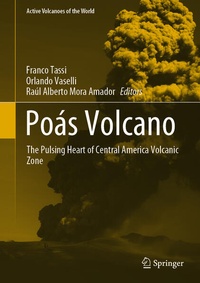
Poás Volcano
The Pulsing Heart of Central America Volcanic Zone
Published on 26. March 2019
Book
Hardback
XI, 317 pages
978-3-319-02155-3 (ISBN)
Description
This book provides a comprehensive description of the volcanological, petrological and geochemical features of the Poás Volcano (Costa Rica), one of the most active volcanic systems in Central America and part of the Central America Volcanic Arc (CAVA). Poás Volcano hosts a unique sulfur lake, which actually is one of the world's most acidic lakes, and has experienced molten sulfur eruptions. Past investigations, current monitoring activities and planned programs of investigation into lessening of the volcanic hazard are reported here. Specific sections of the monograph will be devoted to the impact of this volcano on the social, agricultural and industrial activities in the area. Legends and popular traditions related to this volcano will be described in the last chapter to round up a complete scientific review on this unique volcanic system.
More details
Series
Edition
1st ed. 2019
Language
English
Place of publication
Cham
Switzerland
Publishing group
Springer International Publishing
Target group
Professional and scholarly
Research
Illustrations
27 s/w Abbildungen, 110 farbige Abbildungen
XI, 317 p. 137 illus., 110 illus. in color.
Dimensions
Height: 260 mm
Width: 183 mm
Thickness: 24 mm
Weight
823 gr
ISBN-13
978-3-319-02155-3 (9783319021553)
DOI
10.1007/978-3-319-02156-0
Schweitzer Classification
Other editions
Additional editions
Franco Tassi | Orlando Vaselli | Raul Alberto Mora Amador
Poás Volcano
The Pulsing Heart of Central America Volcanic Zone
E-Book
03/2019
Springer
€96.29
Available for download
Content
1.Overview of the tectonics and geodynamics of Costa Rica.- 2. Geochemical and geochronological characterisation of the Poas stratovolcano stratigraphy.- 3.The extraordinary sulfur volcanism of Poás from 1828 to 2018.- 4.Coseismic landslide susceptibility analysis using LiDAR data PGA attenuation and GIS: The case of Poás volcano, Costa Rica, Central America.- 5. Seismicity Of Poás Volcano, Costa Rica.- 6.Diffuse CO2 degassing and thermal energy release from Poás volcano, Costa Rica.- 7. Behaviour of polythionates in the acid lake of Poás volcano: Insights into changes in the magmatic-hydrothermal regime and subaqueous input of volatiles.- 8.Geophysical and geochemical precursors to changes in activity at Poás volcano.- 9.39 years of geochemical monitoring of Laguna Caliente crater lake, Poás:Patterns from the past as keys for the future.- 10.The last eighteen years (1998-2014) of fumarolic degassing at the Poás volcano (Costa Rica) and renewal activity.- 11.Volcanic hazard assessment of Poás (Costa Rica) based on the 1834, 1910, 1953-1955 and 2017 historical eruptions.- 12.History, legends, customs and traditions of Poás volcano, Costa Rica.- 13. Poás Volcano biodiversity.