

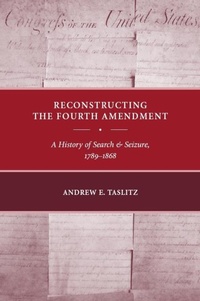
Reconstructing the Fourth Amendment
A History of Search and Seizure, 1789-1868
Published on 1. March 2009
Book
Paperback/Softback
370 pages
978-0-8147-8326-9 (ISBN)
Description
The modern law of search and seizure permits warrantless searches that ruin the citizenry's trust in law enforcement, harms minorities, and embraces an individualistic notion of the rights that it protects, ignoring essential roles that properly-conceived protections of privacy, mobility, and property play in uniting Americans. Many believe the Fourth Amendment is a poor bulwark against state tyrannies, particularly during the War on Terror.
Historical amnesia has obscured the Fourth Amendment's positive aspects, and Andrew E. Taslitz rescues its forgotten history in Reconstructing the Fourth Amendment, which includes two novel arguments. First, that the original Fourth Amendment of 1791-born in political struggle between the English and the colonists-served important political functions, particularly in regulating expressive political violence. Second, that the Amendment's meaning changed when the Fourteenth Amendment was created to give teeth to outlawing slavery, and its focus shifted from primary emphasis on individualistic privacy notions as central to a white democratic polis to enhanced protections for group privacy, individual mobility, and property in a multi-racial republic.
With an understanding of the historical roots of the Fourth Amendment, suggests Taslitz, we can upend negative assumptions of modern search and seizure law, and create new institutional approaches that give political voice to citizens and safeguard against unnecessary humiliation and dehumanization at the hands of the police.
Historical amnesia has obscured the Fourth Amendment's positive aspects, and Andrew E. Taslitz rescues its forgotten history in Reconstructing the Fourth Amendment, which includes two novel arguments. First, that the original Fourth Amendment of 1791-born in political struggle between the English and the colonists-served important political functions, particularly in regulating expressive political violence. Second, that the Amendment's meaning changed when the Fourteenth Amendment was created to give teeth to outlawing slavery, and its focus shifted from primary emphasis on individualistic privacy notions as central to a white democratic polis to enhanced protections for group privacy, individual mobility, and property in a multi-racial republic.
With an understanding of the historical roots of the Fourth Amendment, suggests Taslitz, we can upend negative assumptions of modern search and seizure law, and create new institutional approaches that give political voice to citizens and safeguard against unnecessary humiliation and dehumanization at the hands of the police.
Reviews / Votes
"Insightful in its approach to the Fourth Amendment, not only in terms of the law itself, but what is searched and seized, who particularly is subject to search and seizure, and what abuses led to broadening, thus capturing the full rich detail of the Fourth Amendment. . . .Taslitz shows us in thorough fashion that we would be wise to learn from the past as we address the problems facing our society." (Law and Politics Book Review) "An exciting and original work of history. . . . [A] bracing contribution to the somewhat dormant field of constitutional history . . . that will be of interest to any historian of the Constitution. The book's main accomplishment is that it combines contemporary and historical arguments without slighting either, while providing important new evidence and insight into each." (Journal of American History) "Reconstructing the Fourth Amendment is a remarkable scholarly accomplishment. It presents one of the most radical challenges to standard constitutional thinkingnot just about searches and seizures but also about the interpretation of the Fourteenth Amendment as a protection of individual rightsin recent literature. Taslitz stakes out a radical and compelling position on a pressing contemporary issuethe protection of individual privacy against government invasionand does so on impeccably researched and intellectually conservative grounds. It is a must read." - H. Jefferson Powell,author of A Community Built on Words: The Constitution in History and Politics "Fourth Amendment scholarship has hitherto emphasized the amendment's background and gestation, i.e., the period before its inception in 1789. Taslitz, however, has removed a critical gap in that scholarship by illuminating the amendment's development after 1789, through the ante-bellum and Reconstruction periods, until 1868. Taslitz breaks new ground by exploring the Fourth Amendment's connections with political violence and slavery. He introduces readers to the interpretative diversity of and among scholars who debate the amendment's original and current contents." - William Cuddihy,author of The Fourth Amendment: Origins and Original Meaning, 602-1791 "Taslitz's analysis provides a unique vision of the Fourth Amendment's purpose: to tame political violence from governmental officials, while forcing officials to treat each individual with respect and dignity. Taslitz's research on the search and seizure practices of Southern states during Reconstruction is illuminating and strengthens his thesis that respect for the individual lies at the core of the Fourth Amendment." - Tracey Maclin,Boston University School of Law "An outstanding scholarly achievement in the area of constitutional history and criminal procedure, particularly the law of search and seizure." (Criminal Justice Review)More details
Language
English
Place of publication
New York
United States
Target group
College/higher education
Professional and scholarly
Product notice
Paperback (trade)
Dimensions
Height: 226 mm
Width: 150 mm
Thickness: 25 mm
Weight
522 gr
ISBN-13
978-0-8147-8326-9 (9780814783269)
Copyright in bibliographic data and cover images is held by Nielsen Book Services Limited or by the publishers or by their respective licensors: all rights reserved.
Schweitzer Classification
Other editions
Additional editions
E-Book
10/2006
New York University Press
€30.99
Available for download
Person
Andrew E. Taslitz is Professor at Howard University School of Law. He is the author of five books, including Constitutional Criminal Procedure and Rape and the Culture of the Courtroom (NYU Press).
Content
PrefaceAcknowledgments 1 Plugging into the Fourth Amendment's Matrix PART I: POLITICAL VIOLENCE AND THE ORIGINAL FOURTH AMENDMENT 2 Violence as Political Expression 3 The Quantity and Quality of Evidence 4 Modern Implications I: Peoplehood and Interbranch Responsibilities 5 Modern Implications II: Precedent and Political MeaningPART II: THE RECONSTRUCTED FOURTH AMENDMENT 6 Expressive Violence and Southern Honor7 Slave Locomotion 8 Mobility's Meaning for the South 9 Mobility's Meaning for the North 10 Privacy and Property 11 Civil War and Reconstruction 12 Law on the Street NotesIndex About the Author