

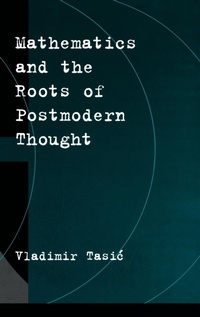
Mathematics and the Roots of Postmodern Thought
Published on 13. September 2001
Book
Hardback
200 pages
978-0-19-513967-9 (ISBN)
Description
This is a charming and insightful contribution to an understanding of the "Science Wars" between postmodernist humanism and science, driving toward a resolution of the mutual misunderstanding that has driven the controversy. It traces the root of postmodern theory to a debate on the foundations of mathematics, early in the 20th century then compares developments in mathematics to what took place in the arts and humanities, discussing issues as diverse as literary theory, arts, and artificial intelligence. This is a straight forward, easily understood presentation of what can be difficult theoretical concepts and demonstrates that a pattern of misreading mathematics can be seen on both the part of science and on the part of postmodern thinking. This is a humorous, playful yet deeply serious look at the intellectual foundations of mathematics for those in the humanities and is the perfect critical introduction to the bases of modernism and postmodernism for those in the sciences.
Reviews / Votes
The book makes pleasant and interesting reading. * Mathematical Reviews *More details
Language
English
Place of publication
Oxford
United Kingdom
Target group
College/higher education
Professional and scholarly
Dimensions
Height: 240 mm
Width: 161 mm
Thickness: 15 mm
Weight
470 gr
ISBN-13
978-0-19-513967-9 (9780195139679)
Copyright in bibliographic data and cover images is held by Nielsen Book Services Limited or by the publishers or by their respective licensors: all rights reserved.
Schweitzer Classification
Other editions
Additional editions
Vladimir Tasic
Mathematics and the Roots of Postmodern Thought
E-Book
08/2001
1st Edition
OUP USA
€24.99
Available for download
Vladimir Tasic
Mathematics and the Roots of Postmodern Thought
E-Book
08/2001
1st Edition
OUP eBook
€24.99
Available for download
Person
Content
1: Introduction
2: Around the Cartesian Circuit
2.1: Imagination
2.2: Intuition
2.3: Counting to One
3: Space Oddity and Linguistic Turn
4: Wound of Language
4.1: Being and Time Continuum
4.2: Language and Will
5: Beyond the Code
5.1: Medium of Free Becoming
5.2: Nonpresence of Identity
6: The Expired Subject
6.1: Empire of Signs
6.2: Mechanical Bride
7: The Vanishing Author
8: Say Hello to the Structure Bubble
8.1: Algebra of Language
8.2: Functionalism Chic
9: Don't Think, Look
9.1: Interpolating the Self
9.2: Language Games
9.3: Thermostats "R" Us
10: Postmodern Enigmas
10.1: Unspeakable Diffd'erance
10.2: Dysfunctionalism Chic
Notes
Select Bibliography
Index
2: Around the Cartesian Circuit
2.1: Imagination
2.2: Intuition
2.3: Counting to One
3: Space Oddity and Linguistic Turn
4: Wound of Language
4.1: Being and Time Continuum
4.2: Language and Will
5: Beyond the Code
5.1: Medium of Free Becoming
5.2: Nonpresence of Identity
6: The Expired Subject
6.1: Empire of Signs
6.2: Mechanical Bride
7: The Vanishing Author
8: Say Hello to the Structure Bubble
8.1: Algebra of Language
8.2: Functionalism Chic
9: Don't Think, Look
9.1: Interpolating the Self
9.2: Language Games
9.3: Thermostats "R" Us
10: Postmodern Enigmas
10.1: Unspeakable Diffd'erance
10.2: Dysfunctionalism Chic
Notes
Select Bibliography
Index