

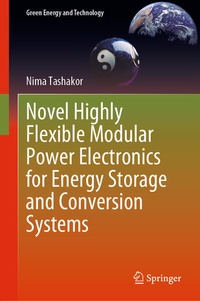
Novel Highly Flexible Modular Power Electronics for Energy Storage and Conversion Systems
Published on 5. September 2023
Book
Hardback
XXXVI, 255 pages
978-3-031-36842-4 (ISBN)
Description
This book describes improvements to the electronics topology of current modular reconfigurable storages by integrating parallel connectivity, reducing the semiconductor count by eliminating irrelevant states, and improving the monitoring techniques through higher function integration. The author also discusses each topology's main advantages and disadvantages at the micro and macro levels. Moreover, the presented modeling of modular reconfigurable storage systems with different storages helps in better understanding the dynamics of the system.
The book establishes novel optimum or near-optimum methods for exploiting the DOF (degrees of freedom) to achieve higher efficiency, more function integration, better balancing, or output quality. Additionally, through a detailed analysis of different modulation techniques, this book presents novel modulation methods, enhances the state-of-the-art, or in some cases, simplifies the complexity of implementation.
The concept of interconnected multi-port systems through integrating novel modulation techniques and the acquired understanding of the behavior of modular dynamically reconfigurable storages is explained. The presented concepts can significantly reduce the number of energy conversion stages as well as the final footprint of the system, reduce the number of required controlled semiconductors, and save costs. It also presents novel monitoring techniques based on estimators that can significantly reduce the number of required sensors and the required data-communication bandwidth.
The book establishes novel optimum or near-optimum methods for exploiting the DOF (degrees of freedom) to achieve higher efficiency, more function integration, better balancing, or output quality. Additionally, through a detailed analysis of different modulation techniques, this book presents novel modulation methods, enhances the state-of-the-art, or in some cases, simplifies the complexity of implementation.
The concept of interconnected multi-port systems through integrating novel modulation techniques and the acquired understanding of the behavior of modular dynamically reconfigurable storages is explained. The presented concepts can significantly reduce the number of energy conversion stages as well as the final footprint of the system, reduce the number of required controlled semiconductors, and save costs. It also presents novel monitoring techniques based on estimators that can significantly reduce the number of required sensors and the required data-communication bandwidth.
More details
Series
Edition
2023 ed.
Language
English
Place of publication
Cham
Switzerland
Publishing group
Springer International Publishing
Target group
Professional and scholarly
Illustrations
16 s/w Abbildungen, 166 farbige Abbildungen
XXXVI, 255 p. 182 illus., 166 illus. in color.
Dimensions
Height: 241 mm
Width: 160 mm
Thickness: 21 mm
Weight
659 gr
ISBN-13
978-3-031-36842-4 (9783031368424)
DOI
10.1007/978-3-031-36843-1
Schweitzer Classification
Other editions
Additional editions
Nima Tashakor
Novel Highly Flexible Modular Power Electronics for Energy Storage and Conversion Systems
Book
09/2024
Springer
€213.99
Shipment within 15-20 days
Nima Tashakor
Novel Highly Flexible Modular Power Electronics for Energy Storage and Conversion Systems
E-Book
09/2023
1st Edition
Springer
€213.99
Available for download
Persons
Nima Tashakor was born in 1990 in Shahrekord, Iran. He received a B.Sc. degree in electrical power engineering from Isfahan University, Isfahan, Iran, in 2013, where he worked on the harmonic sources in the electrical grid and how to filter them. He earned his M.Sc. degree in electrical power engineering from Shiraz University, Shiraz, Iran, in 2015. During his M.Sc. degree, he worked on developing an innovative electric vehicle charger.
He worked on his Ph.D. at the Technical University of Kaiserslautern, Germany, from 2019 to 2022 and collaborated closely with Duke University, USA, and Aalborg University, Denmark as a guest researcher. In 2021, he received a DAAD grant for collaboration with Aalborg University. In 2022, he was awarded the DAAD prize for outstanding achievements of international students.
His research fields include power electronics and energy storage\systems. Furthermore, he investigates the application of machine learning in power electronics domain.
He worked on his Ph.D. at the Technical University of Kaiserslautern, Germany, from 2019 to 2022 and collaborated closely with Duke University, USA, and Aalborg University, Denmark as a guest researcher. In 2021, he received a DAAD grant for collaboration with Aalborg University. In 2022, he was awarded the DAAD prize for outstanding achievements of international students.
His research fields include power electronics and energy storage\systems. Furthermore, he investigates the application of machine learning in power electronics domain.
Content
Introduction to Modular Energy Storage Systems.- Selected Types of Energy Storage.- Topology, Circuit Analysis, and Modeling.- Modulation and Scheduling Techniques.- Novel Topologies and/or Techniques for Emerging Applications.- Monitoring Methods.- Remaining Challenges and Future Potentials.