

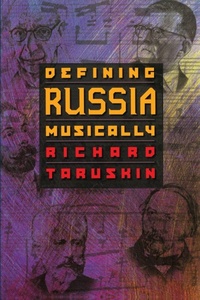
Defining Russia Musically
Historical and Hermeneutical Essays
Published on 25. September 2000
Book
Paperback/Softback
616 pages
978-0-691-07065-0 (ISBN)
Description
The world-renowned musicologist Richard Taruskin has devoted much of his career to helping listeners appreciate Russian and Soviet music in new and sometimes controversial ways. Defining Russia Musically represents one of his landmark achievements: here Taruskin uses music, together with history and politics, to illustrate the many ways in which Russian national identity has been constructed, both from within Russia and from the Western perspective. He contends that it is through music that the powerful myth of Russia's "national character" can best be understood. Russian art music, like Russia itself, Taruskin writes, has "always [been] tinged or tainted ...with an air of alterity--sensed, exploited, bemoaned, reveled in, traded on, and defended against both from within and from without." The author's goal is to explore this assumption of otherness in an all-encompassing work that re-creates the cultural contexts of the folksong anthologies of the 1700s, the operas, symphonies, and ballets of the 1800s, the modernist masterpieces of the 1900s, and the hugely fraught but ambiguous products of the Soviet period.
Taruskin begins by showing how enlightened aristocrats, reactionary romantics, and the theorists and victims of totalitarianism have variously fashioned their vision of Russian society in musical terms. He then examines how Russia as a whole shaped its identity in contrast to an "East" during the age of its imperialist expansion, and in contrast to two different musical "Wests," Germany and Italy, during the formative years of its national consciousness. The final section, expanded from a series of Christian Gauss seminars presented at Princeton in 1993, focuses on four individual composers, each characterized both as a self-consciously Russian creator and as a European, and each placed in perspective within a revealing hermeneutic scheme. In the culminating chapters--Chaikovsky and the Human, Scriabin and the Superhuman, Stravinsky and the Subhuman, and Shostakovich and the Inhuman--Taruskin offers especially thought-provoking insights, for example, on Chaikovsky's status as the "last great eighteenth-century composer" and on Stravinsky's espousal of formalism as a reactionary, literally counterrevolutionary move.
Taruskin begins by showing how enlightened aristocrats, reactionary romantics, and the theorists and victims of totalitarianism have variously fashioned their vision of Russian society in musical terms. He then examines how Russia as a whole shaped its identity in contrast to an "East" during the age of its imperialist expansion, and in contrast to two different musical "Wests," Germany and Italy, during the formative years of its national consciousness. The final section, expanded from a series of Christian Gauss seminars presented at Princeton in 1993, focuses on four individual composers, each characterized both as a self-consciously Russian creator and as a European, and each placed in perspective within a revealing hermeneutic scheme. In the culminating chapters--Chaikovsky and the Human, Scriabin and the Superhuman, Stravinsky and the Subhuman, and Shostakovich and the Inhuman--Taruskin offers especially thought-provoking insights, for example, on Chaikovsky's status as the "last great eighteenth-century composer" and on Stravinsky's espousal of formalism as a reactionary, literally counterrevolutionary move.
Reviews / Votes
One of Choice's Outstanding Academic Titles for 1997 "A passionate vision of what Russian music has meant both as an expression and as a shaping force of the country's character... [Taruskin is] an exceptionally gifted critic... [T]he connections between technique and expression are formidably argued, and it is the capacity to do this, with patience and depth of understanding and with a vast knowledge of the literature, that gives Taruskin's criticism its quality."--John Warrack, Time Literary Supplement "Taruskin's work is far too rich and multi-layered, steeped in Russian intellectual history, literature, and culture, even to synopsize in a short review... His newest book is essential for musicologists wishing to understand Russia's place in music, and for Slavists wishing to understand music's place in Russia."--Robert W. Oldani, The Russian Review "More than a musicologist, Richard Taruskin is a cultural critic who deserves non-scholarly readers. His brilliant and alarmingly timely book Defining Russia Musically is about the battle for a nation's soul--fought between Europe and Asia, modernity and primitivism--in the music of Tchaikovsky and Shostakovich."--Peter Conrad, The Observer "Taruskin's hallmarks are evident throughout: research of almost astonishing breadth, impatience with facile views and those who propound them, and contempt for formalist modes of analysis that ignore the extramusical. This is an important, challenging book; no other book in English covers this ground with equal depth or brilliance."--Choice "When this controversial book first appeared in hardback, it sparked a debate ... both because of and despite the way it tore into big names in the musicological world. Now it seems like a landmark... Richard Taruskin raises important questions about how cultural and artistic judgements are made."--Literary ReviewMore details
Language
English
Place of publication
New Jersey
United States
Target group
Professional and scholarly
College/higher education
Product notice
Paperback (trade)
Illustrations
127 music exs., 11 figures, 3 diagrams
Dimensions
Height: 234 mm
Width: 156 mm
Thickness: 35 mm
Weight
998 gr
ISBN-13
978-0-691-07065-0 (9780691070650)
Copyright in bibliographic data and cover images is held by Nielsen Book Services Limited or by the publishers or by their respective licensors: all rights reserved.
Schweitzer Classification
Other editions
Additional editions
E-Book
02/2021
1st Edition
Princeton University Press
€66.49
Available for download
Person
Richard Taruskin (1945-2022) was professor emeritus of music at the University of California, Berkeley, and a regular contributor to the New Republic, the New York Times, the New York Review of Books, and Opera News. His books include Musorgsky: Eight Essays and an Epilogue (Princeton), Opera and Drama in Russia, and Stravinsky and the Russian Traditions.
Content
Others: A Mythology and a Demurrer (By Way of Preface)Pt. IDefining Russia Musically (Seven Mini-Essays)11N. A. Lvov and the Folk32M. I. Glinka and the State253P. I. Chaikovsky and the Ghetto484Who Am I? (And Who Are You?)615Safe Harbors816After Everything997Objectives105Pt. IISelf and Other1118How the Acorn Took Root1139"Entoiling the Falconet"15210Ital'yanshchina186Pt. IIIHermeneutics of Russian Music: Four Cruxes23711Chaikovsky and the Human: A Centennial Essay23912Scriabin and the Superhuman: A Millennial Essay30813Stravinsky and the Subhuman36014Shostakovich and the Inhuman468Index545