

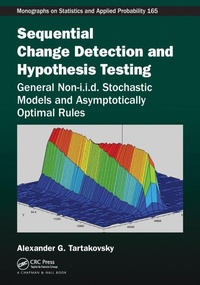
Sequential Change Detection and Hypothesis Testing
General Non-i.i.d. Stochastic Models and Asymptotically Optimal Rules
1st Edition
Published on 30. June 2021
Book
Paperback/Softback
320 pages
978-1-032-08435-0 (ISBN)
Description
How can major corporations and governments more quickly and accurately detect and address cyberattacks on their networks? How can local authorities improve early detection and prevention of epidemics? How can researchers improve the identification and classification of space objects in difficult (e.g., dim) settings?
These questions, among others in dozens of fields, can be addressed using statistical methods of sequential hypothesis testing and changepoint detection. This book considers sequential changepoint detection for very general non-i.i.d. stochastic models, that is, when the observed data is dependent and non-identically distributed. Previous work has primarily focused on changepoint detection with simple hypotheses and single-stream data. This book extends the asymptotic theory of change detection to the case of composite hypotheses as well as for multi-stream data when the number of affected streams is unknown. These extensions are more relevant for practical applications, including in modern, complex information systems and networks. These extensions are illustrated using Markov, hidden Markov, state-space, regression, and autoregression models, and several applications, including near-Earth space informatics and cybersecurity are discussed.
This book is aimed at graduate students and researchers in statistics and applied probability who are familiar with complete convergence, Markov random walks, renewal and nonlinear renewal theories, Markov renewal theory, and uniform ergodicity of Markov processes.
Key features:
Design and optimality properties of sequential hypothesis testing and change detection algorithms (in Bayesian, minimax, pointwise, and other settings)
Consideration of very general non-i.i.d. stochastic models that include Markov, hidden Markov, state-space linear and non-linear models, regression, and autoregression models
Multiple decision-making problems, including quickest change detection-identification
Real-world applications to object detection and tracking, near-Earth space informatics, computer network surveillance and security, and other topics
These questions, among others in dozens of fields, can be addressed using statistical methods of sequential hypothesis testing and changepoint detection. This book considers sequential changepoint detection for very general non-i.i.d. stochastic models, that is, when the observed data is dependent and non-identically distributed. Previous work has primarily focused on changepoint detection with simple hypotheses and single-stream data. This book extends the asymptotic theory of change detection to the case of composite hypotheses as well as for multi-stream data when the number of affected streams is unknown. These extensions are more relevant for practical applications, including in modern, complex information systems and networks. These extensions are illustrated using Markov, hidden Markov, state-space, regression, and autoregression models, and several applications, including near-Earth space informatics and cybersecurity are discussed.
This book is aimed at graduate students and researchers in statistics and applied probability who are familiar with complete convergence, Markov random walks, renewal and nonlinear renewal theories, Markov renewal theory, and uniform ergodicity of Markov processes.
Key features:
Design and optimality properties of sequential hypothesis testing and change detection algorithms (in Bayesian, minimax, pointwise, and other settings)
Consideration of very general non-i.i.d. stochastic models that include Markov, hidden Markov, state-space linear and non-linear models, regression, and autoregression models
Multiple decision-making problems, including quickest change detection-identification
Real-world applications to object detection and tracking, near-Earth space informatics, computer network surveillance and security, and other topics
More details
Series
Language
English
Place of publication
Oxford
United Kingdom
Publishing group
Taylor & Francis Ltd
Target group
College/higher education
Illustrations
19 s/w Abbildungen
19 Illustrations, black and white
Dimensions
Height: 254 mm
Width: 178 mm
Thickness: 17 mm
Weight
605 gr
ISBN-13
978-1-032-08435-0 (9781032084350)
Copyright in bibliographic data and cover images is held by Nielsen Book Services Limited or by the publishers or by their respective licensors: all rights reserved.
Schweitzer Classification
Other editions
Additional editions
Alexander Tartakovsky
Sequential Change Detection and Hypothesis Testing
General Non-i.i.d. Stochastic Models and Asymptotically Optimal Rules
E-Book
12/2019
1st Edition
Chapman & Hall/CRC
€89.99
Available for download
Alexander Tartakovsky
Sequential Change Detection and Hypothesis Testing
General Non-i.i.d. Stochastic Models and Asymptotically Optimal Rules
E-Book
12/2019
1st Edition
Chapman & Hall/CRC
€89.99
Available for download
Alexander Tartakovsky
Sequential Change Detection and Hypothesis Testing
General Non-i.i.d. Stochastic Models and Asymptotically Optimal Rules
Book
12/2019
1st Edition
Chapman & Hall/CRC
€230.40
Shipment within 15-20 days
Person
Alexander Tartakovsky is a Professor and Head of the Space Informatics Laboratory at the Moscow Institute of Physics and Technology and President of AGT StatConsult, Los Angeles, California, USA. From 1997 to 2013, he was a Professor at the Department of Mathematics and the Associate Director of the Center for Applied Mathematical Sciences at the University of Southern California, Los Angeles. From 2013 to 2015, he was a Professor at the Department of Statistics at the University of Connecticut at Storrs. He is a fellow of the Institute of Mathematical Statistics and a recipient of the 2007 Abraham Wald Award in Sequential Analysis. His research interests include theoretical and applied statistics, sequential analysis, changepoint detection phenomena, statistical image and signal processing, video surveillance and object detection and tracking, information integration/fusion, cybersecurity, and detection and tracking of malicious activity. He is the author of three books, several book chapters, and over 150 journal and conference publications.
Content
1 Introduction and Motivation; 2 Elements of optimal stopping theory; 3 Changepoint models; 4 Bayesian approaches; 5 The Lorden criterion; 6 Alternative versions of the Lorden criterion; 7 CUSUM for Poisson processes; 8 The maximal probability criterion; 9 The Pollak criterion; 10 Finite time horizon problems;11 Two-sided problems; 12 Quickest detection of changes with composite hypotheses; 13 Quickest change detection in multiple sensors/populations; 14 Performance evaluation; 15 Retrospective change detection; 16 Sequential hypothesis testing; 17 Sequential tests of composite hypotheses; 18 Sequential hypothesis testing in multiple sensors/populations; 19 Sequential Estimation; 20 Applications and Extensions.