

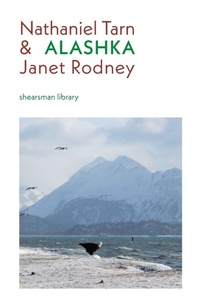
Alashka
Published on 2. February 2018
Book
Paperback/Softback
178 pages
978-1-84861-585-4 (ISBN)
Description
Alashka is a lost book. It was first published as half of a very large, well-printed volume in 1979, spliced together with Tarn's Selected Poems up until that point. The publisher was a new outfit in Boulder, Colorado, called Brillig Works and born in an eponymous bookstore. Distribution was limited, and fitful, and copies were notoriously hard to come by. This ensured that what was, in effect, Janet Rodney's first collection, vanished from view. Also, although it was a valuable expansion of Tarn's anthro- and eco-poetics, this hardly registered in the wider world, whether in Alaska or in the lower states.
The book finally gets its own set of covers here, and a chance to find its own niche, and will soon be joined by some other long-out-of-print Tarn volumes. Although some 40 years old, this book has scarcely aged, and its themes are as apposite today as they were in the 1970s.
The book finally gets its own set of covers here, and a chance to find its own niche, and will soon be joined by some other long-out-of-print Tarn volumes. Although some 40 years old, this book has scarcely aged, and its themes are as apposite today as they were in the 1970s.
More details
Series
Edition
Second edition
Language
English
Place of publication
Exeter
United Kingdom
Dimensions
Height: 229 mm
Width: 152 mm
Thickness: 10 mm
Weight
268 gr
ISBN-13
978-1-84861-585-4 (9781848615854)
Copyright in bibliographic data and cover images is held by Nielsen Book Services Limited or by the publishers or by their respective licensors: all rights reserved.
Schweitzer Classification
Persons
Janet Rodney was born in Washington D.C. in 1941. Her father was killed in the Pacific War in 1942. At the age of nine she moved with her mother to Paris; there followed a lot of travel, learning languages, different schools. About half of her school education was in French. Her mother remarried; they moved to Taipei, then Spain. In Madrid she worked as a reader for publishers, as translator, interpreter, editor and journalist. She left Spain in 1974 to go to graduate school, where she met Nathaniel Tarn. They married in 1983 and later moved to New Mexico. In 1987 she founded The Weaselsleeves Press. Her work as a letterpress printer is in fine print and art book collections across the USA. Her publications include Moon on an Oarblade Rowing (2005), which brought together three previous collections, and Terminal Colors: Selected Poems 1974-2005.
Franco-Anglo-American poet Nathaniel Tarn was born in 1928 and educated in France, Belgium and England, obtaining degrees from Cambridge, the Sorbonne and Chicago; he emigrated to the United States in 1970, where he taught at American universities until his retirement. He now lives just outside Santa Fe, New Mexico. Although he is perhaps best-known these days as a poet and essayist, he is also an anthropologist, with a particular interest in Highland Maya studies and the sociology of Buddhist institutions, and is also a translator of the highest order (see above all his versions of Neruda's The Heights of Macchu Picchu and Victor Segalen's Stelae). His first collection of poetry was Old Savage/Young City (London: Cape, 1964), which was followed the next year by his appearance in the seventh volume of the Penguin Modern Poets series. Three more collections followed in London, during which time he also became editor of Cape Goliard and founder-editor of the remarkable Cape Editions series of seminal modern texts: poetry, prose, anthropology, drama, many of them in pioneering translations. After he emigrated, only two more collections-the important volume A Nowhere for Vallejo and the ambitious book-length poem Lyrics for the Bride of God-were to appear in the UK. Thereafter, with the exception of his Shearsman publications and one other volume, all of his work has appeared in the USA, most significantly: The House of Leaves, Atitlan/Alashka (with Janet Rodney), At the Western Gates, Selected Poems 1950-2000, Ins and Outs of the Forest Rivers and the recent Gondwana. There is also a significant volume of essays in Views from the Weaving Mountain. Tarn's work is remarkable for expansiveness and its willingness to absorb material from very disparate sources-in this, it owes something to the examples of Pound and Olson, but also a lot to the author's own anthropological training, his knowledge of other languages and his interests in areas such as archaeology.
Franco-Anglo-American poet Nathaniel Tarn was born in 1928 and educated in France, Belgium and England, obtaining degrees from Cambridge, the Sorbonne and Chicago; he emigrated to the United States in 1970, where he taught at American universities until his retirement. He now lives just outside Santa Fe, New Mexico. Although he is perhaps best-known these days as a poet and essayist, he is also an anthropologist, with a particular interest in Highland Maya studies and the sociology of Buddhist institutions, and is also a translator of the highest order (see above all his versions of Neruda's The Heights of Macchu Picchu and Victor Segalen's Stelae). His first collection of poetry was Old Savage/Young City (London: Cape, 1964), which was followed the next year by his appearance in the seventh volume of the Penguin Modern Poets series. Three more collections followed in London, during which time he also became editor of Cape Goliard and founder-editor of the remarkable Cape Editions series of seminal modern texts: poetry, prose, anthropology, drama, many of them in pioneering translations. After he emigrated, only two more collections-the important volume A Nowhere for Vallejo and the ambitious book-length poem Lyrics for the Bride of God-were to appear in the UK. Thereafter, with the exception of his Shearsman publications and one other volume, all of his work has appeared in the USA, most significantly: The House of Leaves, Atitlan/Alashka (with Janet Rodney), At the Western Gates, Selected Poems 1950-2000, Ins and Outs of the Forest Rivers and the recent Gondwana. There is also a significant volume of essays in Views from the Weaving Mountain. Tarn's work is remarkable for expansiveness and its willingness to absorb material from very disparate sources-in this, it owes something to the examples of Pound and Olson, but also a lot to the author's own anthropological training, his knowledge of other languages and his interests in areas such as archaeology.