

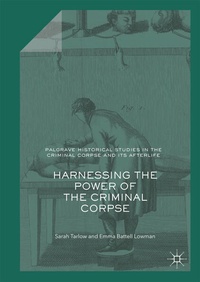
Harnessing the Power of the Criminal Corpse
Published on 5. June 2018
Book
Hardback
X, 273 pages
978-3-319-77907-2 (ISBN)
Description
This open access book is the culmination of many years of research on what happened to the bodies of executed criminals in the past. Focusing on the eighteenth and nineteenth centuries, it looks at the consequences of the 1752 Murder Act. These criminal bodies had a crucial role in the history of medicine, and the history of crime, and great symbolic resonance in literature and popular culture. Starting with a consideration of the criminal corpse in the medieval and early modern periods, chapters go on to review the histories of criminal justice, of medical history and of gibbeting under the Murder Act, and ends with some discussion of the afterlives of the corpse, in literature, folklore and in contemporary medical ethics. Using sophisticated insights from cultural history, archaeology, literature, philosophy and ethics as well as medical and crime history, this book is a uniquely interdisciplinary take on a fascinating historical phenomenon.
More details
Series
Edition
2018 ed.
Language
English
Place of publication
Cham
Switzerland
Publishing group
Springer International Publishing
Target group
Professional and scholarly
Illustrations
31 s/w Abbildungen
X, 273 p. 31 illus.
Dimensions
Height: 216 mm
Width: 153 mm
Thickness: 20 mm
Weight
483 gr
ISBN-13
978-3-319-77907-2 (9783319779072)
DOI
10.1007/978-3-319-77908-9
Schweitzer Classification
Other editions
Additional editions
Sarah Tarlow | Emma Battell Lowman
Harnessing the Power of the Criminal Corpse
Book
12/2018
Palgrave Macmillan
€29.96
Shipment within 7-9 days
Persons
Sarah Tarlow is Professor of Historical Archaeology at the University of Leicester, UK. She has published extensively on the archaeology of death and burial, archaeological ethics, and the post-medieval archaeology of the British isles. She was PI on 'Harnesssing the Power of the Criminal Corpse', the research project on which this book is based.
Emma Battell Lowman is Lecturer in the History of the Americas at the University of Hertfordshire, UK, with research interests in historical narrative, connections between bodies and memory, and the use of power to shape social identity. She holds postgraduate degrees from the University of Victoria, Canada, and the University of Warwick.
Content
SECTION ONE: THE CRIMINAL CORPSE IN HISTORY.- 1. Introduction.- 2. The Power of the Criminal Corpse in the Medieval World.- 3. How was the Power of the Criminal Corpse Harnessed in Early Modern England?.- SECTION TWO: THE WORLD OF THE MURDER ACT.- 4. Murder and the Law, 1752-1832.- 5. Anatomisation and Dissection.- 6. Hanging in Chains.- SECTION THREE: THE LEGACY OF THE CRIMINAL CORPSE.- 7. Seeking the Physical Remains of the Criminal Corpse.- 8. Folk Beliefs and Popular Tales.- 9. Conclusions: Ethics, Bullet Points and Other Ways of Telling.- Index.