

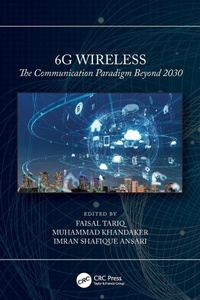
6G Wireless
The Communication Paradigm Beyond 2030
1st Edition
Published on 5. May 2025
Book
Paperback/Softback
346 pages
978-1-032-25235-3 (ISBN)
Description
6G Wireless: The Communication Paradigm Beyond 2030 offers a thorough discussion of some key emerging technologies such as Intelligent Reflecting Surface (IRS), Unmanned Aerial Vehicles (UAV), Aerial Computing, Terahertz (THz) Communications, Non-Orthogonal Multiple Access (NOMA) and Rate Splitting Multiple Access (RSMA).
The book provides a comprehensive coverage of the vision, requirements, use cases, enabling technologies, and challenges for the future 6G wireless communication systems. This includes discussions on how 6G and future IoT systems will enable extremely low latency healthcare systems, smart industry, haptic communications, programmable wireless environment (PWE), advanced VR/AR and holographic communications. IRS is expected to play a prominent role in 6G and the book thoroughly discusses the role of IRS in enabling physical layer security, UAV communications as well as D2D communications. It also explains channel modeling for IRS enabled PWE.
Another key aspect of the book is that it provides a comprehensive discussion on security challenges of emerging 6G systems and their potential solutions. Apart from this, it also explains how blockchain techniques can be used for future IoT applications such as intelligent manufacturing and asset tracking.
Written in tutorial style, the book is primarily intended for postgraduate students and researchers in the broad domain of wireless communications as well as research-active academics. The book can also be useful as a reference book for BSc/MSc project/thesis works.
The book provides a comprehensive coverage of the vision, requirements, use cases, enabling technologies, and challenges for the future 6G wireless communication systems. This includes discussions on how 6G and future IoT systems will enable extremely low latency healthcare systems, smart industry, haptic communications, programmable wireless environment (PWE), advanced VR/AR and holographic communications. IRS is expected to play a prominent role in 6G and the book thoroughly discusses the role of IRS in enabling physical layer security, UAV communications as well as D2D communications. It also explains channel modeling for IRS enabled PWE.
Another key aspect of the book is that it provides a comprehensive discussion on security challenges of emerging 6G systems and their potential solutions. Apart from this, it also explains how blockchain techniques can be used for future IoT applications such as intelligent manufacturing and asset tracking.
Written in tutorial style, the book is primarily intended for postgraduate students and researchers in the broad domain of wireless communications as well as research-active academics. The book can also be useful as a reference book for BSc/MSc project/thesis works.
More details
Language
English
Place of publication
London
United Kingdom
Publishing group
Taylor & Francis Ltd
Target group
College/higher education
Professional and scholarly
Postgraduate and Professional Reference
Illustrations
20 s/w Tabellen, 70 farbige Abbildungen, 70 Farbfotos bzw. farbige Rasterbilder
20 Tables, black and white; 70 Halftones, color; 70 Illustrations, color
Dimensions
Height: 234 mm
Width: 156 mm
Thickness: 19 mm
Weight
538 gr
ISBN-13
978-1-032-25235-3 (9781032252353)
Copyright in bibliographic data and cover images is held by Nielsen Book Services Limited or by the publishers or by their respective licensors: all rights reserved.
Schweitzer Classification
Other editions
Additional editions
Faisal Tariq | Muhammad Khandaker | Imran Shafique Ansari
6G Wireless
The Communication Paradigm Beyond 2030
E-Book
06/2023
1st Edition
CRC Press
€69.99
Available for download
Faisal Tariq | Muhammad Khandaker | Imran Shafique Ansari
6G Wireless
The Communication Paradigm Beyond 2030
E-Book
06/2023
1st Edition
CRC Press
€69.99
Available for download
Faisal Tariq | Muhammad Khandaker | Imran Shafique Ansari
6G Wireless
The Communication Paradigm Beyond 2030
Book
06/2023
1st Edition
CRC Press
€145.90
Shipment within 10-20 days
Persons
Dr. Faisal Tariq earned his B.Sc.(Hons) from Rajshahi University, Bangladesh, and M.Sc. from Chalmers University of Technology, Sweden. He earned his Ph.D. from The Open University, UK. He is currently serving as a Senior Lecturer in the School of Engineering at the University of Glasgow. His main research interests include radio resource management, 5G and beyond wireless networks, and molecular communications for nano-networks. He is the recipient of the best paper award at the Wireless Personal Multimedia Conference (WPMC) in 2013. He is currently serving on the editorial board of Elsevier Journal of Network and Computer Applications.
Dr. Muhammad Khandaker is currently working as an Assistant Professor in the School of Engineering and Physical Sciences at Heriot-Watt University. He earned his Ph.D. in Electrical and Computer Engineering from Curtin University, Australia, in 2013. He is an Associate Editor for IEEE Communications Letters, IEEE Wireless Communications Letters, and IEEE Access and served as an Editor for EURASIP Journal on Wireless Communications and Networking (JWCN), the Lead Guest Editor of the special issue on Heterogeneous Cloud Radio Access Networks (H-CRANs) of EURASIP JWCN as well as the Managing Guest Editor of a special issue on Self-Optimizing Cognitive Radio Technologies of the Elsevier journal Physical Communication.
Dr. Imran Shafique Ansari earned his B.Sc. degree in Computer Engineering from King Fahd University of Petroleum and Minerals (KFUPM) in 2009 (with First Honors) and M.Sc. and Ph.D. degrees from King Abdullah University of Science and Technology (KAUST) in 2010 and 2015, respectively. Currently, since August 2018, he is an Assistant Professor with University of Glasgow, Glasgow, UK. Prior to this, from November 2017 to July 2018, he was an Assistant Professor with Global College of Engineering and Technology (GCET) (affiliated with University of the West of England [UWE], Bristol, UK). From April 2015 to November 2017, he was a Postdoctoral Research Associate (PRA) with Texas A&M University at Qatar (TAMUQ). From May 2009 through Aug. 2009, he was a visiting scholar with Michigan State University (MSU), East Lansing, Michigan, USA, and from Jun. 2010 through Aug. 2010, he was a research intern with Carleton University, Ottawa, Ontario, Canada. Dr. Ansari has authored/co-authored 100+ journal and conference publications. His current research interests include free-space optics (FSO), underwater communications (UWC), physical layer (PHY) secrecy (PLS), and reconfigurable intelligent surfaces (RIS) / intelligent reflective surfaces (IRS).
Dr. Muhammad Khandaker is currently working as an Assistant Professor in the School of Engineering and Physical Sciences at Heriot-Watt University. He earned his Ph.D. in Electrical and Computer Engineering from Curtin University, Australia, in 2013. He is an Associate Editor for IEEE Communications Letters, IEEE Wireless Communications Letters, and IEEE Access and served as an Editor for EURASIP Journal on Wireless Communications and Networking (JWCN), the Lead Guest Editor of the special issue on Heterogeneous Cloud Radio Access Networks (H-CRANs) of EURASIP JWCN as well as the Managing Guest Editor of a special issue on Self-Optimizing Cognitive Radio Technologies of the Elsevier journal Physical Communication.
Dr. Imran Shafique Ansari earned his B.Sc. degree in Computer Engineering from King Fahd University of Petroleum and Minerals (KFUPM) in 2009 (with First Honors) and M.Sc. and Ph.D. degrees from King Abdullah University of Science and Technology (KAUST) in 2010 and 2015, respectively. Currently, since August 2018, he is an Assistant Professor with University of Glasgow, Glasgow, UK. Prior to this, from November 2017 to July 2018, he was an Assistant Professor with Global College of Engineering and Technology (GCET) (affiliated with University of the West of England [UWE], Bristol, UK). From April 2015 to November 2017, he was a Postdoctoral Research Associate (PRA) with Texas A&M University at Qatar (TAMUQ). From May 2009 through Aug. 2009, he was a visiting scholar with Michigan State University (MSU), East Lansing, Michigan, USA, and from Jun. 2010 through Aug. 2010, he was a research intern with Carleton University, Ottawa, Ontario, Canada. Dr. Ansari has authored/co-authored 100+ journal and conference publications. His current research interests include free-space optics (FSO), underwater communications (UWC), physical layer (PHY) secrecy (PLS), and reconfigurable intelligent surfaces (RIS) / intelligent reflective surfaces (IRS).
Content
1. Introduction to 6G Wireless: The Communcation Paradigm Beyond 2030. 2. IRS-Empowered Wireless Communications: State-of-the-Art, Key Techniques, and Open Issues. 3. Role of Intelligent Reflecting Surfaces in the emerging 6G Technologies. 4. Channel Modelling for 6G Programmable Wireless Environment. 5. Wireless Localization with Reconfigurable Intelligent Surfaces. 6. The Emergence of Aerial Computing: Applications and Challenges. 7. THz empowered UAV communications. 8. Performance Characterization of RSMA in THz Networks. 9. A Comprehensive Overview of Security and Privacy in the 6G Era. 10. Hybrid massive-MIMO and Its Practical Beamforming Implementation. 11. Blockchain Technology for 6G-Oriented IoT Systems: Principle, Applications and Challenges. 12. 6G and IOT Use Cases.