

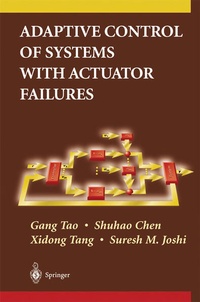
Adaptive Control of Systems with Actuator Failures
Description
Reviews / Votes
From the reviews:
The monograph describes adaptive actuator failure compensation control schemes for systems with uncertain actuator failures . The monograph is a comprehensive and self-contained exposition supposing the knowledge of linear systems and feedback control at the undergraduate level. Graduate students, researchers, and professionals working in the areas of control engineering, computer science, and applied mathematics will appreciate this book as a significant up-to-date technical reference in the field.
Zentralblatt MATH 1063 (2005) (Reviewer: Lubomír Bakule)
More details
Other editions
Additional editions
Persons
Gang Tao received his B.S. degree in Electrical Engineering from the University of Science and Technology of China in 1982, his M.S. degrees in Electrical Engineering, Computer Engineering and Applied Mathematics in 1984, 1987, 1989, respectively, and Ph.D. degree in Electrical Engineering in 1989 all from the University of Southern California. He was a visiting assistant professor at Washington State University from 1989 to 1991, an assistant research engineer at the University of California at Santa Barbara from 1991 to 1992, and an assistant professor at the University of Virginia from 1992 to 1998, where he is now an associate professor. He was a guest editor for International Journal of Adaptive Control and Signal Processing , and is currently an associate editor for IEEE Transactions on Automatic Control and for the discipline's most important journal Automatica . He has been a program committee member for numerous international conferences, among them, American Control Conference and the Conference on Decision and Control in 2001 and 2002.. He has published five books, over 45 journal papers and book chapters, and over 95 conference papers on adaptive cotnrol, nonlinear control, multivariable control, optimal control, and control applications and robotics. He is a Senior Member of IEEE. His research has been supported by NSF, ARMY, NASA, MedQuest, SCEEE and Edison Power.