

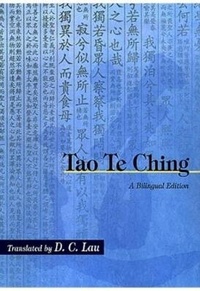
Tao TE Ching
A Bilingual Edition
The Chinese University Press
Will be published approx. on 31. August 2001
Book
Paperback/Softback
368 pages
978-962-201-992-8 (ISBN)
Description
Tao Te Ching, also commonly known as Lao Tzu, is one of the most important Chinese classics and has had great influence on Chinese thought. It is regarded as the bible of Taoism and is by far the most frequently translated Chinese classic, with over thirty translations into English alone.
The work is said to be by Lao Tzu, who was an elder contemporary of Confucius and founder of the school of thought of Taoism. However, it might be an anthology compiled by a series of editors over a period of time.
This bilingual edition consists of two parts. The English text in Part One is a reprint of the earlier translation of the so-called Wang Pi text, first published by Penguin Books in 1963. The text of the translation has been deliberately left unchanged, because there is room for a translation of what has been for centuries the most widely used version of the Lao Tzu.
Part Two is the fresh translation of a text which is a conflation of two manuscripts of the Lao Tzu, dating at the latest from the early Western Han and discovered at Ma Wang Tui in December 1973. This is far superior to the texts previously available to us, as we have here, for the first time, a text we can be sure is free from scribal errors and the editorial tamperings of subsequent ages. Moreover, we have a text with the fuller use of particles which often rules out a good many of the conjectural interpretations by scholars down through the ages.
The work is said to be by Lao Tzu, who was an elder contemporary of Confucius and founder of the school of thought of Taoism. However, it might be an anthology compiled by a series of editors over a period of time.
This bilingual edition consists of two parts. The English text in Part One is a reprint of the earlier translation of the so-called Wang Pi text, first published by Penguin Books in 1963. The text of the translation has been deliberately left unchanged, because there is room for a translation of what has been for centuries the most widely used version of the Lao Tzu.
Part Two is the fresh translation of a text which is a conflation of two manuscripts of the Lao Tzu, dating at the latest from the early Western Han and discovered at Ma Wang Tui in December 1973. This is far superior to the texts previously available to us, as we have here, for the first time, a text we can be sure is free from scribal errors and the editorial tamperings of subsequent ages. Moreover, we have a text with the fuller use of particles which often rules out a good many of the conjectural interpretations by scholars down through the ages.
More details
Language
English
Place of publication
Hong Kong
Hong Kong
Target group
College/higher education
Professional and scholarly
Product notice
Paperback (trade)
Dimensions
Height: 213 mm
Width: 154 mm
Thickness: 19 mm
Weight
454 gr
ISBN-13
978-962-201-992-8 (9789622019928)
Copyright in bibliographic data and cover images is held by Nielsen Book Services Limited or by the publishers or by their respective licensors: all rights reserved.
Schweitzer Classification
Other editions
Additional editions

Book
12/1996
The Chinese University Press
€56.53
Article exhausted; check different version