

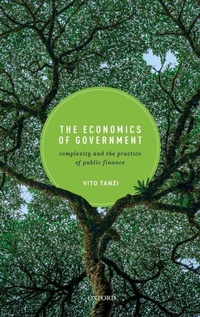
The Economics of Government
Complexity and the Practice of Public Finance
Published on 1. October 2020
Book
Hardback
242 pages
978-0-19-886642-8 (ISBN)
Description
Public finance is an important branch of economics. Over the years it has become more important, more controversial, and more complex. Much of the academic writing on it is highly theoretical, and it is often done by economists who have had little real world experience. Vito Tanzi has been continually engaged in this field for almost six decades, as a professor of public finance, a practitioner of it in many countries, and as a researcher, and has witnessed first-hand the growing gap between theoretical work and the real life practice of public finance. Public finance has come to be increasingly influenced by the pursuit of multiple government goals and by the growing complexity that now characterizes fiscal policy and government programs in many countries.
Notably, the goal of simplicity has played only a small role in the practice of public finance and in academic work. Complexity puts a dense fog around many policies, making it difficult to predict and assess the results. This book aims to highlight to both economists and policymakers the need for simplicity in policies. It also aims to inform students of public finance and public policy about this growing problem and the need to pay more attention to it.
Notably, the goal of simplicity has played only a small role in the practice of public finance and in academic work. Complexity puts a dense fog around many policies, making it difficult to predict and assess the results. This book aims to highlight to both economists and policymakers the need for simplicity in policies. It also aims to inform students of public finance and public policy about this growing problem and the need to pay more attention to it.
More details
Language
English
Place of publication
Oxford
United Kingdom
Target group
Professional and scholarly
Dimensions
Height: 240 mm
Width: 161 mm
Thickness: 18 mm
Weight
531 gr
ISBN-13
978-0-19-886642-8 (9780198866428)
Copyright in bibliographic data and cover images is held by Nielsen Book Services Limited or by the publishers or by their respective licensors: all rights reserved.
Schweitzer Classification
Other editions
Additional editions
E-Book
10/2020
1st Edition
OUP eBook
€84.49
Available for download
E-Book
10/2020
1st Edition
OUP eBook
€84.49
Available for download
Person
Dr Vito Tanzi has a Harvard PhD in Economics, which he received in 1967. He was Professor of Economics at the American University (1967-76), Head of the Tax Policy Division at the IMF (1974-1981), President of the International Institute of Public Finance (1990- 1994) at the Commendatore della Repubblica Italiana, Director of the Fiscal Affairs Department at the IMF (1981-2000), and Undersecretary for Economy and Finance with the Italian Government (2001-2003). Dr Tanzi has been an independent research scholar since 2003. He has received five honorary degrees from universities in four countries and several other prizes. The economic effect 'The Tanzi effect' was named after him.
Content
Part I: Historical Developments and the Growing Economic Role of the State
1: Introduction
2: Government Role and Public Spending: Historical Background
3: Hayek, Keynes, and the Economic Role of the State
4: From the Keynesian to the Supply-Side Revolution
5: Why the Positive and the Normative Roles of the State Differ?
6: The Political Economy of Fiscal Deficit Reductions
7: The Theory versus the Reality of Fiscal Policy
Part II: On the Growth of Complexity in Policy
8: Complexity, Systemic Failure, and Public Policies
9: The Design of Social Policy and Welfare Systems
10: Complexity, Corruption, and Tax Evasion
11: The Elusive Harmony between Government and Market Roles
12: Issues with the Current Uneven Income Distributions
13: Complexity in Stabilization Policy
1: Introduction
2: Government Role and Public Spending: Historical Background
3: Hayek, Keynes, and the Economic Role of the State
4: From the Keynesian to the Supply-Side Revolution
5: Why the Positive and the Normative Roles of the State Differ?
6: The Political Economy of Fiscal Deficit Reductions
7: The Theory versus the Reality of Fiscal Policy
Part II: On the Growth of Complexity in Policy
8: Complexity, Systemic Failure, and Public Policies
9: The Design of Social Policy and Welfare Systems
10: Complexity, Corruption, and Tax Evasion
11: The Elusive Harmony between Government and Market Roles
12: Issues with the Current Uneven Income Distributions
13: Complexity in Stabilization Policy