

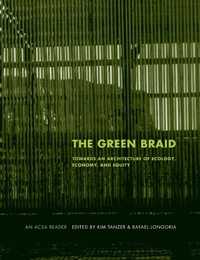
The Green Braid
Towards an Architecture of Ecology, Economy and Equity
1st Edition
Published on 28. February 2007
Book
Paperback/Softback
392 pages
978-0-415-41500-2 (ISBN)
Description
This volume presents the discipline's best thinking on sustainability in written, drawn, and built form, drawing on over fifteen years of peer-reviewed essays and national design awards published by the Association of Collegiate Schools of Architecture (ACSA).
Providing a primer on sustainability, useful to teachers and students alike, the selected essays address a broad range of issues. Combined with design projects that highlight issues holistically, they promote an understanding of the principles of sustainability and further the integration of sustainable methods into architectural projects.
Using essays that alternately revise and clarify twentieth century architectural thinking, The Green Braid places sustainability at the centre of excellent architectural design. No other volume addresses sustainability within the context of architectural history, theory, pedagogy and design, making this book an ideal source for architects in framing their practices, and therefore their architectural production, in a sustainable manner.
Providing a primer on sustainability, useful to teachers and students alike, the selected essays address a broad range of issues. Combined with design projects that highlight issues holistically, they promote an understanding of the principles of sustainability and further the integration of sustainable methods into architectural projects.
Using essays that alternately revise and clarify twentieth century architectural thinking, The Green Braid places sustainability at the centre of excellent architectural design. No other volume addresses sustainability within the context of architectural history, theory, pedagogy and design, making this book an ideal source for architects in framing their practices, and therefore their architectural production, in a sustainable manner.
Reviews / Votes
'With a broad definition of sustainability in mind, the book delves into how architectural designs can be situated at the crossroads of ecology, economy and equity ... The book is rich with examples and case studies that are informative and intriguing.' - CitiesMore details
Series
Language
English
Place of publication
London
United Kingdom
Publishing group
Taylor & Francis Ltd
Target group
College/higher education
Illustrations
203 s/w Photographien bzw. Rasterbilder, 3 s/w Tabellen
3 Tables, black and white; 203 Halftones, black and white
Dimensions
Height: 246 mm
Width: 189 mm
Thickness: 22 mm
Weight
775 gr
ISBN-13
978-0-415-41500-2 (9780415415002)
Copyright in bibliographic data and cover images is held by Nielsen Book Services Limited or by the publishers or by their respective licensors: all rights reserved.
Schweitzer Classification
Other editions
Additional editions

E-Book
04/2007
Routledge
€72.49
Available for download

E-Book
04/2007
Routledge
€72.49
Available for download
Book
02/2007
1st Edition
Routledge
€263.20
Article not available at the moment
Persons
Kim Tanzer is Professor of Architecture at the University of Florida and also maintains an architectural practice in Gainsville.
Rafael Longoria is Professor of Architecture at the University of Houston and a principal of Longoria/Peters, a Houston-based architecture and urban design firm.
Rafael Longoria is Professor of Architecture at the University of Houston and a principal of Longoria/Peters, a Houston-based architecture and urban design firm.
Content
Part 1: The Green Braid: Networked Ways of Knowing 1. The Green Braid: Networked Ways of Knowing 2. Architecture, Ecology Design and Human Ecology 3. A New Social Contract: Equity and Sustainable Development 4. Economic Sustainability in the Post-Industrial Landscape 5. Models, Lists and the Evolution of Sustainable Architecture Part 2: Meta-Discourses in Pedagogy and Practice 6. Introduction 7. Cyborg Theories and Situated Knowledges: Some Speculations on a Cultural Approach to Technology 8. We Are No[w here]: A Social Critique of Contemporary Theory 9. The Hidden Influence of Historical Scholarship on Design 10. Culture and the Recalibration of First Ring Suburbs 11. Portable Construction Training Center 12. One Week, Eight Hours Part 3: Phenomena and Technology 13. Introduction 14. From l'Air Exact to l'Aerateur: Ventilation and its Evolution in the Architectural Work of Le Corbusier 15. Unhealthy Energy Conservation Practices 16. Good-Bye Willis Carrier 17. The Compass House 18. Scupper Houses or the Dogtrot House and the Shotgun House Reconsidered 19. An Affordable, Sustainable House 20. Phenomenal Surface: Fog House Part 4: Building Practices 21. Introduction 22. Poetic Engineering and Invention: Arthur Troutner, Architect, and the Development of Engineered Lumber 23. Terunobu Fujimori: Working with Japan's Small Production Facilities 24. Making Smartwrap: From Parts to Pixels 25. Quilting with Glass, Cedar and Fir: A Workshop and Studio in Rossland, BC and Navy Demonstration Project 26. Modernism Redux: a Study in Light, Surface, and Volume 27. Solar Sails: An Installation Part 5: Settlement Patterns 28. Introduction 29. Economy=Ecology: A Scenario for Chicago's Lake Calumet 30. Sarajevo: Ecological Reconstruction after the 'Urbicide' 31. The Suburban Critique at Mid-Century: A Case Study 32. I-10 The Gulf Coast States/Mall Housing 33. Community Redevelopment for a Small Town in Florida and Drifting Urbanism 34. The Role of Infrastructure in the Production of Public Spaces for the City of Miami Part 6: The Shared Realm 35. Introduction 36. Architectural Intervention and the Post-Colonial Era: The Tjibaou Cultural Center in New Caledonia by the Renzo Piano Building Workshop 37. History, Tradition, and Modernity: Urbanism and Cultural Change in Chanderi, India 38. Global Constructions, Or Why Guadalajara wants a Home Depot while Los Angeles Wants Construction Workers 39. A Raptor Enclosure for the Zuni Pueblo 40. Garden of Time; Landscape of Change: Women Suffrage Memorial St. Paul, Minnesota 41. Unmasking Urban Traces